
If you want smaller capsules, fewer fishy burps, and a modest absorption edge at low doses, krill oil is the better fit. If you want the highest EPA and DHA per capsule and the best value for higher-dose goals, fish oil wins. For brain-specific support, the milligrams of DHA on the label matter more than which fish the oil came from, so read past the marketing and check the actual numbers before you buy either one.
TL;DR:
- Krill oil provides better absorption at low doses due to its phospholipid form but generally delivers less EPA and DHA per capsule than fish oil.
- Fish oil offers a higher total EPA and DHA content per dose, making it more cost-effective for reaching higher omega-3 intake goals.
- The brain primarily benefits from DHA quantity regardless of source, so focus on products listing sufficient DHA rather than the oil type.
- Both oils raise blood omega-3 levels reliably, but current scientific evidence does not confirm cognitive or mood improvements from either supplement.
- When choosing, verify EPA and DHA amounts, check for third-party testing, consider capsule size, and assess cost per 100 mg of EPA+DHA.
Table of Contents
- Krill Oil vs Fish Oil: Form, Absorption, and EPA/DHA Per Serving
- What the Research Actually Shows About Bioavailability and Outcomes
- DHA vs EPA: Why the Ratio Matters More for Your Brain Than the Source
- Safety, Interactions, and Reading the Supplement Facts Panel Correctly
- Sustainability and Cost: What Krill Actually Costs You (and the Planet)
- How to Choose Between Krill Oil and Fish Oil for Your Specific Goal
- A Straight Answer on Krill Oil vs Fish Oil, From Someone Who Reads the Label First
- A Brain-Focused Omega-3 Option Worth Comparing
- Sources
Krill Oil vs Fish Oil: Form, Absorption, and EPA/DHA Per Serving
The biggest structural difference between these two supplements has nothing to do with marketing copy. It comes down to molecular form. Krill oil carries most of its omega-3s bound to phospholipids, the same building blocks that make up your cell membranes. Fish oil, by contrast, usually delivers omega-3s as triglycerides, ethyl esters, or re-esterified triglycerides (rTG), depending on how the manufacturer processed it.
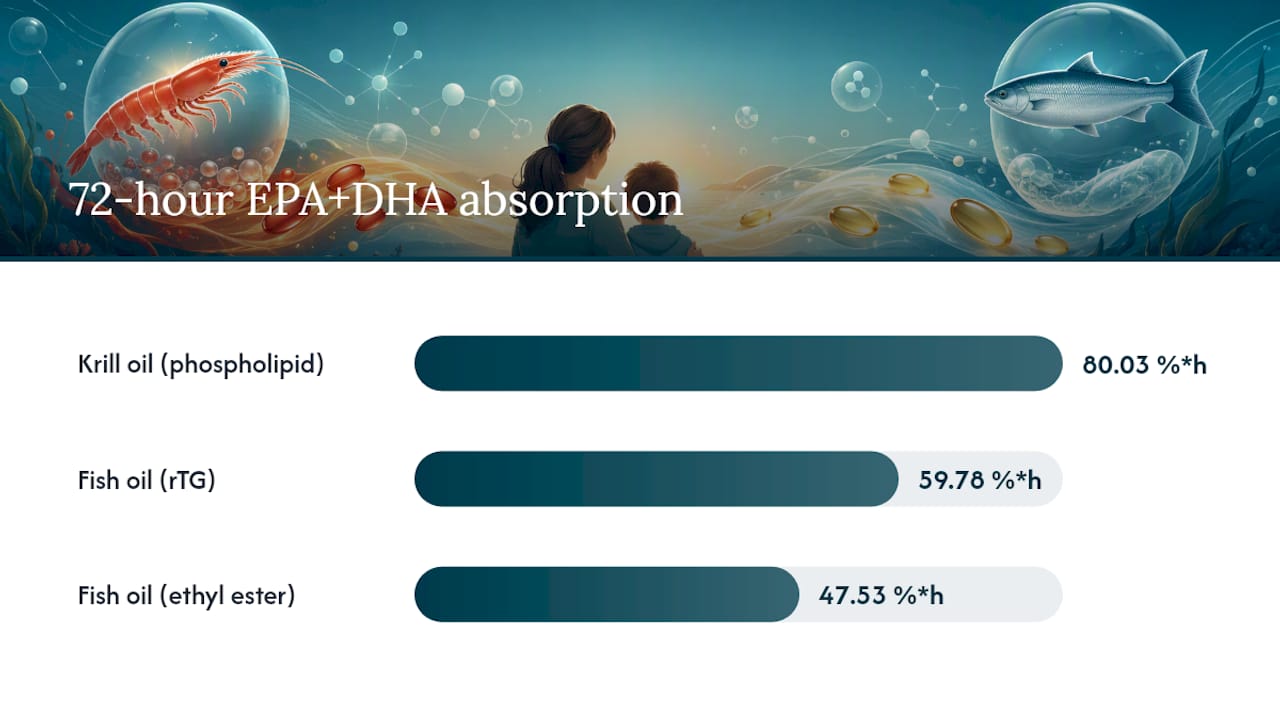
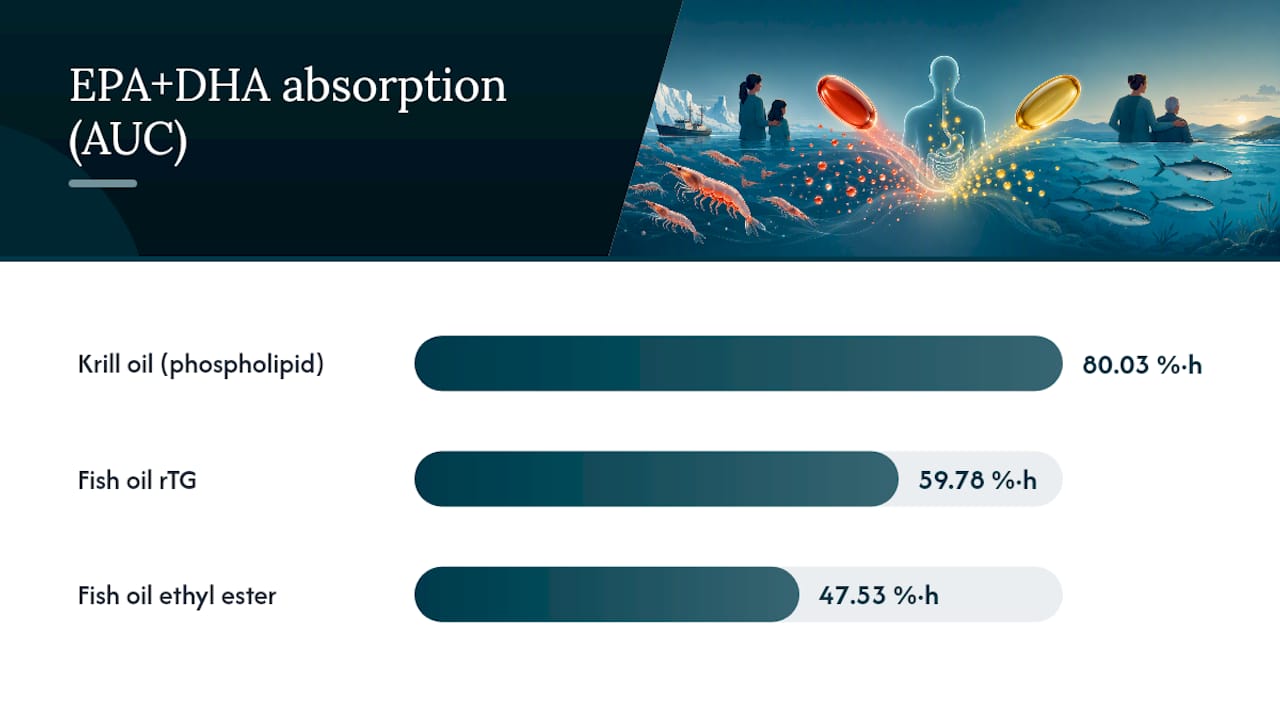
That distinction shows up in how your gut handles each oil. Phospholipid-bound fatty acids tend to integrate into cell membranes somewhat differently than triglyceride-bound ones, and a 2011 trial in Lipids in Health and Disease measured this directly. Researchers tracked EPA and DHA blood levels over 72 hours and found the area under the curve, essentially a measure of total absorption over time, hit 80.03%*h for krill oil, compared with 59.78%*h for fish oil in rTG form and just 47.53%*h for fish oil in ethyl ester form. Ethyl ester fish oil is cheaper to produce but requires an extra digestive step your body has to complete before it can use the fat, which likely explains the gap.
That does not settle the debate, though. A network meta-analysis published in PMC found that krill oil’s phospholipid and free-fatty-acid forms outperformed several fish oil formulations, but mainly at moderate doses, krill oil showed superior absorption, while fish oil at high doses became the more effective option for raising the omega-3 index, a blood marker reflecting long-term omega-3 status. Krill’s absorption advantage is real at low doses. It does not automatically make krill the stronger choice overall, because dose changes the math.
Serving sizes tell the rest of the story. Many krill oil capsules deliver a modest amount of combined EPA and DHA, while fish oil softgels typically deliver more omega-3 per capsule. This means you may need more krill capsules to match the omega-3 content of fish oil, which affects both your pill count and your monthly cost.
A few practical takeaways when you’re standing in the supplement aisle or scrolling product pages:
- Check the “EPA + DHA” line, not the “total omega-3” or “fish oil” line, which often includes other fatty acids that don’t do the same job.
- Look for the molecular form on the label (phospholipid, triglyceride, ethyl ester, or rTG) since it affects both absorption and price.
- Compare cost per 100 mg of combined EPA+DHA rather than cost per bottle or per capsule.
- Remember that higher AUC at low doses does not mean higher total omega-3 delivery. Dose still moves the needle.
What the Research Actually Shows About Bioavailability and Outcomes
Here’s the honest picture: biomarkers respond reliably to both oils, but proving a real-world cognitive benefit is a much harder scientific bar to clear, and most trials haven’t cleared it yet.
The Schuchardt et al. trial remains one of the most cited pieces of evidence for krill’s absorption advantage, largely because it directly compared formulations in the same study rather than pooling results across different designs. The network meta-analysis in PMC built on that by pooling many trials and confirming the same general pattern: krill’s phospholipid and free-fatty-acid forms raise blood omega-3 levels more efficiently per milligram at moderate doses, while fish oil at aggressive, high-dose protocols raises the omega-3 index more in absolute terms.
What the numbers actually mean: Krill oil showed an AUC of 80.03%*h for EPA+DHA incorporation versus 59.78%*h for fish oil rTG and 47.53%*h for fish oil ethyl ester in the same trial. That’s a meaningful absorption gap at matched low doses, but it’s not the same as saying krill delivers more total omega-3 to your body. It delivers more per milligram consumed, which matters most when dose is capped by capsule size or tolerance.
A separate trial from Konagai and colleagues gave phospholipid-rich krill oil to older adults and measured brain oxygenation using near-infrared spectroscopy. Oxyhemoglobin levels rose in frontal brain regions compared with placebo, a physiological signal worth noting. But a rise in blood oxygenation in a small sample is not the same as a measurable improvement in memory, attention, or mood, and the study wasn’t designed to test those outcomes directly.
That gap between biomarker change and functional benefit runs through nearly all the research in this space. A 2025 systematic review and dose-response meta-analysis flagged the same problem across the field: trials mix formulations (ethyl ester, triglyceride, re-esterified triglyceride, phospholipid), use inconsistent doses, run for a few weeks to a few months, and often enroll fewer than 100 participants. That heterogeneity makes it hard to draw firm conclusions about cognitive outcomes, even when blood-level changes are consistent and well documented.
The practical read: if your goal is to raise your measurable omega-3 status, both oils work, and the trial data on that point is solid. If you’re hoping for a specific cognitive or mood outcome, the evidence is suggestive at best, and no responsible source claims otherwise.
DHA vs EPA: Why the Ratio Matters More for Your Brain Than the Source
Your brain doesn’t care whether its DHA came from krill or fish. It cares about the milligram count.
DHA makes up roughly 40% of the total fatty acid content in brain tissue, according to a review on omega-3 roles in brain health. It’s a structural component woven into neuronal membranes, supporting the physical architecture that lets brain cells communicate. EPA, by contrast, makes up less than 1% of brain fatty acid content. Its main established role leans toward anti-inflammatory signaling rather than structural building.
That single fact reframes the whole “krill vs fish oil” question when brain support is your priority. The oil source matters less than whether the product actually delivers meaningful DHA. A Springer review on omega-3s and central nervous system health echoes this, noting that practitioners increasingly emphasize absolute DHA milligrams per day over the specific oil source, and that algae-derived DHA is a legitimate option for people avoiding marine sources entirely.
A few practical rules worth keeping in mind:
- For structural, brain-focused goals, look for products that list DHA prominently and in a meaningful amount, not products that just say “omega-3 rich.”
- For inflammatory or general wellness goals, a more balanced EPA-to-DHA ratio may be the more sensible pick, though the evidence for targeting specific ratios is still developing.
- Don’t assume krill oil automatically means more DHA. Some krill products lean EPA-heavy, and some fish oils are formulated specifically to concentrate DHA. Read the panel, not the marketing.
Pro Tip: If you’re overwhelmed comparing brands, ignore phrases like “enhanced absorption” or “cell membrane friendly” entirely. Go straight to the supplement facts panel, find the DHA line, and compare that number across products. It’s the single most useful data point on the label.
Safety, Interactions, and Reading the Supplement Facts Panel Correctly
Most people tolerate both oils well, but a few safety details deserve real attention, especially if you’re taking other medications or buying for a child or older adult.
Fish and shellfish allergies matter here in different ways. Krill is a crustacean, so anyone with a shellfish allergy should avoid krill oil outright. Fish oil, made from fish rather than shellfish, carries a separate allergy profile and is generally the safer default for someone with a shellfish sensitivity specifically.
Both oils can thin the blood modestly at higher doses, which raises a real consideration for anyone on anticoagulant or antiplatelet medication (warfarin, aspirin therapy, clopidogrel). The NIH Office of Dietary Supplements factsheet on omega-3 fatty acids recommends checking with a clinician before starting either supplement if you’re on blood thinners or scheduled for surgery. Mild gastrointestinal upset, loose stools, and the infamous “fish burp” aftertaste are the most common complaints, and krill oil tends to cause fewer of those complaints than standard fish oil, likely due to its different fat structure and smaller typical serving size.
Here’s a quick checklist to run through before you buy, gift, or hand a bottle to a family member:
- Confirm the actual EPA mg and DHA mg per serving, not just “1000 mg fish oil” or “500 mg krill oil,” which refers to total oil weight, not active omega-3 content.
- Check the serving size. Some labels quote amounts per two or three capsules, not per one.
- Look for a third-party testing seal (USP, NSF, or an independent lab certificate) confirming purity and potency match the label.
- Check the expiration date and, if possible, a peroxide or TOTOX value. These numbers indicate oxidation, and a rancid, overly fishy smell straight out of the bottle is a practical warning sign worth trusting.
- If you take blood thinners, are pregnant, or are buying for a child, confirm the dose with a healthcare provider first, since general maintenance guidance doesn’t automatically apply to every situation.
Sustainability and Cost: What Krill Actually Costs You (and the Planet)
Krill oil generally costs more per milligram of active omega-3 than fish oil, and the reasons go beyond simple supply and demand.
Antarctic krill harvesting operates under quotas set by the Commission for the Conservation of Antarctic Marine Living Resources (CCAMLR), an international body that regulates catch limits to protect the broader Antarctic food web. Krill sits near the bottom of that food chain, which means whales, penguins, and seals depend heavily on the same krill stocks that supplement companies harvest. MSC certification can signal that a fishery meets sustainability benchmarks, but a WWF press release on Antarctic krill management points out that certification alone doesn’t fully account for how concentrated harvesting near penguin and whale feeding grounds can still stress local ecosystems, even within approved quotas.
Cost follows a fairly direct line from that complexity. Because krill oil typically delivers less combined EPA and DHA per serving than fish oil, and because harvesting and processing krill is more resource-intensive, you often end up paying considerably more per 100 mg of active omega-3 with krill than with fish oil.
A few things worth checking before you commit to a long-term bottle:
- Look for brands that disclose the specific catch region and fishery certification rather than a vague “sustainably sourced” claim.
- Calculate cost per 100 mg of combined EPA+DHA across a few products before assuming a cheaper-looking bottle is actually the better deal.
- Favor companies that publish independent lab results (purity, heavy metals, oxidation) rather than just a marketing badge on the front label.
How to Choose Between Krill Oil and Fish Oil for Your Specific Goal
Match the product to the goal, not the other way around. That’s the single most useful rule in this entire category.
If brain support is your main priority, prioritize the DHA milligram count above everything else, including the oil source. If you’re aiming for general maintenance, most guidance from sources like the NIH ODS factsheet points toward a combined EPA+DHA intake in the 250 to 500 mg per day range for healthy adults. If you have elevated triglycerides or a cardiovascular concern your doctor is actively managing, higher doses are sometimes prescribed, but that decision belongs with a physician, not a label.
Run through this before checkout:
- EPA mg and DHA mg, listed separately, not lumped into “omega-3s” or “fish oil blend.”
- Serving size and capsule count needed to hit your target dose.
- Third-party testing for purity and potency verification.
- Freshness signals, including expiration date and smell.
- Sustainability certification and sourcing transparency, especially for krill products.
- Cost per 100 mg of combined EPA+DHA, calculated across a few competing products.
- Capsule size and personal tolerability, since the best product on paper is useless if you won’t take it consistently.
Pro Tip: If capsule size or fishy aftertaste has made you quit omega-3 supplements before, try krill oil’s smaller capsules or an enteric-coated fish oil softgel designed to dissolve past the stomach. Consistency matters more than which oil you pick, so remove the barrier that’s actually stopping you.
If you want food-based ways to round out your omega-3 intake alongside a supplement, these foods for memory and focus are a useful next stop.
A Straight Answer on Krill Oil vs Fish Oil, From Someone Who Reads the Label First
Most articles on this topic dodge the real answer because the real answer is unglamorous: neither oil is “better.” They’re different tools with different tradeoffs, and the marketing on both sides oversells what the science actually supports.
What frustrates me about how this comparison usually gets framed is the obsession with absorption percentages while ignoring dose. Yes, krill oil showed a higher AUC in the Schuchardt trial. That’s a real, measured finding. But absorption efficiency at a small dose doesn’t beat a larger total dose of a slightly less efficiently absorbed oil, and too many product pages lean on that one statistic to justify a premium price tag. If you’re trying to hit a clinically meaningful omega-3 intake and krill oil requires you to swallow six capsules to get there, the “better absorption” claim starts losing its practical relevance fast.
The other thing worth saying plainly: nobody should walk away from this comparison thinking either oil treats ADHD, anxiety, or mood conditions. The research on omega-3s and brain function is real, and DHA’s structural role in neurons is well established, but the leap from “supports normal brain function” to “treats a diagnosis” is a leap the evidence doesn’t support. Snapbrainformula’s approach has always been to give people the actual biomarker data and let them make an informed decision, not to promise outcomes the studies can’t back up. If you want a deeper dive into how omega-3s intersect with ADHD-specific research, this breakdown of omega-3 evidence for ADHD covers the nuance in more depth than most product pages ever will.
— Ellory
A Brain-Focused Omega-3 Option Worth Comparing
If reading absorption studies and calculating cost-per-milligram sounds like more homework than you signed up for, consider the best brain fog supplements for menopausal women that focus on cognitive clarity, which builds that comparison work directly into the product. Snapbrainformula’s brain health formulas list EPA and DHA content transparently on the label, alongside third-party testing details, so you’re not guessing whether “1000 mg” means active omega-3 or just total oil weight.

Whether krill oil’s smaller capsule size or fish oil’s higher per-serving dose fits your household better, the deciding factor should always be the numbers on the panel, not the word “premium” on the front of the bottle. Snapbrainformula publishes those numbers plainly and backs them with certificates you can actually check. If you want to see exactly what’s in a formula before you commit, visit the SNAP Brain Health Supplements product page and compare the label details for yourself.
This article is general information, not a substitute for advice from a qualified doctor. Consult a qualified healthcare professional about your own circumstances before acting on anything here.
Sources
- Schuchardt et al. (2011) - Lipids in Health and Disease
- Review on omega‑3 roles in brain health (PubMed)
- NIH Office of Dietary Supplements — Omega‑3 Fatty Acids (Consumer)
