
Dopamine is a chemical messenger that acts as both a neurotransmitter in the brain and a hormone in the rest of the body, shaping how you feel motivation, chase reward, learn from experience, and move your muscles. It’s not a single “happy chemical” switch. It’s a signaling system that decides how much effort something is worth, and when that system runs too hot or too cold, mood, focus, and movement all show it. The rest of this guide breaks down where it’s made, what it controls, and what actually helps it work the way it should.
TL;DR:
- Consistent sleep, effortful exercise, and adequate protein intake are the most reliable natural supports for healthy dopamine function.
- Dopamine precursors like L-tyrosine may help in acute stress but offer limited benefits for daily motivation, while Mucuna pruriens carries significant risks.
- Supplements claiming to boost dopamine often have modest effects at best and can be dangerous if combined with certain medications or health conditions.
- Low motivation and anhedonia usually stem from specific circuits with no simple blood test for diagnosis, requiring clinical evaluation for accurate diagnosis.
- Overstimulation reduction strategies, like turning off notifications and building slow habits, are more effective than extreme dopamine detoxes, which lack scientific support.
Table of Contents
- How Dopamine Is Made, Stored, and Recycled in the Brain
- How Dopamine Shapes Motivation, Focus, Learning, and Movement
- Signs of Low or High Dopamine Activity and Related Conditions
- Dopamine’s Role Outside the Brain and in Medicine
- Practical, Evidence-Based Ways to Support Healthy Dopamine Function
- Supplements and Precursors: What the Evidence Actually Supports
- Dopamine Myths That Deserve a Correction
- What the Evidence Actually Supports, and Where It Stops
- Your Next Steps for Supporting Dopamine Naturally
- The Gap Between Dopamine Hacks and What Actually Works
- Sources
How Dopamine Is Made, Stored, and Recycled in the Brain
Dopamine production is concentrated in a handful of brain regions, and knowing them explains a lot about why certain conditions affect specific functions and not others. The two biggest dopamine factories are the ventral tegmental area (VTA) and the substantia nigra, both tucked deep in the midbrain. A third source, the hypothalamus, produces dopamine that mostly acts as a hormone rather than as a brain signal.
Each region has a specialty. The VTA feeds dopamine into circuits tied to reward, motivation, and emotional processing, mainly through pathways reaching the nucleus accumbent and prefrontal cortex. The substantia nigra sends dopamine into the basal ganglia to coordinate smooth, intentional movement. That’s why substantia nigra cell loss is the defining feature of Parkinson’s disease, while VTA dysfunction shows up more in motivation and mood problems. The hypothalamus, meanwhile, releases dopamine that travels through the bloodstream and suppresses prolactin release, plus dopamine regulates blood pressure, sodium excretion, and some immune activity once it’s outside the brain.
The manufacturing process itself is a short chemical relay, not a mystery reaction:
- Tyrosine, an amino acid from dietary protein, gets converted into L-DOPA by the enzyme tyrosine hydroxylase.
- L-DOPA is converted into dopamine itself by another enzyme, aromatic L-amino acid decarboxylase.
- Both steps need cofactors to run properly, including vitamin B6, folate, and iron. A deficiency in any of these can bottleneck the whole pathway.
- Finished dopamine gets packed into synaptic vesicles by a transporter called VMAT2, which protects it from breaking down before it’s needed.
- When a signal fires, vesicles dump dopamine into the synaptic gap, where it binds to receptors on the neighboring neuron.
- A separate transporter, the dopamine transporter (DAT), pulls unused dopamine back into the original neuron for reuse or breakdown. This is the same transporter that stimulant medications and cocaine target.
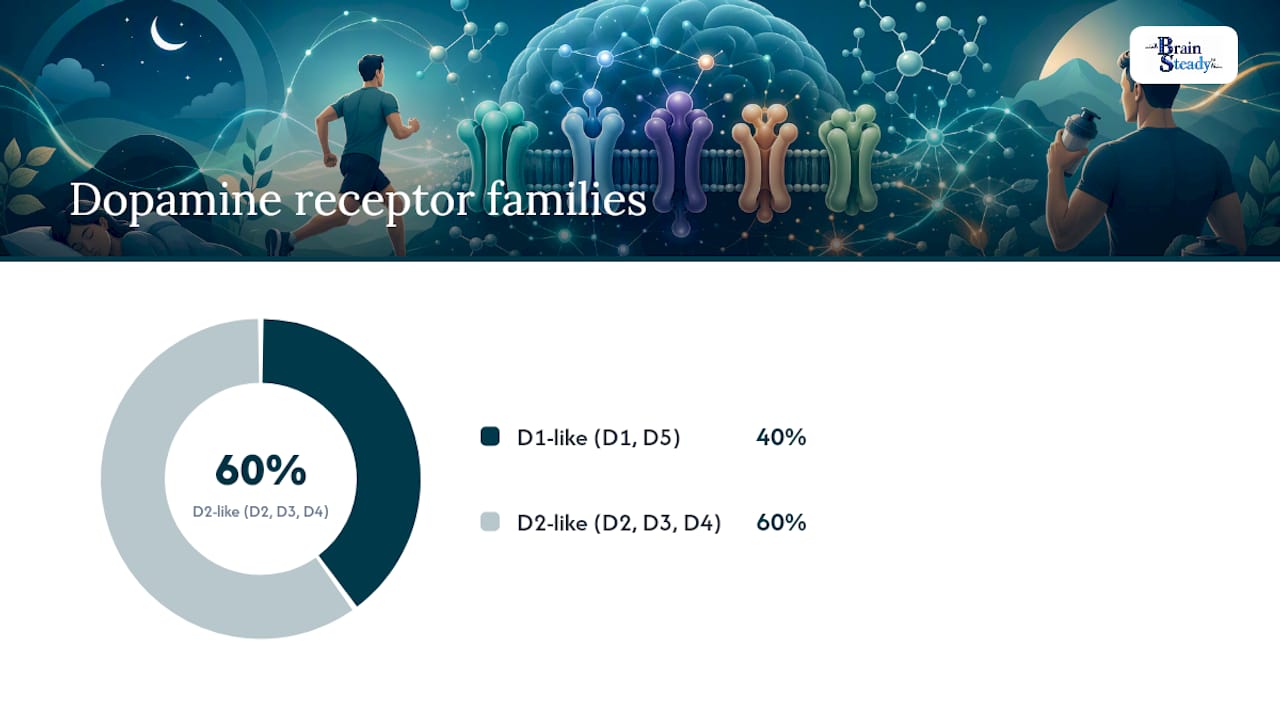
Dopamine binds to five receptor subtypes, grouped into two families with almost opposite jobs. D1-like receptors (D1 and D5) generally excite the receiving neuron and are linked to the “go” signals in reward and movement circuits. D2-like receptors (D2, D3, D4) tend to inhibit the receiving neuron and act more like a brake or filter, shaping which signals get through. This D1/D2 balance inside the basal ganglia is what lets you initiate a movement smoothly instead of either freezing or overshooting, and it’s a big part of why Parkinson’s drugs and antipsychotic medications, which work on these same receptors, produce such different effects depending on the dose and the specific receptor targeted.
This is also the biochemical reason oral dopamine supplements don’t work the way people hope. Dopamine itself can’t cross the blood-brain barrier in any meaningful amount, so swallowing it does nothing for brain levels. Anything marketed as a dopamine booster has to work through precursors, cofactors, or indirect pathways instead, a distinction covered in more depth in the supplements section further down.
How Dopamine Shapes Motivation, Focus, Learning, and Movement
Dopamine’s biggest job isn’t generating pleasure. It’s generating drive, the pull toward doing something before you know whether it will feel good at all. Researchers call this the difference between “wanting” and “liking,” and it explains a lot of confusing human behavior, like why you can crave a snack you don’t even enjoy that much once you’re eating it.
The mechanism behind that pull is called reward prediction error. Dopamine neurons don’t just fire when something good happens. They fire based on the gap between what you expected and what actually occurred. Get a reward you didn’t see coming, and dopamine spikes. Get exactly what you predicted, and the response flattens out. Get less than expected, and dopamine activity can dip below baseline. That’s the biological engine behind reinforcement learning: your brain uses these prediction errors to update what it thinks is worth pursuing next time, which is how dopamine turns experience into behavior change rather than just registering that something felt nice.
This same system does double duty in attention and executive function. Dopamine activity in the prefrontal cortex helps you filter distractions, hold information in working memory, and sustain effort on a task that isn’t intrinsically fun. It’s a big reason stimulant medications for ADHD, which increase dopamine (and norepinephrine) availability, can sharpen focus rather than just amping someone up. When dopamine signaling in these circuits runs low, tasks that require sustained mental effort start to feel disproportionately hard, not because the task changed, but because the internal reward for pushing through got quieter.
Quick facts on dopamine’s four main jobs:
- Reward and reinforcement: signals whether an outcome was better or worse than predicted, shaping what you seek out again.
- Motivation and drive: separate from pleasure, this is the “worth the effort” calculation that gets you off the couch.
- Attention and learning: supports working memory and filters out distraction in the prefrontal cortex.
- Movement: basal ganglia dopamine circuits initiate and smooth voluntary motor control.
That last function, movement, runs on a largely separate dopamine pathway than the motivation circuits, which is worth understanding on its own. The basal ganglia rely on dopamine from the substantia nigra to balance two competing motor circuits, one that promotes movement and one that suppresses it. When substantia nigra neurons die off, as happens progressively in Parkinson’s disease, that balance tips toward suppression. The result is the tremor, rigidity, and slowed movement (bradykinesia) that define the condition. It’s a useful reminder that “dopamine” isn’t one dial. It’s several related but distinct systems that can fail independently of each other.
Signs of Low or High Dopamine Activity and Related Conditions
Dopamine dysfunction rarely announces itself with a single obvious symptom. It shows up as a cluster, and the cluster looks different depending on whether activity is too low or too high in a given circuit.
Signs associated with low dopamine activity:
- Reduced motivation that goes beyond ordinary tiredness, a flat unwillingness to start tasks even when you know they matter.
- Anhedonia, a diminished ability to feel pleasure from activities that used to reliably deliver it.
- Slowed movement, stiffness, or a shuffling gait, particularly relevant in Parkinson’s disease.
- Concentration and working memory problems, including difficulty sustaining attention on effortful tasks.
- Low energy and mood changes, sometimes overlapping with depressive symptoms.
Signs associated with high or dysregulated dopamine activity:
- Impulsivity and difficulty pausing before acting on urges.
- Manic symptoms, including racing thoughts, decreased need for sleep, and grandiosity, seen in bipolar disorder.
- Psychosis-related symptoms, such as hallucinations or delusions, tied to excess dopamine activity in specific pathways implicated in schizophrenia.
- Compulsive reward-seeking, a hallmark of addiction, where dopamine circuits become hijacked by a specific substance or behavior.
Several well-defined conditions map onto these patterns. Dopamine involvement shows up clearly in Parkinson’s disease, ADHD, addiction, and schizophrenia, along with restless legs syndrome and some mood disorders. Parkinson’s stems from substantia nigra cell loss. ADHD is linked to altered dopamine signaling in prefrontal attention circuits. Addiction involves the reward pathway being repeatedly and abnormally reinforced by a substance until natural rewards feel comparatively dull. Schizophrenia and other psychotic disorders are tied, at least partly, to excess dopamine activity in specific brain pathways, which is why many antipsychotic medications work by blocking D2 receptors. Restless legs syndrome involves dopamine dysfunction in circuits controlling limb movement, often worsening in the evening.
One detail that surprises a lot of people: there is no routine blood test that tells you your “dopamine level” in any clinically useful way. Blood dopamine doesn’t reflect brain dopamine, because the two pools are separated by the blood-brain barrier. Clinicians diagnose dopamine-related conditions by evaluating symptoms and history rather than checking a number, and they reserve imaging, such as dopamine transporter (DAT) scans, for specific situations like distinguishing Parkinson’s disease from other movement disorders. If you’re noticing a real cluster of the symptoms above, particularly if they’re new, worsening, or affecting daily function, that’s a conversation for a doctor, not a home test kit.
Dopamine’s Role Outside the Brain and in Medicine
Dopamine has a second career as an emergency medicine, used intravenously in intensive care to support blood pressure and heart function in critically ill patients. This peripheral, clinical use has almost nothing to do with mood or motivation, and understanding the difference clears up a lot of confusion about what “raising dopamine” even means in a medical context.
IV dopamine’s effects change dramatically depending on the dose, because it activates different receptors at different concentrations:
- Low doses primarily activate dopaminergic receptors in the kidneys, historically used to try to protect kidney function, though this use has fallen out of favor as evidence weakened.
- Moderate doses stimulate beta-1 receptors in the heart, increasing cardiac output and heart rate.
- High doses activate alpha-1 receptors in blood vessels, causing vasoconstriction and raising blood pressure.
Because these effects shift so sharply with dose, IV dopamine requires continuous monitoring in a hospital setting. Push the dose too high without watching for it, and a drug meant to support circulation can trigger dangerous vasoconstriction and heart strain instead. This is precision pharmacology, titrated minute to minute, not a supplement you’d ever take at home.
That IV distinction matters for a completely different reason too: it underscores why oral dopamine doesn’t touch brain chemistry. The dopamine infused in an ICU acts on peripheral receptors in the heart, kidneys, and blood vessels; it never needs to cross into the brain to do its job. Anything sold as an oral “dopamine supplement” faces the opposite problem. It has to get past the blood-brain barrier to affect mood or motivation, and dopamine itself simply can’t do that in meaningful amounts. That’s the whole reason supplement formulas lean on precursors and cofactors instead of dopamine itself, which the supplements and precursors section below covers in detail.
Practical, Evidence-Based Ways to Support Healthy Dopamine Function
The most reliable way to support dopamine signaling has nothing to do with a pill, and everything to do with a handful of boring, repeatable habits. Sleep, exercise, protein intake, and stress management form the evidence base for supporting dopamine function naturally, and each one works through a slightly different mechanism.
- Protect your sleep schedule. Dopamine receptor sensitivity drops after sleep deprivation, meaning the same amount of dopamine produces a weaker signal the next day. Keeping a consistent sleep and wake time, even on weekends, does more for baseline motivation than most people expect. Readers dealing with disrupted sleep as part of a larger recovery process may find a closer look at sleep hygiene useful.
- Move your body regularly, and make some of it effortful. Exercise reliably increases dopamine synthesis and release. The learning-relevant piece is that effortful, slightly uncomfortable exercise, not just any movement, appears to strengthen the dopamine signals tied to reinforcement learning, essentially teaching your brain that pushing through discomfort pays off.
- Eat enough protein, spread across the day. Tyrosine, the amino acid precursor to dopamine, comes from protein-rich foods like eggs, poultry, fish, dairy, and legumes. Pair that with adequate iron, vitamin B6, folate, and vitamin D, since all four act as cofactors somewhere in the dopamine synthesis pathway, and a shortfall in any one can slow production.
- Set micro-goals instead of one distant goal. Because dopamine responds to prediction error, breaking a big task into small, completable steps creates more frequent “reward” signals along the way, keeping motivation fed rather than starved until the end.
- Get outside, especially in the morning. Sunlight exposure is linked to healthier dopamine activity and better mood regulation, likely through its effects on circadian rhythm.
- Build in deliberate novelty. New experiences, new music, new routes on a walk, mildly activate the same reward circuits, offering a natural motivation boost without the crash that comes from artificially intense stimulation.
- Practice stress management. Chronic stress disrupts dopamine regulation over time; even brief meditation or breathing practice sessions seem to help stabilize the system.
Pro Tip: Stack a new habit onto an existing one you already enjoy, like listening to a favorite podcast only while exercising. You borrow the dopamine response from something you already look forward to and lend it to the harder task.
These strategies build motivation gradually, typically over a few weeks of consistent practice, not overnight. If you’ve been consistent with sleep, movement, protein intake, and stress management for several weeks and still notice persistent low motivation, anhedonia, or concentration problems, that’s a signal to loop in a clinician rather than keep tweaking habits on your own. For readers specifically wrestling with a loss of pleasure in things they used to enjoy, a practical framework for anhedonia can offer a useful next step alongside professional support. Snapbrainformula’s own content on dopamine’s role in reward and motivation breaks down several of these mechanisms further for readers who want the deeper science.
Supplements and Precursors: What the Evidence Actually Supports
Most products marketed as “dopamine supplements” don’t contain dopamine at all, and for good reason: it wouldn’t work if they did. Instead, these formulas rely on precursors like L-tyrosine or plant-based sources like Mucuna pruriens, which contains natural levodopa, plus cofactor vitamins that support the synthesis pathway described earlier.
The evidence for these ingredients is real but modest, and it varies a lot by ingredient:
- L-tyrosine shows the most consistent short-term signal, with research suggesting it can help preserve cognitive performance during acute stress, such as sleep deprivation or high-pressure tasks. It’s not a motivation booster for everyday life so much as a stress buffer in specific, demanding situations.
- Mucuna pruriens is a different story entirely. Its levodopa content means it can produce genuinely measurable increases in dopamine synthesis, which is exactly why it carries real risk. This isn’t a mild herbal extract; it’s a natural source of the same active compound used in prescription Parkinson’s medication.
- Cofactor nutrients (B6, folate, iron, vitamin D) support the synthesis pathway but only help meaningfully if you’re actually deficient in them. Loading up on extra B6 when you’re not deficient won’t accelerate dopamine production further.
Because Mucuna functions as a natural levodopa source, it should be treated with the same caution as prescription levodopa therapy, not as a casual wellness add-on. Reported adverse effects across dopamine-related supplements include nausea, insomnia, and blood pressure changes, and the interaction risks are significant: combining these ingredients with MAOIs, Parkinson’s medications, certain antidepressants, or stimulants can produce unpredictable and sometimes dangerous effects on dopamine and blood pressure regulation.
None of this is a reason to avoid the category entirely, but it is a strong argument against self-prescribing, especially if you’re already managing a psychiatric condition, taking prescription medication, or dealing with cardiovascular issues. Talk to a clinician before adding a levodopa-containing supplement to your routine, particularly if you’re on any medication that touches dopamine, serotonin, or norepinephrine pathways.
Dopamine Myths That Deserve a Correction
Calling dopamine “the pleasure chemical” is the single most common oversimplification out there, and it undersells what the molecule actually does. Dopamine drives wanting and learning more than it drives raw pleasure, which is a subtler and honestly more useful thing to understand about your own behavior.
The biggest myth built on that misunderstanding is the “dopamine detox” trend, the idea that avoiding all stimulating activities for a day resets your dopamine system. There’s no evidence this works the way it’s marketed, and taken to extremes it can be counterproductive, particularly for people already struggling with motivation or mood.
A more useful, evidence-grounded approach to modern overstimulation:
- Turn off nonessential notifications instead of trying to abstain from screens entirely.
- Schedule specific times for high-stimulation activities rather than banning them outright.
- Deliberately build in slower, effortful tasks (reading, a walk, a real conversation) that offer a steadier, less spiky reward.
- Treat boredom tolerance as a skill you’re rebuilding, not a punishment you’re enduring.
What the Evidence Actually Supports, and Where It Stops
This explainer draws on clinical references from sources like the Cleveland Clinic and NCBI Bookshelf, prioritizing peer-reviewed and institutional sources over supplement marketing claims whenever the two disagreed. That’s a deliberate choice: dopamine is a topic where wellness content routinely overstates what a single ingredient or habit can do, and the gap between a catchy headline and the underlying research is often wide.
Three takeaways worth carrying forward. First, dopamine responds best to consistency, not intensity; a boring sleep schedule beats a dramatic weekend reset. Second, precursor supplements have a real but narrow role, mostly around acute stress, not general motivation. Third, persistent symptoms deserve a clinical conversation, not another habit tweak. An evidence-first framing treats nutritional support as one part of a broader picture that includes sleep, movement, and behavioral strategy rather than a standalone fix.
Your Next Steps for Supporting Dopamine Naturally
Dopamine health comes down to consistent basics: regular sleep and wake times, effortful movement most days, adequate protein and micronutrients, and small, completable goals that keep the reward system engaged rather than starved. Most people notice a shift in motivation and focus within two to four weeks of sticking with these changes, not overnight.
Watch for red flags that go beyond ordinary low motivation: persistent anhedonia, tremor or slowed movement, marked concentration problems, or mood swings involving impulsivity or racing thoughts. Any of those, especially if they’re new or worsening, warrant a conversation with a doctor rather than more lifestyle tweaking. For a deeper look at the biology behind these strategies, Snapbrainformula’s explainer on dopamine synthesis and receptor function is a solid next read, and the focus and productivity guide covers attention-specific strategies in more depth.
The Gap Between Dopamine Hacks and What Actually Works
The wellness industry sells dopamine as something you can hack in a weekend: a detox, a cold shower, a supplement stack. The research doesn’t support that framing, and I think that mismatch is doing readers a real disservice. Dopamine is a learning signal built on repetition and prediction, not a tank you drain and refill.
What gets underrated is how much boring consistency outperforms intensity here. A regular sleep schedule and a protein-rich breakfast will do more for your baseline motivation than any 72-hour “reset” ever could, because dopamine sensitivity rebuilds through steady, predictable inputs, not dramatic gestures.
Where I’d push back hardest on conventional advice is the pressure to self-diagnose “low dopamine” and self-treat with supplements, especially levodopa-containing ones like Mucuna. That’s real pharmacology with real interaction risks, not a wellness add-on. Prioritize the free stuff first: sleep, movement, sunlight, protein. If symptoms persist after weeks of genuine effort, that’s the moment for a clinician, not a stronger supplement.
— Ellory
This article is general information, not a substitute for advice from a qualified doctor. Consult a qualified healthcare professional about your own circumstances before acting on anything here.
Sources
- Dopamine - what it is, addiction | healthdirect
- Dopamine: What It Is, Function & Symptoms | Cleveland Clinic
- Pharmacology and therapeutic use of dopamine (NCBI Bookshelf)
- How to get high on your own dopamine—naturally | National Geographic
