
ADHD disrupts sleep in most people who have it, and the disruption runs both directions: a wired brain at 11 p.m. makes falling asleep hard, and the sleep loss that follows makes ADHD symptoms worse the next day. The two biggest drivers are a delayed body clock and a nervous system that stays physiologically activated well past bedtime. Before anything else, take these steps:
- Screen for a co-occurring sleep disorder first. Loud snoring, gasping, or daytime sleepiness point to something beyond ADHD alone.
- Anchor a fixed wake time and get morning light within 30 minutes of waking. This is the single highest-yield habit for a delayed body clock.
- Review medication timing with the prescriber. Stimulant dosing that runs too late in the day is a common, fixable cause of bedtime resistance.
- Ask about low-dose melatonin, but only with clinician guidance on timing and dose. More is not better here, and timing matters more than amount.
Research pegs chronic sleep trouble in adults with ADHD at 25% to 50% or higher depending on how it’s measured, and a large Swedish study found that among people with ADHD, Nearly half had been prescribed a sleep medication even though far fewer had a formal sleep disorder diagnosis.
Key Takeaways
Sleep and ADHD interact through a delayed circadian clock and physiological hyper-arousal, and fixing sleep timing often reduces ADHD symptom severity in return.
| Point | Details |
|---|---|
| Anchor the wake time | A fixed daily wake time plus morning light exposure corrects circadian delay more reliably than bedtime rules alone. |
| Screen before assuming | Loud snoring, gasping, or severe daytime sleepiness warrant an OSA evaluation before behavioral fixes are tried. |
| Diagnosis often lags treatment | Only 7.5% of people with ADHD have a formal sleep disorder diagnosis, yet 47.5% have been prescribed sleep medication. |
| Combine chronotherapy tools | Timed low-dose melatonin plus morning bright light produces larger phase advances than either alone. |
| Behavioral programs hold up | Structured behavioral sleep programs with parent coaching show sustained benefits at six-month follow-up in trials. |
Table of Contents
- Sleep and ADHD: How Common Are the Problems, Really?
- Why ADHD Affects Sleep: The Circadian and Arousal Connection
- Sleep Disorders That Overlap With ADHD (and the Red Flags)
- Getting Sleep Assessed: What to Bring to the Appointment
- What Actually Works: Comparing the Evidence-Based Options
- Building a Sleep Routine That Actually Fits an ADHD Brain
- Medications, Supplements, and Sleep: What to Discuss With a Clinician
- What Happens When ADHD Sleep Problems Go Untreated
- Is It ADHD, or Is It a Separate Sleep Disorder?
- Sleep Strategies Across Age Groups: What Changes for Teens
- A Circadian-First Take on ADHD and Sleep
- Sources
Sleep and ADHD: How Common Are the Problems, Really?
Ask parents of kids with ADHD about bedtime and you’ll rarely hear “no issues.” Ask adults with ADHD about their sleep and the answer is usually a tired laugh. The gap between how often people report sleep trouble and how often it gets formally diagnosed is one of the most important facts in this whole topic.
Subjective complaint rates run high. Formal diagnosis tells a different story. The nationwide Swedish register study, which tracked more than 6.4 million people, found that only 7.5% of individuals with ADHD carried an actual clinical sleep disorder diagnosis — even though nearly half had been given a sleep medication at some point. That mismatch means most sleep problems in ADHD are being treated, informally or with prescriptions, without ever being properly named or evaluated.
What does this look like day to day? A few patterns show up again and again:
- Bedtime insomnia. Lying awake for 30, 60, even 90 minutes past the intended lights-out, mind still cycling through the day.
- Delayed sleep phase. The body simply isn’t ready for sleep until 1 or 2 a.m., regardless of how tired the person feels earlier in the evening.
- Fragmented sleep. Waking multiple times overnight, sometimes without remembering it, leaving a person feeling like they slept eight hours but functioning like they slept four.
- Morning grogginess and daytime sleepiness. Not the ordinary “needs coffee” tired, but a heavier, harder-to-shake fog that affects school or work performance.
For a parent, this often shows up as nightly battles: a child who says they’re not tired at 9 p.m., resists every step of the bedtime routine, and then can’t be woken for school the next morning. For an adult with ADHD, it’s the 11 p.m. surge of energy right when the day is supposed to be winding down, followed by an alarm that feels like a personal insult. Neither pattern is a discipline problem. Both track closely with what researchers now understand about the ADHD brain’s relationship with its internal clock.
Why ADHD Affects Sleep: The Circadian and Arousal Connection
The dominant explanation isn’t “ADHD brains are bad at sleeping.” It’s that many ADHD brains run on a delayed clock and a nervous system that doesn’t power down on schedule. Both problems have measurable biological markers, not just behavioral ones.
Start with the clock. Dim-light melatonin onset, or DLMO, is the point in the evening when the body starts releasing melatonin and preparing for sleep. In typical adults, that shift happens a couple of hours before their usual bedtime. In people with ADHD, DLMO is frequently delayed, and research shows A majority of people with ADHD show a delayed sleep and wake cycle compared with the general population. That’s not a small subgroup. It’s the majority pattern.
Layer on top of that a second mechanism: hyper-arousal. This is the physiological state where the nervous system stays activated, alert, and reactive even when the mind consciously wants to rest. Clinicians sometimes call the resulting evening energy spike a “second wind,” and it’s a real phenomenon, not a stalling tactic.
Hyper-arousal, not poor discipline or lack of willpower, is often the primary driver of that late-night alertness in ADHD. Interventions that target the body’s arousal and clock timing tend to outperform approaches built around forcing an earlier bedtime through sheer effort.
The Sleep Foundation’s clinical guidance echoes this, recommending that sleep-related anxiety get treated as its own problem, separate from general sleep hygiene fixes. Trying to white-knuckle your way into sleep when your body is chemically primed to stay alert rarely works, and it often makes the frustration worse.
Then the cycle closes. Sleep loss impairs the prefrontal cortex functions that regulate attention, impulse control, and emotional reactivity, which are exactly the systems already under strain in ADHD. A short night doesn’t just make someone tired. It makes:
- Impulse control noticeably weaker the next day
- Working memory less reliable, so tasks and instructions slip
- Emotional reactions bigger and harder to self-correct
- Existing ADHD symptoms look more severe than they would on a full night’s sleep
This is the two-way trap: ADHD delays and disrupts sleep, and disrupted sleep intensifies ADHD. Breaking in at either end helps the whole loop, which is precisely why chronotherapy and behavioral sleep work show up so often as first-line strategies rather than afterthoughts.
Sleep Disorders That Overlap With ADHD (and the Red Flags)
Not every sleep problem in ADHD is “just” ADHD. Several distinct sleep disorders occur alongside it more often than they occur in the general population, and missing them means treating the wrong thing.
-
Obstructive sleep apnea (OSA). Watch for loud, habitual snoring, witnessed pauses in breathing, gasping during sleep, morning headaches, and daytime sleepiness that doesn’t improve no matter how early bedtime is. OSA shows up at elevated rates in ADHD samples, and it’s one of the few sleep disorders that can actually mimic or worsen inattention and hyperactivity on its own. A child who’s inattentive at school because they’re not breathing well at night needs a different treatment path than one whose inattention is purely ADHD-driven.
-
Restless legs syndrome (RLS) and periodic limb movement disorder (PLMD). RLS shows up as an uncomfortable, hard-to-describe urge to move the legs, usually worse in the evening or when lying still. PLMD involves repetitive limb jerks during sleep that the person often doesn’t remember but that fragment sleep architecture all night. Both disorders appear with elevated frequency in ADHD populations, and both are frequently overlooked because the daytime symptom, fatigue and inattention, looks identical to plain ADHD.
-
Delayed sleep phase syndrome (DSPS). This is the clinical version of the circadian delay described earlier: a sleep onset and wake time that’s persistently shifted several hours later than desired or socially required. DSPS is common in ADHD and is the primary target of chronotherapy approaches like timed melatonin and morning light.
-
Insomnia. Difficulty falling or staying asleep that isn’t explained by another sleep disorder. In ADHD, insomnia frequently overlaps with anxiety and with medication effects, particularly stimulants dosed too late in the day.
If snoring, gasping, or witnessed breathing pauses are present, that’s a signal to raise OSA with a clinician regardless of how well the rest of the sleep routine is managed. Fixing bedtime habits won’t fix an airway problem.
Getting Sleep Assessed: What to Bring to the Appointment
You don’t need a sleep lab to start. A two-week sleep diary tracking bedtime, wake time, night wakings, and rough sleep quality gives a clinician more useful information than a single conversation ever could. Add a simple daytime sleepiness scale and a few direct questions about snoring, leg discomfort, or breathing pauses, and you’ve got a genuinely useful screening packet.
Clinicians escalate from there depending on what the diary and screening turn up:
- Actigraphy, a wearable device that tracks movement and rest patterns over one to two weeks, is often used when a delayed sleep phase or irregular schedule is suspected but self-report alone isn’t conclusive.
- Polysomnography, an overnight, in-lab sleep study, gets ordered when OSA or another physiological sleep disorder is suspected, especially with snoring, witnessed apneas, or unexplained severe daytime sleepiness.
- DLMO testing, which measures the timing of melatonin release, is less commonly used outside research or specialist settings but can clarify circadian timing in complicated cases.
Refer up the chain when any of these show up: suspected OSA (snoring plus daytime sleepiness is enough to raise it), sleepiness severe enough to affect driving or school performance, or a solid two to four weeks of consistent behavioral changes that haven’t moved the needle. That last point matters because behavioral fixes need a fair trial, not a three-day test, before you conclude they’ve failed.
Pro Tip: Bring the sleep diary to the appointment even if it feels incomplete. A partial two weeks of real data beats a perfect memory of “it’s been bad for months.” Clinicians can spot patterns you won’t notice yourself.
For families juggling ADHD alongside other diagnoses, screening for sleep problems early tends to prevent a lot of downstream confusion; our guide to ADHD and comorbid conditions walks through how overlapping conditions can muddy the diagnostic picture.
What Actually Works: Comparing the Evidence-Based Options
Not all sleep interventions for ADHD carry the same weight of evidence, and it helps to know which ones have been through randomized trials versus which ones are reasonable but under-studied.
Behavioral sleep programs have the strongest track record in children with ADHD. Structured programs, usually built around consistent wake times, parent coaching, and a standardized wind-down sequence, have shown in randomized trials that they improve sleep and, notably, reduce ADHD symptom scores. One notable finding: benefits from these programs held up at six-month follow-up in trials that included ongoing parental coaching, not just a one-time consultation.

CBT-I (cognitive behavioral therapy for insomnia) is the gold-standard treatment for insomnia generally, and it applies directly to the insomnia that frequently overlaps with ADHD. It works by restructuring the thoughts and habits that keep someone awake, things like clock-watching anxiety, in-bed problem solving, and irregular sleep scheduling. It requires more structure than a self-help routine, usually delivered by a trained therapist over several weeks, but it has a strong evidence base outside ADHD-specific research too.
Chronotherapy is where the circadian-phenotype framing pays off most directly. Timed, low-dose melatonin taken several hours before natural sleep onset can advance DLMO and modestly increase total sleep time, according to controlled trials. Morning bright light therapy, delivered through a light box or simply strategic outdoor exposure right after waking, has replicated evidence for shifting sleep timing earlier. The combination appears to outperform either alone:
Morning bright light combined with timed melatonin produced larger circadian phase advances in trials than either intervention used by itself, which suggests that multimodal chronotherapy is often the more effective approach for delayed sleep phase in ADHD rather than picking just one tool.
That’s a meaningful finding for anyone weighing “should I try melatonin or a light box first?” The honest answer from the evidence on circadian rhythm dysfunction in ADHD is often both, timed correctly, rather than either alone.
A broader review of managing sleep in adults with ADHD identifies morning bright light therapy specifically as a low-risk, promising option, while noting the evidence base, while consistent, still comes from a limited number of smaller studies rather than large-scale trials.
Other adjuncts round out the toolkit with more mixed support:
- Timing exercise earlier in the day rather than right before bed tends to support earlier sleep onset, since vigorous activity close to bedtime can reinforce the hyper-arousal pattern rather than counter it.
- Weighted blankets have anecdotal popularity in ADHD households, but ADHD-specific evidence remains limited; they’re a reasonable low-risk trial rather than a proven fix.
- Sedative medications, whether prescription or over-the-counter, come with real limits. They can mask a sleep problem without addressing the circadian or arousal mechanism underneath it, and the Swedish register data showing high prescription rates against low formal diagnosis rates suggests this happens more than it should.
The takeaway from the evidence isn’t “pick one intervention.” It’s that behavioral structure and circadian-timed interventions stack, and the strongest results in the research come from combining them rather than treating any single tool as sufficient on its own.
Building a Sleep Routine That Actually Fits an ADHD Brain
Generic sleep hygiene advice, no screens an hour before bed, a cool dark room, doesn’t account for the fact that an ADHD brain resists routine and craves stimulation right when it’s supposed to be winding down. Here’s a sequence that respects how ADHD actually works.
-
Fix the wake time first, not the bedtime. This is counterintuitive but backed by the clinical consensus: a stable, non-negotiable wake time, seven days a week, does more to reset a delayed circadian clock than any bedtime rule. Bedtime naturally shifts earlier once the wake time anchors the system.
-
Get outside within 30 minutes of waking. Ten to twenty minutes of direct outdoor light, even on a cloudy day, delivers a circadian signal that indoor lighting can’t match. This is the practical, no-cost version of morning bright light therapy.
-
Build a short, concrete evening sequence, not a vague “wind down” instruction. Vague instructions fail with ADHD. A specific, repeatable sequence, dim lights at 8:30, shower at 8:45, ten minutes of reading at 9:00, lights out at 9:15, works better because it removes decision points.
-
Set a hard stop on hyperfocus activities at least an hour before the sequence starts. Video games, intense scrolling, or absorbing projects are the most common reason bedtime routines get blown past. A visible timer or alarm works better than willpower alone.
-
Limit screens in the last hour, but don’t rely on that alone. Screen light matters less than most people assume; the bigger issue is that screens deliver the kind of stimulation that feeds hyper-arousal right when the brain needs to downshift.
-
For parents: use visual schedules and a pre-bed warning system. A picture-based checklist on the wall and a “15 minutes until bedtime” warning give a child with ADHD the predictability that verbal reminders alone rarely provide.
-
Keep calming activities consistent, not novel. The same short book, the same low-key music, the same brief conversation. Novelty is stimulating, which works against the goal at this hour.
-
If two to four weeks of consistent routine changes don’t move things, ask about a formal behavioral sleep program. These structured, often clinician-guided programs go further than a home routine and have the randomized-trial evidence to back sustained improvement.
Pro Tip: Post the evening sequence somewhere visible, on the fridge, a phone lock screen, a bathroom mirror. ADHD households do better with an external reference than with anyone trying to remember the plan from memory alone.
For more structured behavioral frameworks, our routine-building guide for children with neurodevelopmental disorders covers visual scheduling in more depth, and general ADHD management strategies at home offer complementary daytime structure that makes evening routines easier to hold.
Medications, Supplements, and Sleep: What to Discuss With a Clinician
Stimulant medication timing is one of the most fixable, and most overlooked, contributors to ADHD-related sleep trouble. A dose that runs too long into the evening, particularly with extended-release formulations, can push sleep onset later without anyone connecting the dots. Clinicians sometimes address this by shifting to an earlier dosing window, switching between short-acting and long-acting formulations, or adjusting the afternoon dose specifically to reduce evening stimulation. None of these changes should happen without medical guidance, since under-dosing daytime symptoms carries its own costs.
Melatonin has real trial evidence behind it, but timing and dose matter more than most over-the-counter labels suggest. Controlled trials use low doses, timed several hours before natural sleep onset, specifically to shift DLMO earlier rather than simply sedate. Taking melatonin right at bedtime, at a high dose, or inconsistently misses the mechanism that makes it work as chronotherapy rather than a sleep aid.
- Discuss stimulant dosing schedule and formulation with the prescriber before assuming sleep trouble is unrelated to medication.
- Ask specifically about melatonin timing and dose rather than trying an OTC bottle’s default instructions.
- Avoid combining multiple OTC sedatives or sleep aids without clinician input; interactions with stimulant medications aren’t always obvious.
- Treat any sedative, prescription or otherwise, as a short-term bridge, not a long-term fix for an unaddressed circadian or arousal problem.
The Swedish register data is a useful reality check here: 47.5% of people with ADHD had been prescribed a sleep medication, a rate far higher than the A smaller percentage with a formal sleep disorder diagnosis. That gap suggests a lot of prescribing happens without the underlying mechanism, circadian delay, hyper-arousal, or a distinct sleep disorder, ever getting properly identified.
Where Nutritional Support Fits Into the Bigger Picture
Sleep problems in ADHD sit downstream of brain chemistry, and that’s the space where Snapbrainformula’s educational work and supplement line focus. Targeted nutritional support is best understood as an adjunct that may support the pathways involved in focus, mood regulation, and emotional balance, not a replacement for behavioral sleep programs, CBT-I, or clinician-guided chronotherapy.
- Nutritional supplements can be a reasonable piece of a broader plan, alongside routine changes and, where needed, professional sleep treatment.
- Any supplement discussion, including melatonin or other targeted nutrients, belongs in the same conversation you’re already having with a prescriber about medication timing and sleep.
- Snapbrainformula’s educational content on ADHD, executive functioning, and brain chemistry is built to help families ask better questions in that clinical conversation, not to substitute for it.
- Safety first: no supplement decision should override a clinician’s guidance, particularly for children or anyone on existing ADHD medication.
What Happens When ADHD Sleep Problems Go Untreated
Sleep debt that accumulates over months or years doesn’t stay contained to feeling tired. It compounds directly with existing ADHD symptoms, and the long-term pattern is worse than the sum of two separate problems.
Academically and professionally, chronic sleep deprivation on top of ADHD tends to erode exactly the skills someone needs most: sustained attention, working memory, and the emotional regulation required to handle setbacks without a disproportionate reaction. Grades slip, performance reviews get harder to explain, and the person often can’t tell whether the struggle is “ADHD” or “exhaustion,” because by that point, they’re the same problem wearing one face.
Relationships absorb a lot of the damage too. A chronically under-slept person with ADHD is more reactive, more prone to snapping over small friction, and less able to read social cues accurately. For children, this shows up as more frequent meltdowns and harder mornings; for adults, it shows up as strain in partnerships and friendships that outside observers often misread as a personality issue rather than a sleep issue.
Physical health carries its own toll. Chronic sleep restriction is tied to broader metabolic and cardiovascular risk over time, independent of ADHD, and an unaddressed co-occurring disorder like sleep apnea compounds that risk further.
The reassuring side of this picture is that the cycle runs in reverse too. Clinical guidance consistently notes that improving sleep tends to reduce ADHD symptom severity and improve daytime function, which means the years of compounding damage aren’t necessarily permanent once the sleep problem gets treated properly.
Is It ADHD, or Is It a Separate Sleep Disorder?
This distinction matters more than it might seem, because treating ADHD harder won’t fix a sleep disorder, and treating a sleep disorder in isolation won’t fix ADHD.
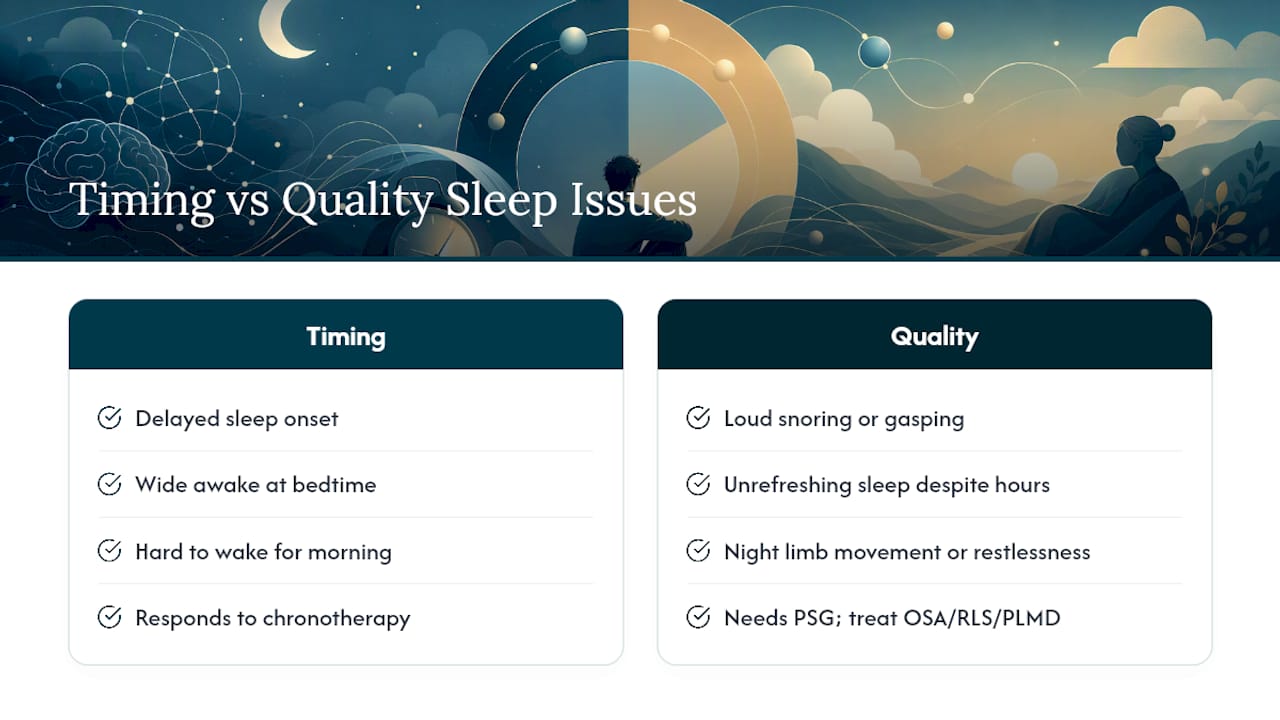
A useful starting question: does the sleep problem look like a timing issue or a quality issue? Delayed sleep onset, feeling wide awake at bedtime, and difficulty waking for a fixed morning commitment point toward the circadian delay pattern common in ADHD. That’s DSPS territory, and it responds to chronotherapy.
A quality issue looks different: loud snoring, gasping, unrefreshing sleep despite adequate hours in bed, or noticeable limb movement and discomfort at night. Those symptoms point toward OSA, RLS, or PLMD, disorders that exist independently of ADHD and need their own diagnostic workup, often including polysomnography.
Timing matters too. If sleep problems appeared or worsened right alongside a medication change, that’s a strong clue pointing toward a medication-timing issue rather than a separate disorder. If sleep problems have been present since early childhood, long before any ADHD diagnosis or treatment, that’s more consistent with an underlying circadian phenotype or a distinct sleep disorder that happens to coexist with ADHD.
When in doubt, the sleep diary described earlier is the most useful tool for sorting this out, because patterns that are invisible night to night usually show up clearly across two weeks of data. Our overview of ADHD and common behavioral disorders covers more on how overlapping conditions complicate diagnosis generally.
Sleep Strategies Across Age Groups: What Changes for Teens
Adolescence adds a wrinkle that neither the standard “child” nor “adult” advice fully covers: puberty itself delays circadian timing in every teenager, ADHD or not. Layer an ADHD-related circadian delay on top of a normal adolescent phase shift, and you get some of the most severe sleep timing problems seen at any age.
Fixed wake times still matter for teens, but enforcing them runs into a real obstacle: early school start times that conflict directly with a biologically later sleep phase. Where possible, advocating for later start times or, at minimum, protecting weekend sleep from further slippage helps more with teenagers than it does with younger children, whose schedules are more parent-controlled to begin with.
Morning light exposure becomes harder to arrange for teens who are also trying to leave the house on a tight school schedule, but it’s arguably more important for this age group, given how strong the adolescent circadian delay already is. A short walk or bright light exposure before leaving for school, rather than after arriving, makes a measurable difference.
Autonomy is the other piece that shifts. Visual schedules and parent-enforced bedtime warnings, effective for younger children, tend to backfire with teenagers who are developmentally pushing for independence. Collaborative approaches, where the teen has input into the routine design and understands the reasoning behind fixed wake times, tend to hold up better than rules imposed from outside. Screen limits and caffeine timing, both flagged in practical guidance on ADHD-related insomnia, deserve particular attention here, since teens with ADHD often lean on both to manage daytime fatigue in ways that worsen the nighttime problem.
A Circadian-First Take on ADHD and Sleep
Most sleep advice for ADHD still leads with bedtime hygiene: dim the lights, no screens, cool room. That’s not wrong, but it treats the symptom while skipping the mechanism. The stronger read of the evidence points somewhere else: fix the clock first, and the bedtime problems often shrink on their own.
The conventional wisdom overweights bedtime and underweights wake time. A fixed wake time paired with morning light does more to correct a delayed circadian phase than any evening ritual, because it anchors the one end of the sleep cycle that’s actually under voluntary control. Bedtime, for a delayed chronotype, is largely downstream of that anchor.
The other place conventional advice falls short is treating hyper-arousal as a willpower problem. It isn’t. Telling someone to “just relax” when their nervous system is physiologically activated is like telling someone to slow a car with no brakes by asking nicely.
If you take one thing from this article, prioritize the wake time and morning light before anything else, and bring a two-week sleep diary to whoever you see next. That combination, chronotherapy plus real data, outperforms guesswork every time.
— Ellory
Sources
- ADHD as a circadian rhythm disorder: evidence and implications for chronotherapy - PMC
- Prevalence of sleep disorder diagnoses and sleep medication prescriptions in individuals with ADHD across the lifespan: a Swedish nationwide register-based study
- Sleep & ADHD: Restorative Rest for Improved Productivity
This article is general information, not a substitute for advice from a qualified doctor. Consult a qualified healthcare professional about your own circumstances before acting on anything here.
Recommended
- ADHD vs Other Behavioral Disorders What You Need to Know – SNAP Brain Health Supplements
- Recognizing Overlapping Symptoms of ADHD and Anxiety – SNAP Brain Health Supplements
- ADHD And Comorbid Conditions Blog – SNAP Brain Health Supplements
- Effective Solutions for Managing ADHD Alongside Depression – SNAP Brain Health Supplements
