
Regulating emotions is a trainable skill, not a fixed trait you either have or lack. The most effective path combines two things: quick nervous-system tools like paced breathing or the STOP technique for the moment a feeling spikes, and longer-term skill building through approaches like CBT, DBT, and mindfulness. Many people who practice consistently experience noticeable improvement in how fast they recover from distress.
TL;DR:
- Consistent practice of quick nervous-system tools like paced breathing and longer-term strategies such as CBT, DBT, and mindfulness significantly improves emotional recovery speed over time.
- Emotional dysregulation manifests through disproportionate reactions, mood swings, and trouble calming down, with severity heightened by factors like sleep loss and substance use.
- Techniques like cognitive reappraisal, distress tolerance, and somatic tools target different regulation stages, and combining them enhances overall emotional management.
- Building regulation skills involves daily habits such as naming emotions promptly, maintaining a sleep routine, and practicing distress tolerance, even during calm periods.
- Immediate tools only buy short-term relief; lasting change depends on ingrained habits, repeated practice, and developing automatic regulation responses through consistent effort.
Table of Contents
- What It Means to Regulate Your Emotions
- Why This Skill Shapes Your Health, Goals, and Relationships
- Signs You Might Be Struggling With Dysregulation
- CBT, DBT, ACT, and Somatic Tools: What Each One Actually Does
- Tools to Use Right Now and Habits That Build Long-Term Capacity
- When to Get Professional Support
- How Snapbrainformula Supports Skill Building
- How Emotion Regulation Skills Change Across a Lifetime
- Emotion Regulation’s Role in Anxiety, Depression, and Borderline Personality Disorder
- Culture Shapes How You’re Taught to Handle Feelings
- Myths That Get in the Way of Real Progress
- What Changes When You Practice Consistently
- The Real Gap Between Regulation Advice and What Actually Helps
- Sources
What It Means to Regulate Your Emotions
Emotion regulation is the process of assessing, maintaining, or adjusting how intense, frequent, or long-lasting an emotional reaction gets, so it serves your goals instead of derailing them. That operational definition traces back to the developmental psychologist Thompson, and it still holds up in current clinical practice. When that process breaks down, you get emotional dysregulation: reactions that feel uncontrollable and start interfering with work, relationships, or basic daily function.
Psychologist James Gross offers a useful map for where regulation succeeds or fails, called the Extended Process Model. It breaks the process into four stages:
- Identification — noticing an emotion has shown up and naming what it is
- Selection — choosing a strategy suited to that emotion and situation
- Implementation — actually running the strategy in real time
- Monitoring — checking whether it worked and adjusting
Regulation is not suppression. Pushing a feeling down or numbing it out might look like control from the outside, but it usually just delays the reaction or lets it leak out sideways. The brain science behind this is straightforward: your amygdala fires the alarm, and your prefrontal cortex is supposed to step in and modulate that alarm. Chronic stress, poor sleep, or trauma history can weaken that prefrontal brake.
Why This Skill Shapes Your Health, Goals, and Relationships
Poor regulation does not stay contained to the moment it happens. It spills into how you sleep, how you show up at work, and how your relationships hold together over time. Chronic dysregulation is linked to internalizing problems like anxiety and depression, strained partnerships, and reduced functioning on the job, because the same reactive pattern that blows up at home tends to show up in a meeting, too.
Where this capacity comes from matters. Early caregiving environments, unresolved trauma, and neurodivergent brain wiring (ADHD and autism, in particular) all shape how much regulatory bandwidth someone starts with. None of that is destiny, though.
Regulation is a skill you can build at any age. Repeated practice with strategies like cognitive reappraisal strengthens the underlying regulatory circuitry over time, according to research summarized by PositivePsychology.com. That single fact reframes the whole conversation: struggling with emotions now does not mean you are stuck struggling with them forever.
Signs You Might Be Struggling With Dysregulation
Some signs are loud. Others are quiet enough that you might mistake them for just having a personality.
Outward signs tend to include outbursts that feel disproportionate to what triggered them, impulsive decisions you regret later, and avoidance that keeps growing to cover more of your life. Internally, you might notice mood swings that arrive out of nowhere, a recovery time that stretches on far longer than the situation warrants, or a flat, disconnected numbness that some people mistake for calm.
According to the Cleveland Clinic, common markers of dysregulation include:
- Reactions that feel far bigger than the trigger deserves
- Frequent, hard-to-predict mood shifts
- Trouble calming down once activated
- Leaning on substances, self-harm, or other maladaptive coping to manage the feeling
Watch for context, too. Sleep loss, increased alcohol or substance use, and a history of trauma all lower your regulatory reserve, which makes any of the signs above show up more often and hit harder.
CBT, DBT, ACT, and Somatic Tools: What Each One Actually Does
These approaches are not competing for the same job. They target different points in the regulation process, which is why clinicians often blend them.
Cognitive Behavioral Therapy (CBT) works mainly at the selection and implementation stage through cognitive reappraisal: catching the thought driving the emotion and reframing it before the feeling snowballs. If you feel your chest tighten before a presentation and think “I’m going to fail,” CBT trains you to test that thought against the actual evidence, which reliably dials down the intensity of the fear itself.
Dialectical Behavior Therapy (DBT) was built specifically for severe emotional dysregulation, originally for borderline personality disorder, and now used far more broadly. Its emotion-regulation module teaches you to identify and label feelings accurately, while its distress-tolerance skills give you something to do when the wave hits before you can think your way out of it. Two worth knowing:
- TIP (Temperature, Intense exercise, Paced breathing, Paired muscle relaxation): a fast-acting set of physical resets for crisis-level distress
- Opposite action: deliberately acting against what the emotion urges you to do
Acceptance and Commitment Therapy (ACT) and mindfulness take a different angle entirely. Instead of trying to lower the emotion’s intensity, they reduce the secondary suffering that piles on top of it. Accepting that anxiety is present, without fighting it or judging yourself for having it, often shrinks the distress even when the raw feeling doesn’t disappear. That’s why change-focused and acceptance-focused strategies work well together rather than against each other. For a deeper side-by-side, our comparison of popular therapy approaches covers how clinicians decide which to lead with.
Somatic tools work fastest because they bypass thinking altogether. Paced breathing, cold water or an ice pack on the face, and progressive muscle relaxation all downregulate physiological arousal directly, which is often the only way back to clear thinking once you’re flooded.
Pro Tip: Try naming the emotion out loud, or even in a text to yourself, the moment you notice it building. Affect labeling has been shown to quiet amygdala activity, which is the neuroscience behind the old therapy phrase “name it to tame it.”
Tools to Use Right Now and Habits That Build Long-Term Capacity
When a feeling is already spiking, you don’t need theory. You need a script.
- Run the STOP sequence. Stop what you’re doing, take a breath, observe what’s happening in your body and mind, then proceed with intention rather than impulse. This creates a small cognitive gap that interrupts emotional flooding and gives your prefrontal cortex a chance to catch up.
- Try paced breathing. Inhale for four counts, hold briefly, exhale for six. The longer exhale is what tells your nervous system it’s safe to stand down.
- Use a TIP skill for crisis-level intensity. Splash cold water on your face, do a short burst of intense exercise like jumping jacks, or tense and release major muscle groups.
- Practice opposite action. Shame urges you to hide, so show up instead. Anger urges you to lash out, so soften your voice or step away. Avoidance urges you to skip it, so approach in small steps.
Beyond the moment, capacity gets built or eroded daily. Prioritize consistent sleep, since exhaustion measurably weakens prefrontal regulatory function. Move your body regularly, keep some structure in your day, go easy on alcohol, and stay connected to people who don’t add to your stress load. For more structured daily exercises, our guide to ten emotion regulation techniques for everyday life walks through several of these in more depth, and this breathing-science breakdown explains the physiology behind why exhale-focused breathing works so reliably.
Pro Tip: If you only remember one thing, remember the exhale. Nearly every somatic technique on this list works partly because a longer exhale than inhale slows your heart rate and signals safety to your nervous system.
When to Get Professional Support
Self-help tools have real limits, and knowing where they stop matters as much as knowing the tools themselves.
Treat these as red flags for urgent care: thoughts of self-harm, dysregulation severe enough to disrupt work or relationships consistently, or any safety concern involving yourself or someone else. None of that waits for a “better time.”
For ongoing treatment, DBT is considered first-line therapy for severe emotional dysregulation, particularly when it’s tied to conditions like borderline personality disorder. CBT and ACT also carry strong evidence and often fit better for milder or more situational struggles. According to the Cleveland Clinic, medication can play a helpful adjunctive role, especially when an underlying condition like depression, anxiety, or ADHD is fueling the dysregulation. Treating that co-occurring condition often does more for regulation than any standalone technique.
How Snapbrainformula Supports Skill Building
Skills-based work is the foundation. Nutrition is what makes that foundation easier to stand on.
Snapbrainformula’s educational content is built to sit alongside therapy and self-directed skill practice, not replace either one. A few resources worth exploring:
- Our breakdown of what mood regulation really means for a plain-language look at how mood and regulation interact day to day
- A comprehensive guide to emotional regulation techniques for readers who want more depth than a single article can hold
- Our piece on parenting styles and children’s emotional wellbeing for caregivers building these skills in kids
These articles come from Snapbrainformula’s ongoing work translating research on ADHD, anxiety, autism, and executive function into guidance families can actually use. Nutritional support for mood and focus, the kind Snapbrainformula’s supplement line is built around, works as one piece of a larger picture: it can support the brain chemistry that makes regulation skills easier to practice consistently, but it works best paired with, not instead of, the skill-based approaches covered above.
How Emotion Regulation Skills Change Across a Lifetime
A toddler’s version of regulation is a parent’s calm voice and a hand on the back. That’s it. Infants and young children rely almost entirely on caregivers to help their nervous system settle, a process developmental researchers call co-regulation. The skill isn’t in the child’s head yet; it’s borrowed from the adult nearby.

Somewhere around the preschool and early school years, kids start internalizing some of that. They learn to label feelings, wait a beat before reacting, and use language instead of a full-body meltdown. This is also the window where inconsistent or harsh caregiving can leave lasting gaps, which is part of why early environment shows up so strongly in adult regulation capacity.
Adolescence complicates things because the emotional intensity system matures faster than the regulatory braking system. Teenagers feel things at full volume with a prefrontal cortex that’s still under construction, which explains a lot of what looks like impulsiveness or overreaction but is really a temporary mismatch in brain development timelines.
Adulthood tends to bring steadier regulation, partly from a fully matured prefrontal cortex and partly from accumulated practice. But it’s not automatic. Adults under chronic stress, sleep deprivation, or unresolved trauma can regulate worse than a well-supported teenager. Older adulthood often brings another shift: many people report better emotional stability, possibly because life experience has taught more accurate appraisal of what’s actually worth reacting to. The skill can keep strengthening well past the point most people assume it’s fixed.
Emotion Regulation’s Role in Anxiety, Depression, and Borderline Personality Disorder
Dysregulation isn’t a symptom that belongs to one diagnosis. It’s a mechanism that shows up across many of them, which is why it’s often described as transdiagnostic.
In anxiety disorders, the pattern usually looks like an overactive threat-detection system paired with avoidance as the go-to regulation strategy. Avoidance works in the short term, which is exactly the problem: it reinforces the belief that the feared thing was actually dangerous, so the anxiety comes back stronger next time.
Depression often involves the opposite pattern: a dampened capacity to generate positive affect combined with rumination, which is a regulation strategy that feels like problem-solving but usually just prolongs the low mood instead of resolving it.
Borderline personality disorder is where dysregulation shows up most intensely and most visibly, with rapid mood shifts, high emotional reactivity, and slow recovery time as central features rather than side effects. That’s precisely why DBT, built for this population, has become the most evidence-backed treatment specifically targeting regulation itself rather than treating it as secondary to some other diagnosis.
The practical implication matters more than the diagnostic detail: because the same mechanism drives distress across these conditions, the same core skills, cognitive reappraisal, distress tolerance, mindfulness, tend to help regardless of which label someone carries.
Culture Shapes How You’re Taught to Handle Feelings
The strategies covered so far are backed by strong evidence, but evidence doesn’t erase the fact that cultures teach very different rules about which feelings to show and how.
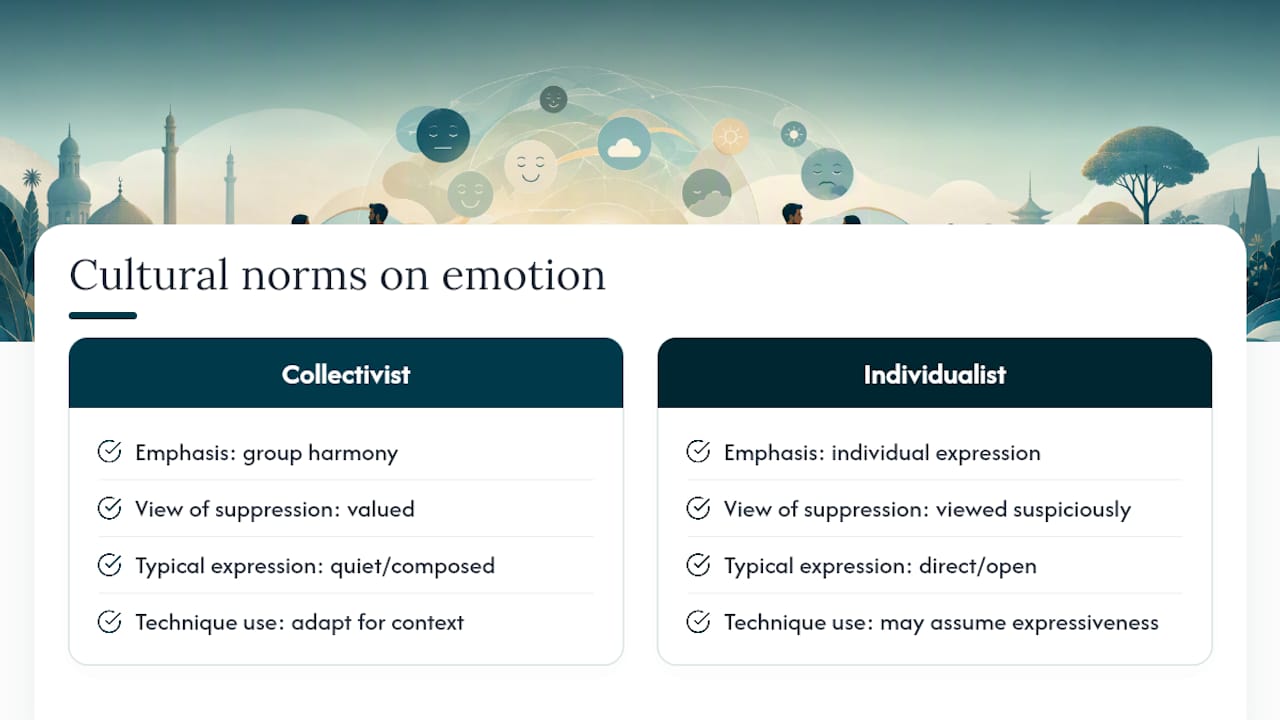
Collectivist cultures often emphasize emotional suppression in service of group harmony, where individual expression takes a back seat to not disrupting the people around you. Individualist cultures, more common across much of North America and Western Europe, tend to encourage direct expression and treat suppression with more suspicion, sometimes labeling it as unhealthy almost by default.
Neither framework is objectively correct, and treating Western expressive norms as the universal gold standard is a mistake clinicians increasingly try to avoid. A strategy that looks like avoidance through one cultural lens can function as appropriate context-sensitive regulation through another. The research base behind CBT, DBT, and mindfulness comes disproportionately from Western clinical settings, which means techniques sometimes need adaptation, not wholesale rejection, when applied elsewhere.
What holds steady across cultural lines is the underlying goal: keeping emotional responses from working against your own well-being or your relationships. How that goal gets pursued, through open expression, through quiet composure, through communal processing, varies. If a technique from this article feels culturally mismatched, the goal still applies even when the specific method needs adjusting to fit your context.
Myths That Get in the Way of Real Progress
Myth: Regulating emotions means not feeling them. This is probably the most damaging misconception out there. Regulation isn’t suppression, it’s changing the intensity, timing, or expression of a feeling so it doesn’t run the show. Numbing out or pushing feelings down often gets mistaken for successful regulation, but clinically it signals avoidance and nervous-system disengagement, and it tends to predict worse outcomes over time unless it gets addressed directly.
Myth: Some people are just naturally bad at this, permanently. Regulation capacity is shaped by genetics, environment, and history, but it’s a skill that strengthens with practice at any age. Struggling now says nothing about where you’ll be in a year of consistent practice.
Myth: Staying calm all the time is the goal. Constant calm isn’t regulation, it’s often disconnection. The actual goal is feeling the full range of emotion without it derailing your decisions or relationships.
Myth: If a technique doesn’t work instantly, it’s not working. Skills like cognitive reappraisal take repetition to become automatic. Expecting one attempt at STOP or paced breathing to fix a decade-old reactive pattern sets up the exact kind of disappointment that gets people to quit before the skill has a chance to take.
What Changes When You Practice Consistently
Emotion regulation practiced consistently doesn’t just make bad days feel less bad. It compounds. Recovery time after a stressful event tends to shrink from hours to minutes. Relationships stabilize because reactive outbursts stop being the default response to conflict. Sleep often improves, since less time gets spent lying awake replaying the day’s emotional wreckage, which then feeds back into better regulation the next day.
Maintaining that progress usually comes down to a few unglamorous habits repeated often enough to become automatic: naming emotions as they arise instead of after the fact, keeping a consistent sleep schedule, and revisiting distress-tolerance skills even during calm stretches so they’re ready when needed. A short daily check-in, even sixty seconds of noticing what you’re feeling and why, keeps the identification stage of the regulation process sharp. The Infinite Bath’s short mindfulness rituals are a good model for how brief this can be and still count.
Setbacks are part of the process, not evidence it failed. A bad week doesn’t erase months of practice; it just means the skill needs to be picked back up, not started from scratch.
The Real Gap Between Regulation Advice and What Actually Helps
Most advice on this topic oversells the calm-down trick and undersells the skill-building underneath it. Breathing exercises and the STOP technique work, but they’re triage. They buy you five minutes of clear thinking. What actually changes your baseline is the slower work: cognitive reappraisal practiced enough times that it becomes automatic, distress tolerance skills rehearsed before you need them in a crisis.
The conventional wisdom that “staying calm” is the goal misses the point entirely. I’d argue the better standard is recovery speed, not absence of reaction. Someone who gets angry and recovers in ten minutes is regulating better than someone who never looks upset but is quietly falling apart for three days.
If I had to pick one priority for someone starting from zero, it would be building the habit of naming the emotion the moment it shows up, out loud or in writing, before reaching for any technique to change it. Every strategy in this article works better once you know exactly what you’re regulating. Skip that step and even good tools get aimed at the wrong target.
— Ellory
This article is general information, not a substitute for advice from a qualified doctor. Consult a qualified healthcare professional about your own circumstances before acting on anything here.
Sources
- Self-regulation for adults: Strategies for getting a handle on emotions and behavior - Harvard Health
- Emotional Dysregulation: Signs, Causes & Treatment - Cleveland Clinic
- Emotional regulation strategies in daily life: the intensity of emotions and regulation choice - PMC
- Integrative review of emotion regulation models and interventions - Annual Review of Clinical Psychology
