
There is no FDA-approved over-the-counter medication for anxiety. What you will find on store shelves are dietary supplements and calming products marketed for stress and nervousness, and some people find them helpful for occasional, situational nerves. They are not substitutes for prescription treatment, and evidence for individual ingredients ranges from solid to thin. If you or your child takes medication, is pregnant or breastfeeding, or deals with anxiety that will not let up, talk to a clinician before trying anything new.
TL;DR:
- Dietary supplements marketed for nervousness do not require FDA approval and often lack consistent ingredient dosing or independent safety testing.
- Evidence supports only modest benefits from ingredients like L-theanine and kava, with safety risks such as kava’s potential liver toxicity.
- Choose products with transparent ingredient lists, third-party testing seals, and FDA disclaimers; avoid proprietary blends and unverified claims.
- Lifestyle habits like breathing exercises, grounding techniques, and good sleep habits often provide more reliable anxiety relief than supplements alone.
- Persistent or severe anxiety symptoms warrant professional evaluation, as supplements cannot replace clinical treatment for diagnosed anxiety disorders.
Table of Contents
- What “OTC Nervousness Medication” Actually Means
- Common OTC Supplements People Try for Nervousness
- Safety, Interactions, and How to Choose a Product
- Practical Habits That Calm Nervousness Without a Pill
- When Nervousness Might Be More Than Nerves
- Where Nutritional Support Fits Into the Picture
- The Gap Between the Marketing Shelf and the Evidence
- Sources
What “OTC Nervousness Medication” Actually Means
Search for “OTC nervousness medication” and you will land on products that look and act like medicine, packaged in capsules or tinctures with calming names. Legally, though, they occupy a different category entirely from anything a doctor prescribes.
Prescription anti-anxiety medications, such as SSRIs or benzodiazepines, go through clinical trials and FDA review for safety and effectiveness before they reach a pharmacy. Dietary supplements do not. The FDA does not pre-approve dietary supplements for safety or effectiveness before they hit shelves. A company can sell a “calming” capsule the day after formulating it, as long as the label avoids disease claims.
That legal boundary shapes what a label can and cannot say. Supplement makers can describe a “structure/function” benefit, something like “supports relaxation” or “promotes a calm mood.” They cannot legally claim to treat, cure, or prevent anxiety as a diagnosed condition. The FDA requires a specific disclaimer on any product making a structure/function claim, stating that the claim has not been evaluated by the FDA and the product is not intended to diagnose, treat, cure, or prevent any disease.
Before buying anything marketed for nervousness, run the label through this checklist:
- Does it name the active ingredient and exact dose per serving, not just a blend percentage?
- Is there a “not evaluated by the FDA” disclaimer? (If a product skips this and claims to treat anxiety, that is a red flag, not a selling point.)
- Does it list every other ingredient, including allergens like soy, gluten, or shellfish-derived compounds?
- Is there a third-party testing seal, such as USP or NSF, on the bottle?
Common OTC Supplements People Try for Nervousness
Here is where the evidence actually stands on the ingredients that show up again and again in calming supplements.
- L-theanine. This amino acid, found naturally in tea leaves, has the most consistent research behind it for acute stress. A 2026 meta-analysis of 31 randomized trials involving 1,168 participants found that a single 200 mg dose produced a modest reduction in acute stress, with an effect size (SMD) of 0.31. That is a real but limited signal, not a cure. Separate research on daily 200 mg doses over four weeks also found improvements in stress-related symptoms and sleep in healthy adults. L-theanine has a good safety profile, but product content varies widely between brands, so check the label against the 200 mg figure used in trials.
- Magnesium. Often marketed as a nervous system relaxant, magnesium’s evidence for anxiety specifically is mixed rather than strong. Supplemental doses in studies vary considerably, and most benefit shows up in people who are actually deficient rather than across the general population.
- Ashwagandha. This adaptogenic herb has some supportive evidence for stress reduction, with trial doses commonly falling between 250 and 600 mg per day. The research base is smaller than L-theanine’s and results vary by extract type.
- Omega-3 fatty acids. Fish oil shows some mood-support evidence for certain people, though the ratio of EPA to DHA in a given product matters more than the total fish oil dose, and results are inconsistent across studies.
- NAC, taurine, vitamin B6, and phosphatidylserine. These support neurotransmitter-related pathways involving glutamate, GABA, and cognitive stress response, but the research is early and dosing is not standardized. Treat any claims here as supportive, not definitive.
- Chamomile, valerian, kava, and CBD. Chamomile and valerian have traditional use and some small-study support for mild calming effects. Kava shows real anxiolytic benefit in trials, but carries a rare, serious risk of liver injury, which is why clinicians urge caution around kava for anyone with liver conditions. CBD’s regulation varies by product and jurisdiction, and it can interact with several medications, so it deserves the same scrutiny as any other active ingredient.
Safety, Interactions, and How to Choose a Product
A supplement being “natural” says nothing about whether it is safe for you specifically, especially if you take other medications.
Watch for interactions with antidepressants, blood thinners, and sedatives. St. John’s wort, for example, is notorious for interfering with SSRIs and blood thinners, and several calming herbs can amplify sedation when combined with sleep aids or anti-anxiety prescriptions. If you take any prescription medication, talk to a pharmacist or clinician before adding a supplement, not after.
When comparing products, favor ones with:
- A clearly labeled active ingredient and dose that matches what studies actually used
- A third-party testing seal (USP, NSF, or ConsumerLab)
- Full ingredient transparency, with no vague “proprietary blend” language
- The required FDA structure/function disclaimer
Start with one ingredient at a time rather than a multi-ingredient stack. If something causes an odd reaction, a single-ingredient approach tells you exactly what to stop.
Children need extra caution. Pediatric dosing is not simply a fraction of the adult dose, and most calming supplements were never studied in children at all. Never give a child an adult-formulated product, and always run any supplement decision by a pediatrician first.
Pro Tip: Keep a simple log for the first two weeks on any new supplement: date, dose, time of day, and how you felt a few hours later. It turns a guessing game into information you can actually bring to a doctor’s appointment.
Practical Habits That Calm Nervousness Without a Pill
Supplements work better as a supplement to good habits, not a replacement for them. Clinicians consistently point to lifestyle strategies as the foundation for managing everyday nervousness.
- Box breathing. Inhale for four counts, hold for four, exhale for four, hold for four. Repeat for two minutes before a stressful event, and your heart rate will usually drop noticeably.
- Grounding exercises. Name five things you can see, four you can touch, three you can hear. It interrupts a racing mind by forcing attention back into the present moment.
- Sleep hygiene and regular exercise. These are unglamorous, but they do more for baseline emotional stability than almost any supplement on this list.
- Brief cognitive reframing. Ask yourself what evidence actually supports the worst-case thought, and what you would tell a friend having the same worry.
- A pre-event routine. In the 30 to 60 minutes before a known stressor, like a big presentation or a flight, stack two or three of the above: a short walk, box breathing, then a grounding exercise right before you walk in.
When Nervousness Might Be More Than Nerves
Occasional nervousness fades once the stressful event passes. An anxiety disorder does not follow that pattern; it persists for weeks or months and interferes with work, relationships, or daily function. About one-third of U.S. adults and adolescents experience an anxiety disorder at some point, which tells you this is common, not a personal failing.
Watch for these signals that it is time to talk to a clinician:
- Panic attacks or physical symptoms severe enough to disrupt daily activities
- Avoiding places, people, or responsibilities because of anxiety
- Sleep disruption lasting more than a few weeks
- Any thoughts of self-harm, which need immediate attention
Bring a symptom diary and a full medication list to that first appointment. For parents worried about a child or teen, the same duration-and-interference rule applies. If school avoidance, sleep problems, or physical complaints (stomachaches, headaches) stretch past two or three weeks, a pediatrician or child psychologist is the right next step.
Where Nutritional Support Fits Into the Picture
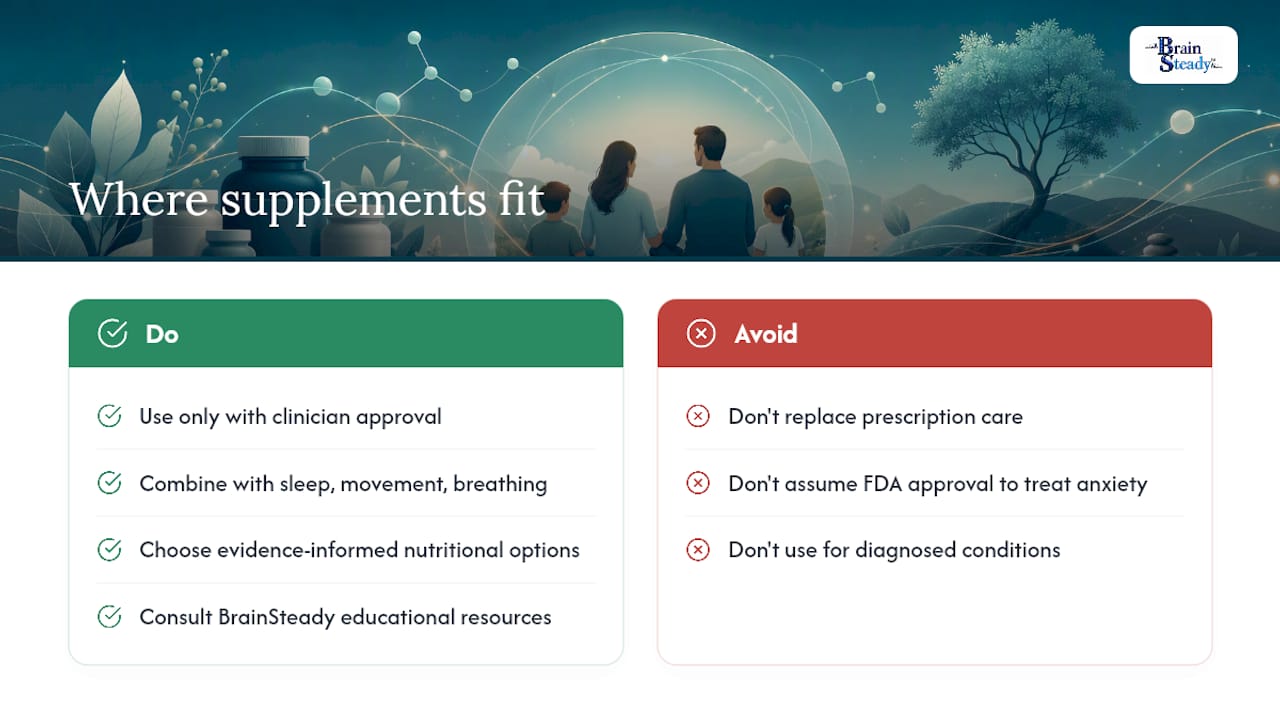
A particular supplement product line focuses on nutritional support for mood, focus, and emotional regulation rather than treatment of any diagnosed condition. Some formulations target neurotransmitter balance linked to calm and steady attention, based on research. None of this replaces prescription care, and none of it is FDA-approved to treat, prevent, or cure anxiety. If occasional nervousness is what you are managing, and your clinician has given the green light, BrainSteady’s educational resources are worth a look for anyone weighing evidence-informed nutritional options alongside good sleep, movement, and breathing habits.
The Gap Between the Marketing Shelf and the Evidence
The calming supplement aisle sells confidence more than it sells proof. Walk down it and you would think ashwagandha, magnesium, and a dozen proprietary blends have all cleared the same bar L-theanine has. They have not. L-theanine has a real, if modest, effect size behind a specific 200 mg dose. Several other popular ingredients rest on smaller studies, mixed results, or traditional use that has not been tested with the same rigor.
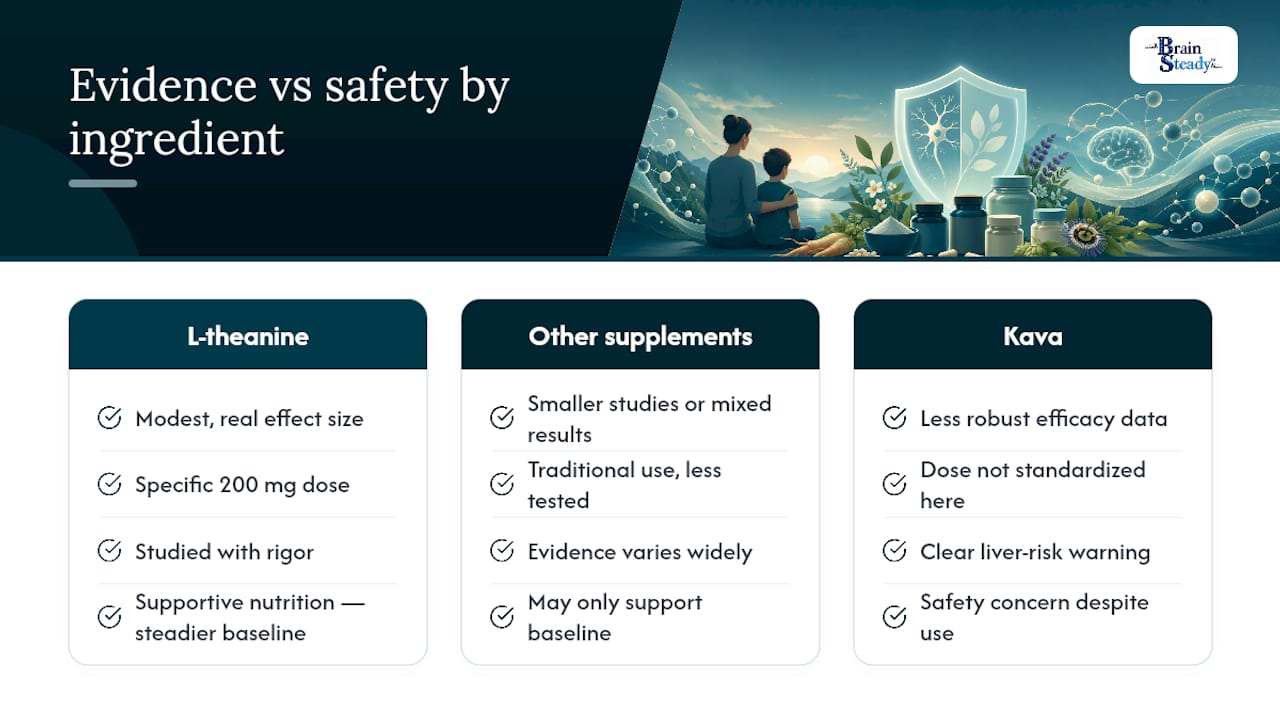
That gap does not mean skip supplements entirely. It means match your expectations to the evidence tier each ingredient actually sits in, and stop treating “natural” as a synonym for “harmless.” Kava’s liver risk is the clearest example of why that assumption fails. The ingredient with the best anxiolytic data on this entire list is also the one carrying the sharpest safety warning.
The more useful mental model is not “supplement versus medication.” It is “supportive nutrition versus clinical treatment.” One helps you build a steadier baseline. The other addresses a diagnosed condition under professional supervision. Confusing the two is where people either waste money on something too weak for what they are dealing with, or delay real care for a problem that needed it weeks ago.
— Ellory
This article is general information, not a substitute for advice from a qualified doctor. Consult a qualified healthcare professional about your own circumstances before acting on anything here.
Sources
- Anxiety disorders - National Institute of Mental Health (NIMH)
- Dietary supplements: Fact sheet for consumers — NIH ODS
- Questions and answers on dietary supplements — FDA
- Anxiety - Diagnosis and treatment — Mayo Clinic
