
For most people whose anxiety disrupts daily life, effective anxiety problems treatment means psychotherapy (often cognitive behavioral therapy), medication when clinically warranted, or both together, paired with supportive daily habits. The right combination depends on the person’s age, symptom severity, health history, and how much anxiety is interfering with school, work, or relationships. Occasional worry rarely needs formal care. Persistent, life-disrupting anxiety does, and a licensed clinician should help build that plan.
TL;DR:
- Medication like SSRIs and SNRIs are typically first-line for moderate to severe anxiety, requiring four to twelve weeks for full effect and carrying potential side effects.
- Cognitive behavioral therapy, especially exposure techniques, is the most researched psychotherapy, with treatment courses often lasting 12 to 20 sessions and involving active homework.
- Combining therapy and medication usually yields better results for complex or long-standing anxiety, but mild cases might improve with just self-help or brief therapy.
- Lifestyle changes such as consistent sleep, regular movement, and controlled breathing techniques can support treatment but are not substitutes for professional care.
- Supplements like BrainSteady should be discussed with a healthcare provider before use, as they support brain health but do not replace diagnosis or prescribed treatments.
Table of Contents
- What Are the Main Approaches to Anxiety Problems Treatment?
- Which Therapy Actually Helps With Anxiety Symptoms?
- What Medications Treat Anxiety, and What Are the Risks?
- What Daily Habits Actually Reduce Anxiety Symptoms?
- How Do You Build an Anxiety Treatment Plan That Works?
- Where BrainSteady Fits Into Anxiety Support
- A Closing Note on Getting Help
- Try BrainSteady as an Everyday Support for Mood and Focus
- Sources
- FAQ
What Are the Main Approaches to Anxiety Problems Treatment?
Anxiety disorders respond to three broad approaches: psychotherapy, pharmacotherapy, or a combination of the two, according to a clinical review published through the National Institutes of Health. Cognitive behavioral therapy stands out as the first-line psychotherapy across most anxiety subtypes, while SSRIs and SNRIs are typically the first medications a prescriber considers.
Therapy works by changing the thought patterns and avoidance behaviors that keep anxiety running in a loop. Medication works differently. It adjusts brain chemistry to lower the baseline intensity of anxious symptoms, which can make therapy easier to engage with in the first place. Neither approach is inherently better. The choice depends on symptom severity, the person’s preferences, access to a trained therapist, and whether anxiety co-occurs with depression, ADHD, or another condition that complicates treatment selection.
Combination therapy tends to get recommended when anxiety is moderate to severe, when there’s a co-occurring condition, or when someone hasn’t responded well to therapy or medication alone. Research on anxiety treatment outcomes generally finds that combining the two produces better results than either one in isolation for more severe presentations. That doesn’t mean everyone needs both. Someone with mild social anxiety might do well with a structured exposure protocol and nothing else. Someone with panic disorder that’s kept them from driving for six months may need medication just to make exposure work tolerable.
Self-help and lifestyle measures round out the picture, but they play a supporting role, not a starring one, for anyone whose anxiety meets criteria for a disorder. They matter. They just aren’t a substitute for professional care once anxiety has crossed the line from uncomfortable to disabling.
A rough map of how these pathways typically get matched to severity:
- Mild, situational anxiety: Self-help strategies, lifestyle adjustments, and sometimes brief, structured therapy.
- Moderate anxiety with clear triggers: Psychotherapy, most often CBT or exposure-based work, as the primary intervention.
- Moderate to severe anxiety, or anxiety with comorbid depression: Combination of psychotherapy and medication, with closer follow-up.
- Severe or treatment-resistant anxiety: Psychiatric evaluation, medication adjustment, and specialized therapy protocols, sometimes with more frequent sessions.
Age matters too. A guideline summary for treating anxiety in children and adolescents recommends developmentally tailored exposure techniques and often calls for coordination with schools when anxiety affects attendance or academic performance. A ten-year-old with separation anxiety needs a different plan than a 45-year-old with generalized anxiety disorder, even if both technically qualify for CBT.
Which Therapy Actually Helps With Anxiety Symptoms?
Cognitive behavioral therapy remains the most researched and most broadly effective psychotherapy for anxiety, and it isn’t one technique. It’s a toolbox, and which tools get used depends on the specific anxiety subtype.
Cognitive restructuring targets the distorted thoughts that fuel anxiety: catastrophizing, mind reading, all-or-nothing thinking. A therapist helps the patient identify these patterns, challenge them, and replace them with more accurate assessments. Thought records are the homework version of this. Patients write down the anxious thought, the evidence for and against it, and a more balanced alternative. It sounds simple. It’s also one of the most consistently effective parts of CBT for generalized anxiety.
Behavioral experiments take restructuring a step further by testing the anxious prediction in real life. Someone convinced a work presentation will go badly might be asked to give it and then compare the actual outcome to the feared one. The gap between prediction and reality is often the therapeutic payload.
Exposure therapy deserves its own explanation because it isn’t one thing:
- In-vivo exposure puts the person directly in the feared situation, gradually and repeatedly, until the anxiety response fades. This is the backbone of treatment for specific phobias and social anxiety disorder.
- Interoceptive exposure deliberately triggers the physical sensations of panic, like a racing heart or shortness of breath, in a controlled setting, so the person learns those sensations aren’t dangerous. This is considered a core active ingredient for panic disorder, not an optional add-on.
- Imaginal exposure uses vivid mental visualization when the feared scenario can’t easily be recreated in real life, common in PTSD-adjacent anxiety and some phobia work.
For social anxiety disorder specifically, exposure protocols paired with cognitive restructuring around perceived judgment tend to outperform either technique alone. For phobias, exposure alone often does the heavy lifting.
Acceptance and commitment therapy (ACT) and mindfulness-based approaches offer a different angle. Some patients respond better to this than to cognitive restructuring, especially those who find “arguing with their brain” exhausting or who have tried CBT before without full success. Mindfulness-based stress reduction and mindfulness-based cognitive therapy borrow similar principles and often get layered on top of standard CBT rather than replacing it.
Pro Tip: Ask your therapist which specific technique they’re using in a given session, not just the modality name. “We’re doing CBT” tells you less than “we’re doing interoceptive exposure for your panic symptoms this week.” Naming the active ingredient helps you track what’s actually changing.
Session expectations vary by subtype and severity, but a typical structured CBT course for anxiety runs somewhere between 12 and 20 sessions, often weekly. Specific phobias sometimes resolve faster with intensive exposure. Generalized anxiety disorder with long-standing worry patterns often takes longer. Homework between sessions, thought records, exposure practice, breathing drills, isn’t optional extra credit. It’s where a large share of the actual change happens.
Progress gets tracked with validated measures rather than gut feeling. The GAD-7 questionnaire is standard for generalized anxiety, the PDSS (Panic Disorder Severity Scale) for panic disorder, and the LSAS (Liebowitz Social Anxiety Scale) for social anxiety. A SUDS hierarchy (Subjective Units of Distress Scale, rated 0 to 100) tracks exposure progress session by session, showing the anxiety curve dropping as exposures repeat.
What Medications Treat Anxiety, and What Are the Risks?
SSRIs (selective serotonin reuptake inhibitors) and SNRIs (serotonin-norepinephrine reuptake inhibitors) are considered first-line medication for most anxiety disorders, including generalized anxiety disorder and panic disorder, according to NIMH guidance on GAD treatment. They don’t work instantly. Most people need four to six weeks before noticing meaningful improvement, and a full effect can take up to eight to twelve weeks. Common side effects early on include nausea, headache, and sleep disruption, most of which fade as the body adjusts.
Benzodiazepines work fast, sometimes within thirty minutes, which makes them tempting for acute panic. That speed is also the problem. Regular use carries real risk of dependence and tolerance, so most prescribers reserve them for short-term or as-needed use, not as a long-term anxiety solution. Clinical guidance on panic disorder treats benzodiazepines as a bridge medication, useful while an SSRI takes effect, rather than a standalone plan.
Buspirone is a non-habit-forming option sometimes used for generalized anxiety, particularly when a prescriber wants to avoid benzodiazepine risk or is treating someone with a history of substance use. Beta-blockers, originally developed for heart conditions, are sometimes prescribed off-label for the physical symptoms of situational anxiety, like a racing heart before public speaking, though they don’t touch the psychological worry itself.
Here’s a quick reference for how these classes typically get used:
- SSRIs/SNRIs: First-line, daily use, four to six weeks for initial effect, best for ongoing management.
- Benzodiazepines: Fast-acting, short-term or situational use, dependence risk with regular long-term use.
- Buspirone: Non-habit-forming alternative for generalized anxiety, slower onset.
- Beta-blockers: Situational use for physical symptoms, not a treatment for the underlying worry.
Interoceptive exposure and breathing retraining are often used alongside medication for panic disorder rather than instead of it, since the physical calming from medication can make exposure work more tolerable.
Anyone taking a dietary supplement alongside prescribed medication needs to loop their prescriber in first. The FDA warns explicitly that supplements can interact with prescription drugs and change how potent those drugs are in the body, sometimes dangerously. This applies to herbal products, high-dose vitamins, and nutritional formulas alike, not just prescription-to-prescription combinations.
Many American adults have taken some form of anxiety medication or therapy in a given year according to national mental health surveillance data, though the exact figures shift depending on how “treatment” is defined and which year’s survey you’re looking at. What’s consistent across the research is the follow-up pattern: most prescribers want a check-in within four to six weeks of starting a new medication, then periodic reviews every few months once a stable dose is found. If symptoms haven’t improved by the eight-to-twelve-week mark, that’s the signal to re-evaluate the plan, not to assume medication doesn’t work for anxiety in general.
What Daily Habits Actually Reduce Anxiety Symptoms?
Sleep deprivation and anxiety feed each other in both directions. Poor sleep raises next-day anxiety sensitivity, and anxiety makes it harder to fall and stay asleep. Consistent sleep and wake times, even on weekends, do more for anxiety regulation than almost any other single lifestyle change available without a prescription.
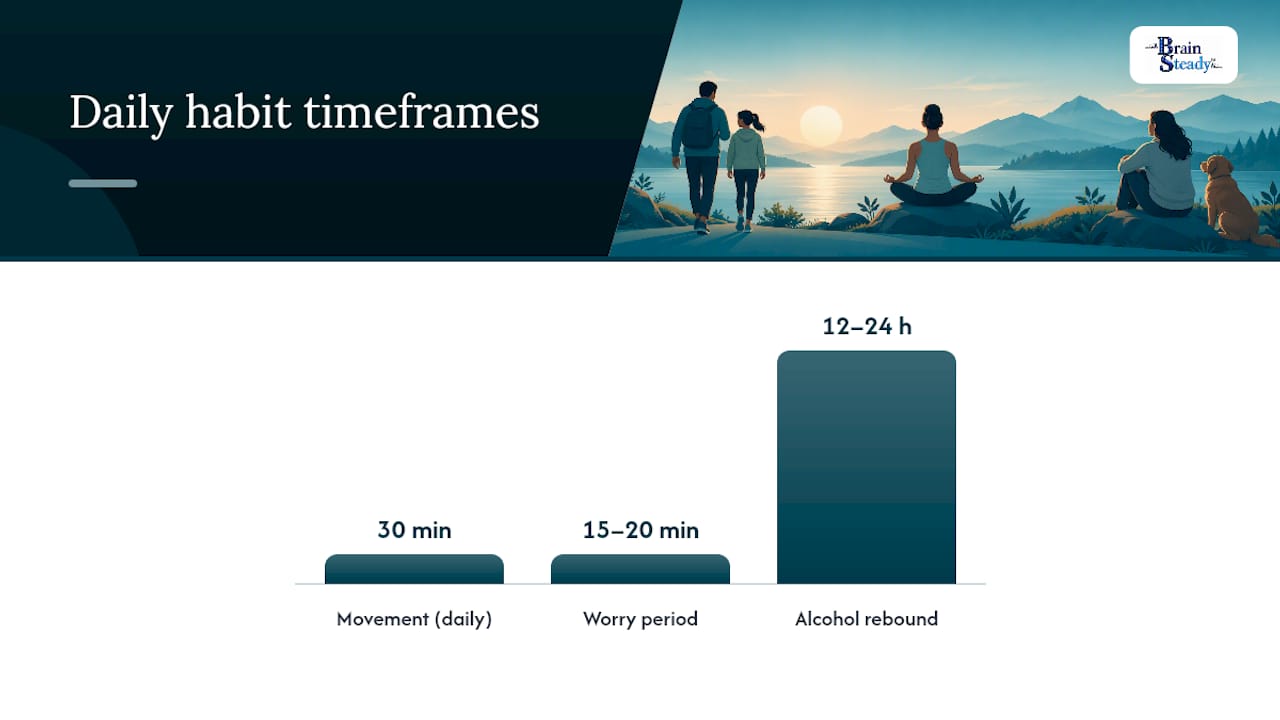
Regular physical activity lowers baseline anxiety through several overlapping mechanisms, including improved stress hormone regulation and better sleep quality. It doesn’t need to be intense. Thirty minutes of brisk walking most days produces measurable benefit, and for people who find high-intensity exercise itself anxiety-provoking, movement-based approaches aligned with broader fitness guidance, like these NHS-informed anxiety relief techniques, offer a gentler entry point.
Caffeine and alcohol both deserve scrutiny. Caffeine mimics the physical sensations of anxiety, a racing heart, jitteriness, which can trigger panic-like symptoms in people already prone to them. Alcohol calms anxiety in the short term and then rebounds it, often within twelve to twenty-four hours, which is part of why it’s a poor long-term coping strategy.
A short list of the highest-yield daily supports:
- Fixed sleep and wake times, even on days off.
- Thirty minutes of movement most days, walking counts.
- Reduced caffeine, especially in the afternoon.
- Slow, diaphragmatic breathing during acute anxiety spikes.
- A dedicated, time-limited “worry period” instead of worrying all day.
- Predictable daily routines that reduce decision fatigue.
Breathing techniques work faster than most people expect. Slow, controlled breathing counters the hyperventilation pattern that drives panic symptoms, and clinical research on panic disorder links slow-breathing training to measurable reductions in panic frequency. Progressive muscle relaxation, tensing and releasing muscle groups in sequence, and grounding techniques, naming five things you can see or feel, work through a similar calming pathway. Structured worry time, setting aside fifteen or twenty minutes a day specifically to worry, then redirecting intrusive worry thoughts outside that window, is a technique borrowed from CBT that many people can use without a therapist’s supervision. Reducing daily overwhelm through predictable routines matters more than it sounds. A practical checklist for managing stress and overwhelm can help make these routines concrete rather than aspirational.
Pro Tip: If your anxiety spikes are unpredictable, try tracking triggers for two weeks in a simple notes app. Most people find a pattern, poor sleep the night before, skipped meals, a specific type of meeting, that they can then plan around.
Some adults and parents look into nutritional supplements as part of a broader support routine. That’s reasonable as an adjunct, but it comes with a caveat worth repeating: any supplement should be discussed with a prescriber first, since combining supplements with medication carries real interaction risk. Supplements support; they don’t replace diagnosis or treatment.
How Do You Build an Anxiety Treatment Plan That Works?
A treatment plan that’s actually built to work names four things specifically: the anxiety subtype, measurable goals, the exact techniques being used, and a timeline for reviewing progress. Vague plans (“work on anxiety in therapy”) are harder to evaluate than specific ones (“reduce GAD-7 score from 15 to under 10 within eight weeks using cognitive restructuring and weekly exposure homework”).
- Name the subtype. Generalized anxiety, panic disorder, social anxiety, and specific phobias respond to overlapping but distinct techniques. A plan built around the wrong subtype wastes time.
- Set SMART goals. Specific, measurable, achievable, relevant, time-bound targets, tied to symptom reduction or functional improvement (returning to work, tolerating a specific trigger), give both patient and clinician something concrete to check progress against.
- Choose validated measures. The GAD-7 tracks generalized anxiety, the PDSS tracks panic disorder severity, and the LSAS tracks social anxiety. A worked treatment plan template by subtype shows how these measures attach to specific goals.
- Set a review cadence. Re-administering the relevant measure every four to six weeks early in treatment catches a plan that isn’t working before months get wasted on it.
- Define discharge criteria. What does “better” look like, and how will both patient and clinician know when formal treatment can step down in intensity?
When interviewing a potential therapist or psychiatrist, a short list of questions clarifies fit fast: What specific techniques do you use for my anxiety subtype? How many sessions before we’d expect to see change? What does homework look like between sessions? If medication is on the table, what’s the plan if the first one doesn’t work? What’s your protocol if I’m in crisis between sessions?
Access to care doesn’t require a single path. A primary care provider can prescribe first-line medication and refer out for therapy. Psychiatrists handle more complex medication management, especially with comorbid conditions. Psychologists and licensed therapists deliver the structured psychotherapy itself. Telehealth has made specialized exposure-based therapy far more available for people in areas without a local specialist, and group programs offer a lower-cost, peer-supported option for milder presentations. Stepped care, starting with the least intensive option and escalating only if needed, is a reasonable framework for mild to moderate symptoms, though anyone with safety concerns should skip straight to a full evaluation.
Where BrainSteady Fits Into Anxiety Support
BrainSteady supplements offer nutritional support for mood, focus, and emotional balance, but they are not medication and not a treatment for anxiety disorders. They exist to support everyday brain health alongside whatever clinical care a person or family already has in place, not instead of it.
The educational content on the site reflects that same boundary. Resources like the comprehensive guide to developing an anxiety treatment plan walk through measurement-based care, SMART goals, and review cadence in more depth for parents and caregivers who want to understand what a solid plan looks like before they sit down with a clinician.
A few things worth keeping straight when supplements enter the picture:
- Nutritional support is not a substitute for diagnosis, therapy, or prescribed medication.
- Any supplement, BrainSteady included, should be discussed with a prescriber before combining it with existing medication, given documented interaction risks between supplements and drugs.
- Formulas differ by age group, and choosing the right one matters as much as choosing to use one at all.
For readers building a broader safe-use plan around over-the-counter options and supplements, the 6 to 8 week safe OTC plan for mild anxiety breaks down what’s reasonable to try before escalating to a clinical evaluation.
A Closing Note on Getting Help
Anxiety treatment rarely moves in a straight line, and that’s normal, not a sign that something’s broken. The first therapy approach or medication doesn’t always fit, and adjusting course based on a GAD-7 score or a PDSS trend isn’t failure, it’s exactly how measurement-based care is supposed to work. Give a plan real time before judging it, but don’t wait indefinitely if a measure isn’t moving after two or three review cycles.
What matters most is that someone, a primary care provider, a therapist, a psychiatrist, is actually tracking progress with you, not guessing. Anxiety problems treatment works best as a collaboration, not a solo project.
If anxiety ever comes with thoughts of self-harm, or if a situation feels unsafe right now, that’s not a wait-and-see moment. Contact a crisis line, go to an emergency department, or call emergency services immediately.
— Ellory
Try BrainSteady as an Everyday Support for Mood and Focus
BrainSteady’s nutritional support is available in various forms to fit different household preferences, without requiring a commitment to a single format before trying. Capsules or liquid, single bottle or value pack, one formula for adults and separate age-specific liquid options for kids and teens.
The SNAP BrainSteady Capsules collection covers flexible options, including a single bottle of 90 capsules, a 2 bottle value pack starting from $74.95, and a 3 bottle value pack for households that want a longer supply on hand. For teens, the liquid formula for ages 13 and up offers a non-capsule option, while the BrainSteady Liquid Formula collection, starting from $34.95, includes age-specific versions for younger kids, including ages 9 to 12 and ages 4 to 8. The family-focused option is built for parents supporting more than one person at home.
If anyone in your household is currently on prescribed medication, talk to their prescriber before adding a supplement, since supplement-drug interactions are a real and documented risk. Browse the capsule and liquid options to find the format that fits your family, then check in with your clinician before you start.
Sources
- Treatment of anxiety disorders - PMC - NIH
- Generalized anxiety disorder (GAD) treatment guidance - NIMH
- Mixing medications and dietary supplements can endanger your health - FDA
- Panic Disorder - StatPearls - NCBI Bookshelf
FAQ
How Do You Overcome an Anxiety Disorder?
There’s no single fix, but the most reliable path combines evidence-based psychotherapy, most often CBT with exposure elements, medication when symptoms are moderate to severe, and consistent daily habits like sleep regulation and movement. Research on anxiety treatment outcomes shows combination approaches typically outperform either method alone for more severe presentations. Progress tends to happen gradually and gets tracked with measures like the GAD-7 rather than judged by how someone feels on any given day.
What Are the Common Symptoms of an Anxiety Attack?
An anxiety or panic attack typically involves a racing heart, shortness of breath, chest tightness, dizziness, sweating, and a sense of impending danger or loss of control. These physical symptoms often peak within ten minutes and then subside, even without intervention. Interoceptive exposure, a technique used in structured panic disorder treatment, specifically targets these sensations by helping people learn they aren’t dangerous.
How Do You Get Diagnosed With Anxiety?
Diagnosis starts with a primary care provider or mental health professional, who evaluates symptoms against clinical criteria and often uses a screening tool like the GAD-7 to gauge severity. There’s no blood test or scan for anxiety disorders. It’s a clinical evaluation based on symptom pattern, duration, and how much daily functioning is affected. Bring a list of specific situations that trigger anxiety and how long symptoms have been present. It speeds up an accurate diagnosis.
How Do You Stop Overthinking?
Structured worry time, setting aside a fixed fifteen to twenty minute window each day to worry deliberately, then redirecting intrusive thoughts outside that window, is one of the more effective CBT-derived techniques for chronic overthinking. Pairing it with thought records, writing down the anxious thought and testing it against evidence, breaks the automatic loop over time. For overthinking that’s persistent and interferes with sleep or daily function, that’s usually a sign it’s crossed from occasional worry into something worth discussing with a therapist.
Is There a Difference Between Occasional Anxiety and an Anxiety Disorder?
Yes. Occasional anxiety is a normal response to stress, a job interview, a big exam, and it fades once the situation passes. A persistent anxiety disorder involves excessive worry or fear that continues for weeks or months, interferes with work, school, or relationships, and doesn’t resolve on its own. If anxiety is affecting sleep, attendance, or relationships most days for more than a few weeks, that’s the point to seek a professional evaluation rather than wait it out.
