
Most healthy children who eat a varied diet don’t need a daily multivitamin, and giving one anyway isn’t risk-free. The real danger with supplement side effects in kids comes from four places: accidental overdose from gummies that look like candy, fat-soluble vitamin buildup (A and D especially), melatonin and certain herbs, and interactions with prescription medicine.
If you’re already worried about something your child took:
- Stop giving the product immediately.
- Check the label for exact ingredients and dosage per serving.
- Call your pediatrician or a poison control center, and bring the container with you to any visit.
Gummy vitamins are the single most common route to accidental pediatric overdose, according to the NCCIH, simply because kids can’t tell them apart from candy.
Key Takeaways
Most supplement harm in children comes from preventable causes: accidental overdose, fat-soluble vitamin buildup, and unsupervised combination use rather than the ingredients themselves being inherently dangerous.
| Point | Details |
|---|---|
| Most kids don’t need supplements | A varied diet covers nutrient needs for most healthy, growing children without added products. |
| Fat-soluble vitamins accumulate | Vitamins A, D, E, and K build up in the liver and fat, unlike water-soluble vitamins, raising chronic toxicity risk. |
| Gummies drive accidental overdose | Candy-like formats are the leading cause of unintentional pediatric supplement ingestion; store them like medicine. |
| No premarket safety approval exists | The FDA regulates supplements as food, so mislabeling and contamination are documented, ongoing risks. |
| Brain-health supplementation needs its own review | Snapbrainformula’s evidence-informed resources support, but never replace, pediatrician guidance for mood and focus concerns. |
Table of Contents
- Common Side Effects Of Vitamins In Kids By Supplement Type
- Why Do Kids React Differently To Supplements Than Adults?
- Are Supplements Regulated The Same Way As Medicine?
- What Should You Do If Your Child Swallows Too Much?
- When Are Supplements Actually Appropriate For Children?
- A Safe-Use Checklist Before You Buy Anything
- Where Snapbrainformula Fits Into Safe, Informed Supplementation
- How Do You Report A Bad Reaction To A Supplement?
- What Parents Get Wrong About Supplement Safety
- A Smarter Starting Point For Brain-Focused Supplementation
- Sources
Common Side Effects Of Vitamins In Kids By Supplement Type
Different supplement classes cause different problems, and knowing which symptom maps to which product saves you a frantic guessing game later.
Fat-soluble vitamins (A, D, E, K) build up in the liver and fat tissue instead of flushing out in urine like water-soluble vitamins do. That accumulation is what makes them uniquely risky. The Pediatrics in Review journal documents toxicity effects ranging from nausea and headaches to hepatomegaly (an enlarged liver) and hypercalcemia (excess calcium in the blood), which can affect growth over time.
Iron and zinc typically cause milder, more immediate symptoms: stomach upset, constipation, or diarrhea. Iron is the exception that turns serious fast. Iron overdose in a small child can cause bloody stools and organ injury, and it’s one of the leading causes of pediatric poisoning deaths tied to household products.
Melatonin side effects usually show up the next morning: grogginess, headaches, or unexpected agitation. What worries pediatric researchers more is what’s still unknown. Melatonin is a hormone, and its long-term effects on puberty and endocrine development in children haven’t been well studied.
Probiotics are generally mild, usually just gas or bloating, but they carry a real exception. In children with compromised immune systems, probiotics have been linked to rare but serious bloodstream infections.
Herbal and stimulant blends are the wild card. Depending on the ingredient, these have been tied to cardiac arrhythmia, seizures, or liver injury, especially in products never intended for children in the first place.
Why Do Kids React Differently To Supplements Than Adults?
A child’s smaller body mass changes everything about how a dose behaves. An adult dose split “in half” for a kid isn’t necessarily half as risky. It’s a matter of dose-per-kilogram, and most supplement labeling doesn’t do that math for you.
Fat-soluble vitamins compound the problem. They accumulate over weeks in the liver and fat, so a child can look fine for days and then develop chronic toxicity that a single water-soluble overdose would never cause. On top of that, most supplements simply haven’t been through pediatric clinical trials, so the long-term developmental picture, hormone effects, growth effects, is often a blind spot.
Pro Tip: When a supplement is genuinely recommended, use the FDA’s age-specific Daily Values for children under four as your baseline, not the adult label math.
Are Supplements Regulated The Same Way As Medicine?
No, and this is the gap most parents don’t realize until it matters. The FDA treats dietary supplements as food, not drugs. That means no premarket approval process for safety or effectiveness. Manufacturers are responsible for their own safety claims, and the FDA only steps in after a product is shown to cause harm.
That gap has consequences. Independent investigations have found supplements, particularly weight-loss and performance products, mislabeled, contaminated with heavy metals, or spiked with prescription drugs never listed on the packaging.
Before you buy anything:
- Add up total nutrient intake from fortified cereals, drinks, and any supplements combined, not just the supplement alone.
- Look for third-party certification such as NSF on the label.
- Confirm the label lists an age-appropriate dose, not just an adult serving size.
What Should You Do If Your Child Swallows Too Much?
Gummies and chewables are designed to taste good, which is exactly the problem. A bottle left on a counter looks and smells like a bag of fruit snacks to a four-year-old.
Watch for these emergency signs: persistent vomiting, severe abdominal pain, bloody stools, seizures, extreme drowsiness, or trouble breathing. Any one of them means it’s time to act, not wait and see.
- Call your local poison control center right away, or your pediatrician if symptoms are mild.
- Follow their instructions exactly, don’t guess at home remedies.
- Bring the product bottle and label with you to the ER or the call, so the exact ingredients and dose are on hand.
Pro Tip: Store all supplements the same way you’d store prescription medicine, in a child-resistant container, up high, out of sight. “Out of reach” alone isn’t enough for a determined toddler.
When Are Supplements Actually Appropriate For Children?
Supplements make sense when a clinician has documented an actual deficiency, iron deficiency anemia or a confirmed vitamin D shortfall, for example, or prescribed something therapeutic for a diagnosed condition. That’s a different situation entirely from giving a well-nourished child a daily gummy multivitamin just in case.
For kids eating a varied diet and growing normally, routine multivitamins add little benefit and carry real downside: GI upset at high doses, plus potential interactions with medications your child already takes.
- Melatonin should not become a nightly habit without medical supervision.
- Teens should avoid stimulant or “performance” supplements marketed for bodybuilding or rapid weight loss, categories where contamination risk runs highest.
- If you’re unsure whether your child’s diet already covers their needs, that’s a pediatrician conversation, not a guessing game at the pharmacy aisle.
A Safe-Use Checklist Before You Buy Anything
Run through this before a bottle ever enters your house:
- Confirm actual medical need with your pediatrician, using bloodwork if a deficiency is suspected.
- Choose a product formulated and dosed for your child’s specific age group, not a scaled-down adult version.
- Calculate total daily intake across fortified foods and any supplements combined, not each item in isolation.
- Favor third-party tested brands and skip anything containing undeclared herbs or stimulant blends.
- Store the product securely, label the start date, and log any symptoms that appear afterward.
Pro Tip: Keep a simple note on your phone: supplement name, dose, start date. If a symptom shows up two weeks later, that log turns a mystery into a five-minute conversation with your pediatrician.
If your child’s needs are more about focus, mood regulation, or emotional balance than a specific nutrient deficiency, that’s a distinct conversation. Brain-targeted supplements formulated for that purpose work differently than a general multivitamin and deserve their own safety review with your child’s doctor.
Where Snapbrainformula Fits Into Safe, Informed Supplementation
Snapbrainformula focuses on evidence-informed education around brain health, ADHD, anxiety, and emotional regulation, not blanket supplementation advice. Clinician oversight still matters most; our content is meant to sit alongside that, not replace it. For calming and sleep-related supplement questions specifically, our guide to natural calming supplements walks through safety considerations parents often miss.
How Do You Report A Bad Reaction To A Supplement?
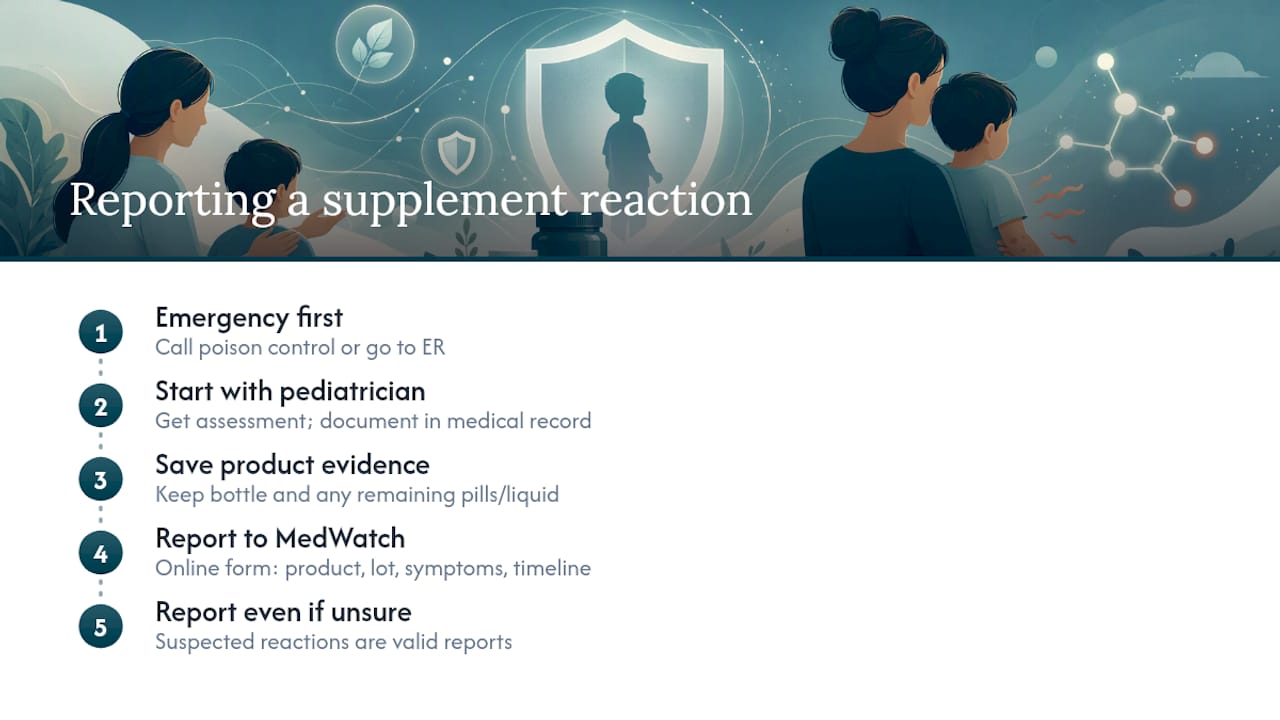
If your child has a reaction, mild rash, stomach upset that won’t quit, something more serious, report it even if you’re not sure it was the supplement. The FDA and consumer safety systems rely almost entirely on parents and clinicians flagging problems after the fact, since there’s no premarket testing catching these issues first.
Start with your pediatrician. Getting a professional assessment matters more than the report itself, and your doctor can document the reaction properly in your child’s medical record, which matters if a pattern emerges later.
Then report it through MedWatch, the FDA’s adverse event reporting system for foods, supplements, and drugs. It’s a straightforward online form: product name, lot number if you have it, symptoms, and timeline. You don’t need a diagnosis confirmed first. Suspected reactions are exactly what the system is built to catch.
If the reaction was severe, difficulty breathing, seizures, loss of consciousness, call poison control or go to the emergency room first. Reporting comes after your child is stable, not instead of getting care.
Keep the product bottle and any remaining pills or liquid until you’ve made the report. Investigators sometimes need the actual lot number to trace whether other children reported similar problems with the same batch. Manufacturers occasionally issue quiet recalls based on exactly this kind of parent-driven reporting, since the FDA has no independent testing requirement forcing that transparency upfront.
What Parents Get Wrong About Supplement Safety
The conventional advice on this topic tends to stop at “ask your doctor first,” which is true but incomplete. It treats supplement safety as a single decision point instead of an ongoing tracking problem. The bigger failure I see in how this topic gets discussed is that parents monitor the supplement bottle, not the child’s total intake. Fortified cereal at breakfast, a vitamin gummy at lunch, and a probiotic at dinner can quietly stack toward an upper limit no single product label would ever warn you about.
What deserves more attention than it gets: the format problem. A pill that looks like medicine gets treated with caution. A gummy that looks like candy doesn’t, even when it carries the same fat-soluble vitamin dose. That’s a labeling and packaging failure as much as a parenting one.
If you take one thing from this article, make it the running list, not the one-time doctor visit. Write down what your child takes, when, and how much. That habit catches problems the label never will.
— Ellory
A Smarter Starting Point For Brain-Focused Supplementation
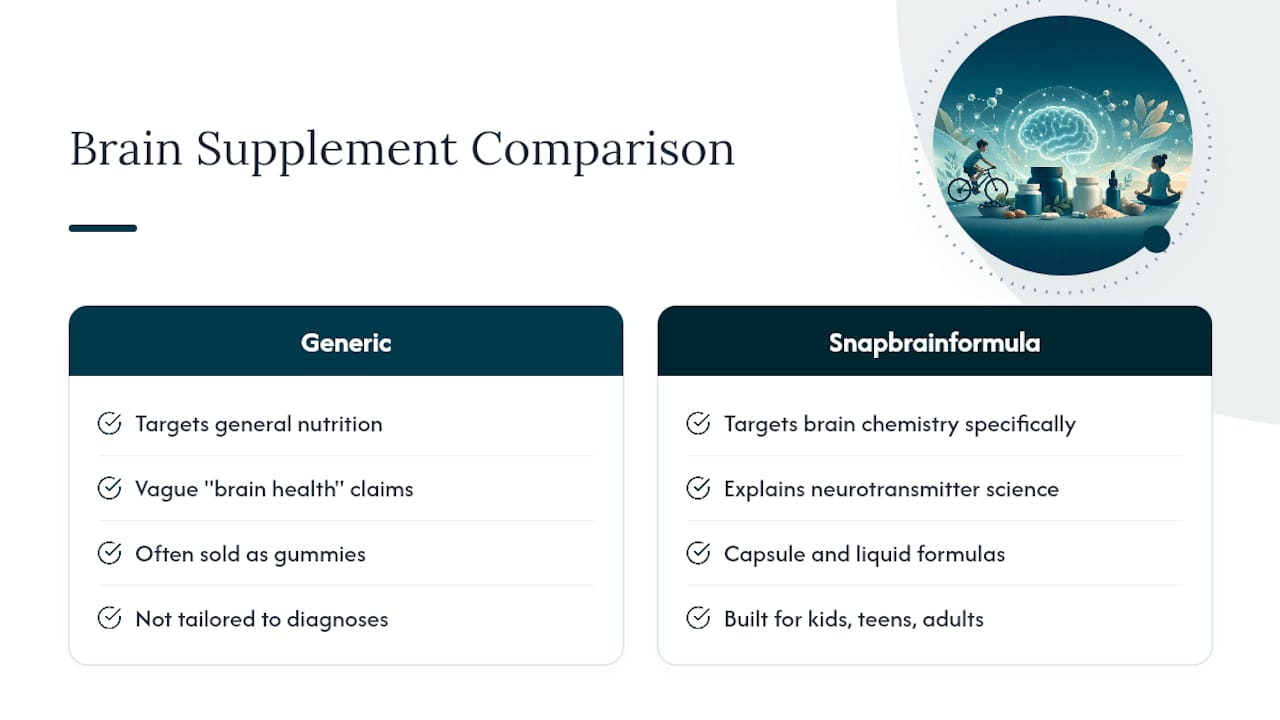
If you’ve read this far because you’re weighing whether a supplement could help your child’s focus, mood, or emotional regulation, generic multivitamin advice won’t get you there. Snapbrainformula was built specifically around brain chemistry, not general nutrition, with formulas designed for kids, teens, and adults navigating ADHD, anxiety, and executive functioning challenges.

What sets this approach apart from grabbing a random gummy off a shelf is the specificity. Snapbrainformula’s capsule and liquid formulas target mood and focus support directly, paired with educational content that explains the neurotransmitter science behind why a given ingredient is included, not just a vague “brain health” claim on a label. That transparency matters more once you know how many products on the market skip it entirely.
If your child’s challenges look more behavioral than nutritional, our guide on building routines for neurodevelopmental differences is worth reading alongside any supplement decision. When you’re ready to look at formulas built for this specific purpose, visit Snapbrainformula to see which option fits your child’s needs, and bring it to your pediatrician before you start.
This article is general information, not a substitute for advice from a qualified doctor. Consult a qualified healthcare professional about your own circumstances before acting on anything here.
Sources
- Fat-soluble vitamins: deficiency and excess — Pediatrics in Review
- Use of dietary supplements by children and adolescents — PMC
- Multivitamins: Do young children need them? — Mayo Clinic
- Things to know about dietary supplements for children and teens — NCCIH
Recommended
- How to Build Effective Routines for Children with Neurodevelopmental Disorders – SNAP Brain Health Supplements
- Top 7 Brain Supplements to Support Neurotransmitter Balance – SNAP Brain Health Supplements
- Top 7 Supplements to Ease Your Anxiety Effectively – SNAP Brain Health Supplements
- 10 Supplements to Help Calm Your Mind Naturally – SNAP Brain Health Supplements
