
Rhodiola rosea has real, if modest, evidence behind it for stress-related fatigue and subjective stress, with less consistent support for anxiety and mood. The most cited trial used a standardized extract called WS® 1375 at 200 mg twice daily, and some participants noticed improvements within three days, with fuller effects tracked over four weeks. That’s a fast timeline compared to most botanical supplements, which often need months to show anything measurable.
Here’s what that means for you before you buy a bottle:
- Typical study dose: 200 mg twice daily, or a total daily range of roughly 144 to 400 mg depending on the extract.
- Timeline: some symptom relief reported by day 3; primary endpoints usually measured at 2 to 4 weeks.
- Best-supported use: stress-related fatigue and low energy, not major depression or diagnosed anxiety disorders.
Rhodiola is not a substitute for psychiatric or medical treatment, and it interacts with several common medications, including antidepressants and blood pressure drugs. Talk to a clinician before starting, especially if you take other prescriptions, are pregnant or breastfeeding, or are considering it for a child.
Key Takeaways
Rhodiola’s clearest, best-supported benefit is reducing stress-related fatigue at doses of roughly 200 mg twice daily, with effects measurable within 2 to 4 weeks in clinical trials.
| Point | Details |
|---|---|
| Trial-backed dosing | Most studies used 200 mg twice daily of standardized extracts like WS® 1375, within a broader 144 to 400 mg daily range. |
| Fastest-responding symptom | Stress-related fatigue improved in some trial participants within days, though most benefits were measured within a few weeks. |
| Evidence limits | Anxiety and depression symptom relief is mixed and inconsistent; rhodiola is not a substitute for clinical treatment. |
| Safety first | Check with a clinician before combining rhodiola with antidepressants, blood pressure medications, or diabetes drugs. |
| Choosing wisely | Snapbrainformula’s educational resources can help you evaluate standardized extracts and pair supplements with broader stress-support habits. |
Table of Contents
- How Does Rhodiola Help With Stress? The Clinical Evidence
- How Rhodiola Affects the Stress Response in the Body
- What Rhodiola Actually Helps: Stress, Fatigue, and Beyond
- Rhodiola Dosage for Anxiety and Stress: What Trials Used
- Is Rhodiola Safe? Side Effects and Drug Interactions
- How to Choose a Quality Rhodiola Supplement
- How to Trial Rhodiola Safely: A Starter Protocol
- The Snapbrainformula Take on Rhodiola and Stress Support
- Why the Standard Rhodiola Advice Undersells the Details
- Find Evidence-Informed Support With Snapbrainformula
- Frequently Asked Questions About Rhodiola for Stress
- Sources
How Does Rhodiola Help With Stress? The Clinical Evidence
The clearest human data on rhodiola for stress comes from an open-label study of 101 people with stress-related symptoms who took WS® 1375 at 200 mg twice daily for 28 days. Researchers tracked fatigue, concentration, irritability, and other stress markers, and found clinically relevant improvement across the study period, with some participants reporting change as early as day 3. That speed matters. Most nutritional interventions for stress take weeks before anyone notices a difference, and rhodiola’s early responders gave researchers a reason to look closer at its mechanism.
The other major research thread involves the SHR-5 extract, a standardized formulation used in several European trials examining fatigue, mental performance, and stress symptoms under repeated dosing. Trials using SHR-5 generally ran for shorter windows, sometimes single-dose or acute-stress designs, and reported improvements in cognitive tasks performed under fatigue or stress conditions. The consistency across different extract brands using similar dosing ranges is one reason rhodiola gets taken more seriously than many trendier adaptogens.
Review-level evidence adds useful context. A broad review of rhodiola’s pharmacology describes anti-stress and antifatigue effects across both animal and human studies, attributing much of the effect to salidroside, one of the plant’s main active compounds. That review, along with others summarizing the clinical literature, treats the evidence as real but not conclusive. Sample sizes in individual trials tend to be small, ranging from a few dozen to just over 100 participants, and blinding wasn’t always rigorous.
The National Center for Complementary and Integrative Health puts it plainly: the evidence for rhodiola is promising but low-to-moderate in quality, and it works best as a support for mild-to-moderate stress symptoms, not as a treatment for clinical anxiety or depression. That’s an important distinction if you’re comparing rhodiola to prescription options rather than to nothing at all.
A few patterns show up consistently across the trial data:
- Effects on fatigue and subjective stress appear more reliably than effects on mood or anxiety scores.
- Shorter trials (days to a few weeks) show effects faster than researchers initially expected from an herbal supplement.
- Extract standardization matters. Trials using SHR-5 or WS® 1375 report more consistent outcomes than studies using unstandardized rhodiola powder.
One data point worth flagging: the 28-day WS® 1375 study is one of the few rhodiola trials with a sample size over 100, which gives its findings more statistical weight than the smaller studies that dominate this research area.
None of this makes rhodiola a guaranteed fix. The honest read is that it’s a reasonably well-studied adaptogen with a specific, narrow lane: stress-related fatigue and general “burnt out” feelings, backed by trials that are short in duration and modest in size. If you want research that’s aiming at deep depression or panic disorder, rhodiola isn’t the literature to look at.
How Rhodiola Affects the Stress Response in the Body
Rhodiola’s stress-relieving effects trace back to how it interacts with your hypothalamic-pituitary-adrenal (HPA) axis, the system that governs your cortisol response under pressure. Animal and human research points to rhodiola helping modulate this stress response rather than simply blunting it, which is a meaningfully different claim than “it lowers cortisol.” Chronic stress tends to dysregulate the HPA axis so it overreacts or underreacts to triggers. Rhodiola’s compounds appear to help nudge that system back toward a more typical response pattern.
The two active compounds doing most of the work are salidroside and rosavin. Salidroside shows antioxidant and anti-inflammatory activity in preclinical research, protecting cells against oxidative stress, a byproduct of chronic physical and psychological strain. Rosavin is believed to contribute to rhodiola’s adaptogenic profile, though salidroside has drawn more direct mechanistic study.
There’s also a metabolic angle that gets less attention than it deserves. Rhodiola appears to support mitochondrial function, the part of your cells responsible for generating ATP, your body’s basic energy currency. Chronic stress and fatigue often correlate with reduced cellular energy output, so a compound that helps support ATP production offers a plausible biological reason why rhodiola shows up in fatigue trials as often as it does in pure “stress” trials. One review of rhodiola’s mechanisms describes it as working on multiple pathways simultaneously, which is likely why the same supplement shows up helping both energy and stress symptoms in the same person.
Here’s the practical translation of that biology:
- HPA-axis modulation may explain why some people report feeling less “on edge” without feeling sedated.
- Antioxidant activity from salidroside may reduce some of the cellular wear-and-tear associated with chronic stress.
- Mitochondrial support may be the missing link between rhodiola’s fatigue benefits and its stress benefits, since both symptoms can stem from cellular energy shortfalls.
Pro Tip: If you’re mainly dealing with brain fog and low energy rather than racing thoughts, rhodiola’s mitochondrial angle is probably more relevant to your symptoms than its calming effects. Track energy levels separately from mood when you evaluate whether it’s working.
None of these mechanisms are fully mapped in humans the way, say, SSRIs are. But the multi-pathway explanation is consistent with what trial data actually shows: modest, broad-spectrum benefit rather than one dramatic effect on a single symptom.
What Rhodiola Actually Helps: Stress, Fatigue, and Beyond
Stress-related fatigue has the most consistent trial support of anything rhodiola is used for. The WS® 1375 open-label study and several SHR-5 trials both point in the same direction: people who feel drained and depleted from ongoing stress tend to report meaningful improvement in energy and stress symptoms over 2 to 4 weeks of use. If your main complaint is “I’m exhausted and can’t shake it,” rhodiola has more evidence behind it than most supplements marketed for that exact problem.

Anxiety and depressive symptoms tell a murkier story. Some trials report improvement in mood-adjacent measures alongside stress and fatigue scores, but the evidence isn’t strong or specific enough to treat rhodiola as a stand-in for anxiety or depression treatment. The NCCIH is direct about this: rhodiola shouldn’t replace established care for anxiety or depressive disorders. If you’re managing a diagnosed condition, rhodiola is worth discussing with your clinician as a possible add-on, not a substitute.
Cognitive performance and physical endurance show some interesting positive findings, though the picture is inconsistent across trials. Several studies looking at mental performance under fatigue conditions, things like reaction time, concentration, and error rates during demanding tasks, found improvement with rhodiola compared to placebo. Endurance studies are more mixed, with some showing modest gains in exercise capacity and others finding no meaningful difference.
Where the evidence stands right now:
- Strong-ish support: stress-related fatigue, subjective feelings of being “burnt out” or drained.
- Mixed support: anxiety symptoms, depressive symptoms, cognitive performance under fatigue.
- Weak or inconsistent support: exercise endurance, general cognitive enhancement in non-stressed, healthy people.
The populations studied matter too. Most trials recruited adults dealing with chronic life stress or work-related burnout rather than people with clinical anxiety diagnoses or older adults. If you fall outside that studied population, the evidence base thins out considerably, and you’re extrapolating more than the research strictly supports.
Rhodiola Dosage for Anxiety and Stress: What Trials Used
The most-cited dosing protocol in stress research is 200 mg twice daily, totaling 400 mg per day, using the standardized WS® 1375 extract. That’s the dose tied to the 28-day open-label trial with the largest sample size in this research area. Other trials and the EMA’s own monograph reference a broader range.
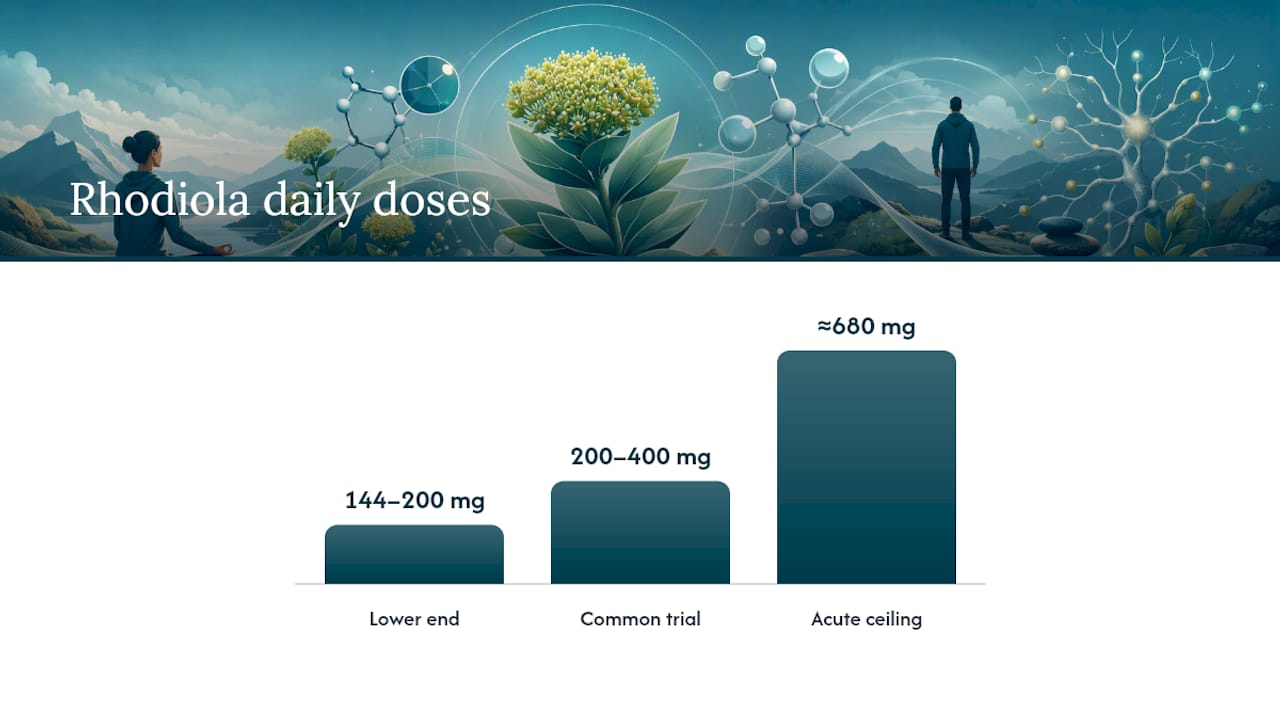
- Lower end (144 to 200 mg per day): the EMA monograph cites 144 to 200 mg once or twice daily for certain standardized dry extracts, reflecting traditional use for fatigue and exhaustion related to stress.
- Common trial range (200 to 400 mg per day): this is where most of the stress and fatigue trials cluster, split into two doses to keep blood levels more stable through the day.
- Acute or higher-range use (up to roughly 680 mg): some sources describe acute dosing ranges as high as 680 mg, though this is generally the ceiling, not a target, and higher doses don’t reliably outperform moderate ones.
That last point deserves emphasis: rhodiola appears to follow a bell-curve response. Benefits show up at low-to-moderate doses, and pushing past roughly 680 mg doesn’t add more benefit; it may just add more risk of side effects. More is not automatically better with this supplement, which runs counter to the instinct a lot of people have with adaptogens.
Extract type matters as much as milligram count. Trials use standardized extracts, SHR-5 and WS® 1375 being the two most studied, with declared salidroside and rosavin content. A product labeled simply “rhodiola rosea 500 mg” without standardization tells you almost nothing about whether it resembles what was actually tested in a clinical trial.
Timing is the other practical detail worth locking in. Rhodiola has a mild stimulating effect for some people, and taking it late in the day can interfere with sleep. Morning or early afternoon dosing is the standard recommendation, both in clinical manuals and among people who’ve used it long enough to notice the pattern themselves.
Is Rhodiola Safe? Side Effects and Drug Interactions
Rhodiola is generally well tolerated in short-term use, according to clinical safety summaries. The most common side effects are mild: dizziness, dry mouth, and excessive salivation show up most often in safety data from consumer-facing clinical resources. These tend to be dose-related and often resolve when you lower the amount or stop taking it.
Certain groups should avoid rhodiola or use it only under direct medical supervision:
- Pregnant or breastfeeding people: insufficient safety data exists, so it’s not recommended.
- Children: rhodiola hasn’t been adequately studied in pediatric populations; don’t give it to a child without a pediatrician’s specific guidance.
- People with autoimmune conditions: some clinical sources caution that stimulating immune activity could theoretically be relevant here, so this deserves a direct conversation with a treating physician.
Drug interactions are where rhodiola requires real caution, not just a passing mention. If you take a serotonergic antidepressant, an SSRI or SNRI, combining it with rhodiola carries a theoretical risk of excess serotonergic activity, sometimes described as serotonin syndrome in more severe cases. This risk applies specifically to serotonergic antidepressants and should be discussed with a prescriber before combining the two, the same way you’d flag any supplement that affects neurotransmitter activity.
Blood pressure medications are the second major interaction category. Rhodiola may have mild effects on blood pressure regulation, and stacking it with antihypertensive drugs could amplify or unpredictably shift those effects. The same caution applies to diabetes medications: rhodiola’s influence on energy metabolism means it could interact with insulin or oral hypoglycemics in ways that haven’t been well mapped in controlled trials.
Pro Tip: If you’re on any prescription medication, especially antidepressants, blood pressure drugs, or diabetes medications, bring your rhodiola product’s label to your next appointment. A pharmacist can flag interaction risks specific to your exact prescriptions faster than a general internet search can.
Monitoring is simple in practice: track how you feel over the first one to two weeks, watch for dizziness or unusual jitteriness, and stop if anything feels off rather than pushing through.
How to Choose a Quality Rhodiola Supplement
Match the label to what trials actually used. Look for a standardized extract, ideally one referencing SHR-5 or WS® 1375 by name, or at minimum a declared percentage of rosavin and salidroside. A bottle listing “rhodiola rosea root extract, 4:1” tells you more than one simply listing “rhodiola rosea” with a milligram count and nothing else.
Third-party testing separates serious manufacturers from the rest of the market. A certificate of analysis (COA) confirming actual salidroside and rosavin content, along with screening for contaminants, is the closest thing to proof that what’s on the label matches what’s in the capsule. If a brand can’t produce a COA on request, that’s worth noting.
Watch for these red flags before buying:
- Proprietary blends with no individual amounts listed — you can’t verify dosing against trial data if the label hides the numbers.
- Unusually high single-dose claims (well above the 400 mg range used in most trials) with no explanation of the extract ratio behind them.
- No manufacturer contact information or country of origin, which makes accountability for quality control essentially impossible.
- Marketing language that promises anxiety or depression treatment, since no rhodiola product is positioned that way by regulatory bodies.
| Quality Marker | What to Look For |
|---|---|
| Standardized extract | Named extract (SHR-5, WS® 1375) or declared rosavin/salidroside percentage |
| Dose transparency | Exact milligrams per serving, matching studied ranges of 144 to 400 mg/day |
| Third-party testing | Available COA confirming potency and screening for contaminants |
| Manufacturer info | Clear company name, contact details, and country of manufacture on the label |
A product that checks these boxes isn’t guaranteed to work for you, but it at least gives you a fair shot at replicating what clinical trials actually tested.
How to Trial Rhodiola Safely: A Starter Protocol
Start low and give yourself a clear window to evaluate results, rather than guessing based on how you feel after a few days.
- Week 1: begin at the lower end of studied ranges, around 150 to 200 mg once daily in the morning, after confirming with a clinician that it’s appropriate given your health history and any medications.
- Weeks 2 through 4: if well tolerated, you can move toward the more commonly studied range of 200 mg twice daily, still dosed earlier in the day to avoid sleep disruption.
- Reassessment at 2 to 4 weeks: this mirrors the timeline used in most clinical trials, giving you a realistic window to judge whether it’s actually helping rather than expecting results.
Track a few specific things during that window: energy levels, a simple 1 to 10 stress rating, sleep quality, and mood. Writing these down, even briefly, makes it far easier to tell whether you’re seeing a real trend or just noticing normal day-to-day variation.
Pro Tip: Keep a one-line daily note rather than a detailed journal. “Energy 6/10, stress 4/10, slept fine” takes ten seconds and gives you enough data to spot a pattern after three weeks.
Rhodiola works best paired with the basics that actually move the needle on stress: consistent sleep, regular movement, and some active stress-reduction practice, whether that’s breathing exercises, time outdoors, or simply protecting a wind-down routine at night. A supplement layered onto a chaotic schedule and four hours of sleep is fighting an uphill battle no matter how good the extract is.
The Snapbrainformula Take on Rhodiola and Stress Support
Snapbrainformula’s approach to stress and mood support starts from the same place the clinical literature does: rhodiola has a real, evidence-backed but bounded role. It helps most with stress-related fatigue and general depletion, and it works alongside good sleep and movement habits rather than replacing them. Our educational content exists to help parents, caregivers, and adults understand where a given supplement fits into the bigger picture of brain chemistry, rather than treating any single ingredient as a complete answer.
For caregivers specifically, the conversation with a pediatrician or clinician should happen before, not after, starting anything for a child or teen. Bring the exact product label, the standardized extract name if there is one, and a clear description of the symptoms you’re hoping to address, whether that’s stress-related fatigue, mood, or focus.
Rhodiola’s evidence base rewards patience and precision: the right extract, a moderate dose, a few weeks of tracking, and a clinician in the loop. That combination matters more than which brand ends up in your cabinet.
A few things worth carrying forward from this guide:
- Rhodiola’s best-supported use is stress-related fatigue, not anxiety or depression treatment.
- Standardized extract and clinician conversation both matter more than chasing the highest available dose.
- Pairing supplements with broader stress-reduction strategies tends to outperform relying on any single ingredient alone.
Why the Standard Rhodiola Advice Undersells the Details
Most rhodiola content online treats it as a single dose, single benefit story: take some, feel less stressed. That framing misses the two things that actually determine whether it works for you. First, the bell-curve dose response means chasing a bigger number on the label can backfire, which contradicts the instinct most people bring to supplements generally. Second, the mismatch between trial extracts and store-shelf products is the real reason so many people try rhodiola and feel nothing. If your capsule doesn’t specify a standardized extract or its rosavin and salidroside content, you’re not really replicating the studies you read about.
The bigger priority, ahead of dosage tweaking, is matching your symptom to the evidence. Rhodiola is strongest for stress-related fatigue and weakest for treating diagnosed anxiety or depression. Start there, track your response honestly for a few weeks, and loop in a clinician before combining it with any prescription medication.
Find Evidence-Informed Support With Snapbrainformula
If the research in this guide left you wanting a more complete picture of how mood, focus, and stress connect to brain chemistry, that’s exactly the gap Snapbrainformula’s educational content and supplement line are built to close. Rather than handing you a single ingredient in isolation, Snapbrainformula develops capsule and liquid formulas designed around how neurotransmitters and stress pathways actually interact, paired with content that explains the reasoning behind each ingredient choice.
That combination matters most for parents and caregivers trying to support a child’s focus and emotional regulation, and for adults managing their own stress and mood without wanting to guess their way through the supplement aisle. Snapbrainformula’s formulas are built for people who want a product grounded in the same kind of evidence discussed throughout this guide, not marketing claims detached from actual research.
If you’re ready to see how a formulated approach compares to a single-ingredient supplement, visit Snapbrainformula to explore the current product lineup and find the formula that matches your stress, mood, or focus goals.
Frequently Asked Questions About Rhodiola for Stress
Does rhodiola actually work for stress? Clinical trials, including a 28-day open-label study using WS® 1375, show modest but measurable improvement in stress-related fatigue and subjective stress symptoms. It’s not a dramatic effect, and evidence quality is rated low-to-moderate, but the benefit is real for the specific symptom of stress-related exhaustion.
How long does rhodiola take to work for anxiety or stress? Some trial participants noticed improvement within 3 days, though most studies measured meaningful change at the 2 to 4 week mark. If you’ve taken it consistently for a month with no change, it may not be the right fit for your symptoms.
What is the best rhodiola dosage for anxiety and stress? The most common trial dose is 200 mg twice daily, totaling 400 mg per day, using a standardized extract. The EMA monograph also references lower ranges of 144 to 200 mg once or twice daily depending on the extract type.
Can rhodiola help with fatigue as well as stress? Yes, and fatigue improvement is arguably rhodiola’s most consistently supported benefit across trials, likely tied to its effects on mitochondrial energy production alongside HPA-axis modulation.
Is rhodiola safe to take with antidepressants? This requires direct medical guidance. Combining rhodiola with serotonergic antidepressants carries a theoretical interaction risk, and the Merck Manual specifically flags this combination as one to discuss with a prescriber before starting.
Can rhodiola replace anxiety medication or therapy? No. The NCCIH is explicit that rhodiola should not replace established treatment for diagnosed anxiety or depressive disorders. It may work as a complementary approach for mild stress symptoms, discussed with a clinician alongside, not instead of, standard care.
Sources
- Therapeutic Effects and Safety of Rhodiola rosea Extract WS® 1375 in Subjects with Life‐stress Symptoms – Results of an Open‐label Study
- Rhodiola rosea L.: an herb with anti-stress, anti-aging, and immunostimulating properties for cancer chemoprevention
- EMA final assessment report: Rhodiola rosea L.
- Rhodiola - Special Subjects - Merck Manual Consumer Version
Recommended
- How to Manage Stress and Anxiety Naturally with Safe Supplements – SNAP Brain Health Supplements
- Natural Remedies That Are Proven to Alleviate Worry – SNAP Brain Health Supplements
- Top 7 Supplements to Ease Your Anxiety Effectively – SNAP Brain Health Supplements
- Top 8 Science-Backed Supplements for Alleviating Anxiety – SNAP Brain Health Supplements
