
Rejection sensitivity is a heightened tendency to expect, perceive, and react intensely to rejection, real or imagined. It shows up often in people with ADHD, where the related term rejection sensitive dysphoria (RSD) describes overwhelming emotional pain after criticism or exclusion, but RSD is not a formal diagnosis in the DSM-5-TR. When it spikes, pause, take a slow breath, name the feeling out loud, and consider professional support if this pattern keeps disrupting your relationships or work.
TL;DR:
- Rejection sensitivity often causes disproportionate emotional responses, including shame, anger, or withdrawal, triggered by mild criticism or perceived rejection.
- Brain wiring and early childhood experiences shape rejection sensitivity, with emotional dysregulation common across conditions like ADHD, autism, anxiety, depression, PTSD, and BPD.
- In the moment, pausing, naming feelings, and checking assumptions can help create space between trigger and reaction, reducing impulsive responses.
- Ongoing support through therapy like CBT or DBT, combined with healthy habits and managing social exposure, can improve emotional regulation over time.
- Professional help is advisable if rejection sensitivity leads to self-harm thoughts, relationship breakdowns, or significantly impairs daily functioning.
Table of Contents
- What Rejection Sensitivity and RSD Actually Look Like
- How Rejection Sensitivity Connects to ADHD and Other Conditions
- What Causes Rejection Sensitivity in the First Place
- The Real Signs and the Real Cost
- When to Seek Professional Help
- Practical Strategies You Can Start Using Today
- Therapy and Medical Approaches That Often Help
- How Snapbrainformula Approaches Rejection Sensitivity
- A Few Honest Words for Parents and Adults Living With This
- Explore BrainSteady’s Educational Resources and Nutritional Support
- Sources
- FAQ
What Rejection Sensitivity and RSD Actually Look Like
Rejection sensitivity is a pattern, not a single bad moment. It’s the tendency to anticipate rejection before it happens, to read rejection into situations that were never about you, and then to respond with a reaction that feels bigger than the trigger. For some people, that reaction is quiet devastation. For others, it’s a flash of anger or a sudden urge to disappear from the room.
Rejection sensitive dysphoria describes the more extreme end of this experience. Clinical sources describe it as intense emotional pain triggered by perceived rejection, and it comes up frequently in ADHD communities. The word “dysphoria” matters here. It’s not sadness. It’s closer to a wave of distress that can hit in seconds and take hours to settle.
What does this look like day to day? Consider these common scenes:
- A teacher circles three sentences in red ink, and a normally confident 12-year-old shuts down for the rest of the school day.
- A friend takes four hours to text back, and the wait spirals into “they’re done with me” before any actual answer arrives.
- A manager offers one piece of feedback in a meeting, and the employee replays it for the entire commute home.
- A parent hears their toddler say “I don’t like you” and feels a gut punch that lasts into the evening.
- A partner cancels a Saturday plan, and the other person reads it as proof they were never really wanted.
None of these reactions are irrational once you understand the wiring behind them. They’re just disproportionate to what actually happened, and that gap is the whole story of rejection sensitivity.
How Rejection Sensitivity Connects to ADHD and Other Conditions
ADHD brains often process disappointment and criticism differently than neurotypical brains do, partly because of documented differences in emotional regulation and executive function. Executive function difficulties make it harder to hit pause between a trigger and a reaction, so a sting that most people could shrug off in a minute becomes a spiral that lasts the whole afternoon.
Rejection sensitivity is not exclusive to ADHD, though. It shows up regularly alongside several other conditions:
- Autism, where social feedback loops and masking add another layer of exhaustion
- Social anxiety disorder, where the fear of judgment often arrives before any actual rejection
- Depression, where negative self-talk amplifies every perceived slight
- PTSD, where past betrayal or abandonment gets triggered by present-day cues
- Borderline personality disorder, where fear of abandonment is a core feature
These conditions overlap because they share a common thread: emotional dysregulation. Worth repeating clearly, because it changes how you should treat this experience: rejection sensitivity and RSD are not listed in the DSM-5-TR or the ICD-11. Clinicians use the terms descriptively, not diagnostically, which means naming your experience this way is valid even though no doctor will write “RSD” on a chart.
What Causes Rejection Sensitivity in the First Place
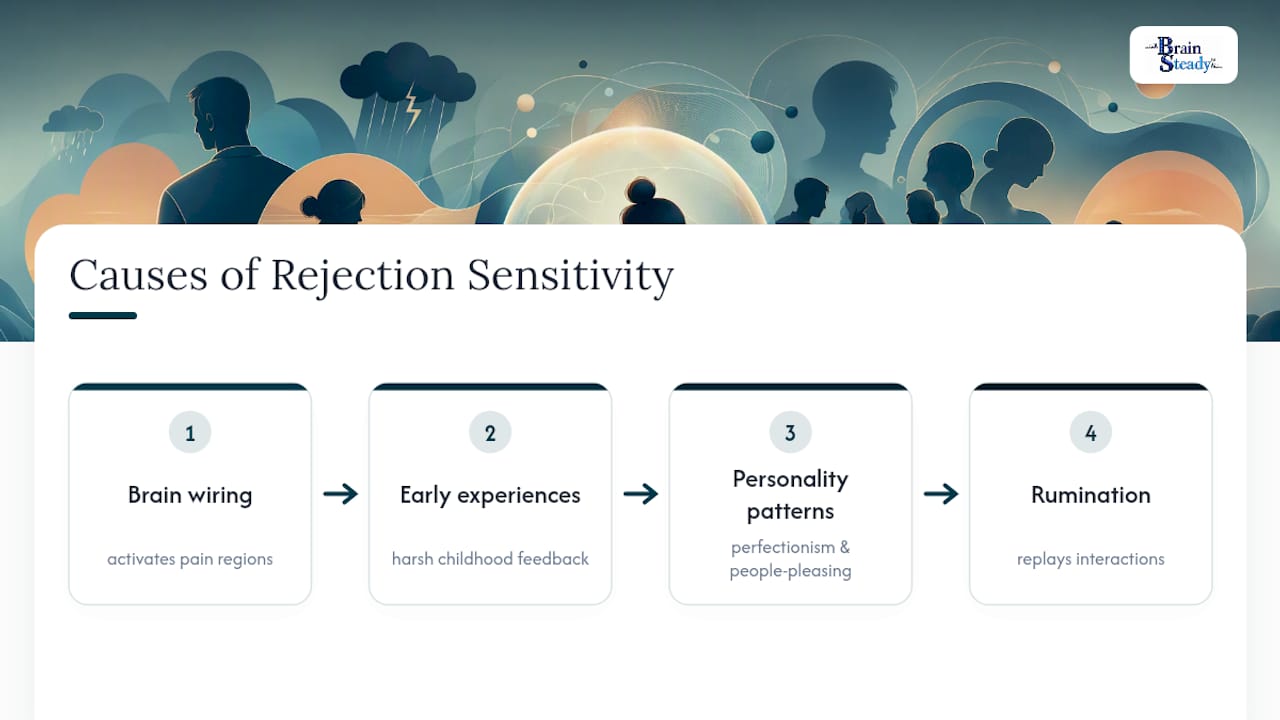
The honest answer is that researchers don’t point to one single cause. A few threads show up consistently across neuroscience, developmental psychology, and clinical practice, and they usually combine rather than act alone.
Brain wiring plays a real role. Social rejection activates brain regions in a way that overlaps with how the brain processes physical pain, which is part of why a snide comment or a canceled plan can feel like an actual injury rather than just an unpleasant thought. That overlap helps explain why “just get over it” advice lands so badly. The pain is not imagined; the nervous system is registering something close to physical distress.
Early experiences shape the baseline. Kids who grew up with harsh criticism, inconsistent affection, or frequent bullying often develop a kind of radar for rejection that never fully switches off. If disapproval from a parent or peer group meant real consequences growing up (social exclusion, punishment, withdrawal of love), the brain learns to scan constantly for the same threat later in life, even in safe relationships.
Personality patterns reinforce the loop. Perfectionism and people-pleasing are frequent companions of rejection sensitivity, and they create a nasty feedback cycle. The person becomes hypervigilant for signs of disapproval, misreads a neutral comment as a rejection, reacts defensively or withdraws, and that reaction sometimes actually strains the relationship, reinforcing the original fear that people leave when you disappoint them. Researchers have documented this self-fulfilling loop in studies on interpersonal rejection and cognitive bias, and it’s one of the more useful things to understand about your own patterns, because it points directly at where change is possible.
Rumination tends to ride along with all of this. Replaying a hard interaction for hours, or days, keeps the nervous system activated long after the actual moment has passed.
The Real Signs and the Real Cost
Rejection sensitivity doesn’t always look the way people expect. It’s not always tears. Sometimes it’s rage. Sometimes it’s total silence.
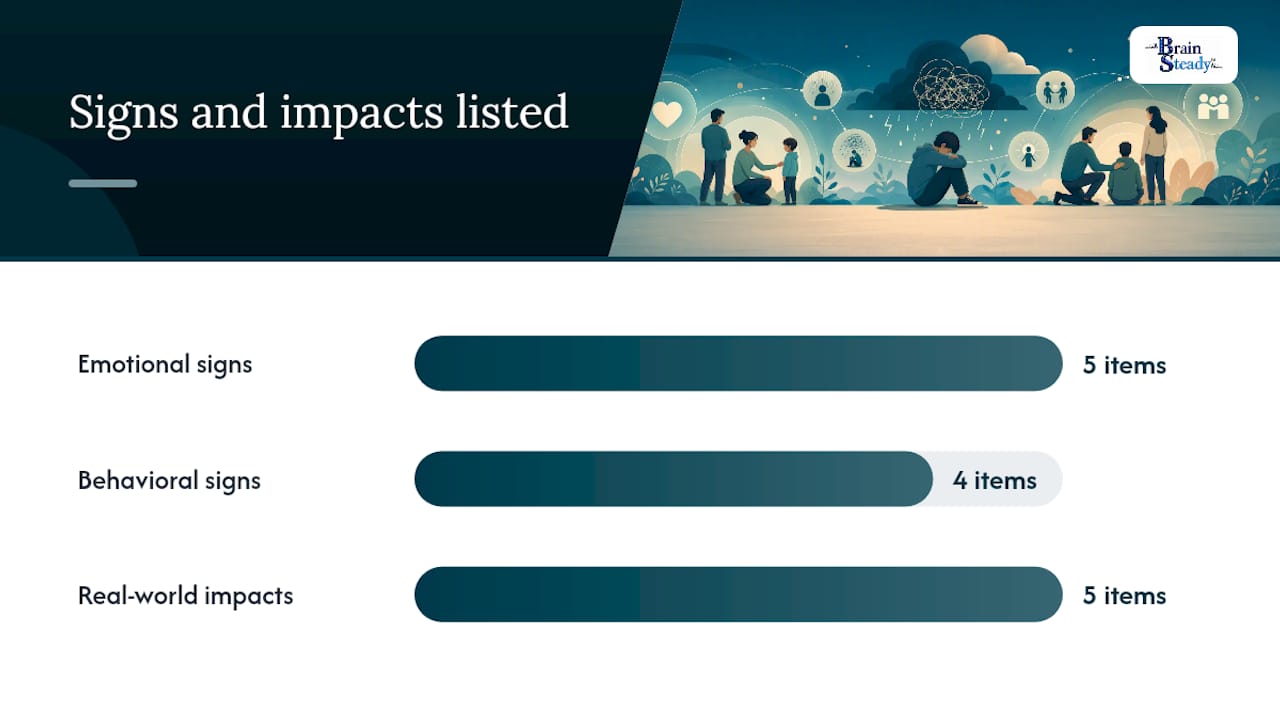
Emotional signs tend to arrive fast and hit hard:
- A wave of shame that feels disproportionate to the actual event
- Sudden anger or irritability that surprises even the person feeling it
- Overwhelming sadness that can tip into hopelessness within minutes
- Panic or a racing heart when anticipating criticism, even before it’s spoken
- Physical sensations: a tight chest, nausea, or a flushed face that mirrors real physical pain
Behavioral signs are where other people usually notice something is off:
- Withdrawing from a conversation, a friendship, or an entire social situation
- People-pleasing to the point of abandoning your own preferences to avoid disapproval
- Avoiding risk altogether, turning down a promotion or a date rather than risk a “no”
- Reacting impulsively, sending an angry text or quitting a group chat mid-conflict
A qualitative study of adults with ADHD found that rejection sensitivity is genuinely multidimensional. It’s emotional pain, negative self-talk, and physical discomfort layered together, and many participants described masking their reactions in front of others to seem fine. That masking has a cost. Suppressing the internal storm to look calm or composed tends to increase exhaustion and loneliness over time, because the person never actually processes the feeling. They just hide it and carry it forward.
The real-world impact compounds from there. At work, someone might avoid asking for a raise or stop volunteering ideas after one piece of critical feedback, which quietly caps their career growth. At school, a student might stop raising their hand after one wrong answer got a laugh. In parenting, a parent who takes a toddler’s tantrum as personal rejection can end up more reactive than the situation calls for, which strains the relationship further. In romance, one partner’s need for reassurance can start to feel, to the other partner, like being under constant suspicion.
Pro Tip: Keep a simple log for two weeks: what happened, what you felt, and how intense it was on a scale of 1 to 10. Patterns show up fast, and seeing them in writing makes the reaction feel less like a personal flaw and more like a fixable pattern.
When to Seek Professional Help
Rejection sensitivity and RSD are descriptive labels, not diagnoses, so a clinician will not “diagnose” you with RSD. What they will do is assess the conditions that often sit underneath it, most commonly ADHD, mood disorders, or anxiety disorders, using tools like a structured diagnostic interview, ADHD screening questionnaires, and standardized mood or anxiety scales.
You don’t need a crisis to justify reaching out. That said, certain signs mean you should not wait:
- Thoughts of self-harm or a sense that life isn’t worth living after a rejection
- A pattern of relationships or jobs repeatedly ending because of these reactions
- A general sense that you can no longer function normally at work, school, or home
If any of those apply to you or someone you love, talk to a doctor or licensed mental health professional soon rather than trying to push through alone.
Practical Strategies You Can Start Using Today
The goal isn’t to stop feeling things. It’s to build a small gap between the trigger and the reaction, so you get to choose your response instead of the feeling choosing it for you.
In the moment, a few tools make a real difference:
- Pause before you respond. Even ten seconds of silence changes the outcome of most conversations.
- Try a grounding breath: in for four counts, hold for four, out for six. It signals to your nervous system that the threat has passed.
- Name the feeling specifically. “I feel embarrassed” carries far less power than an unnamed wave of dread.
- Check the assumption. Ask yourself: what’s the evidence this was actually rejection, and what’s another explanation?
- Delay your reply. Draft the text, then wait an hour before sending it. Most people are relieved they waited.
Communication matters as much as internal regulation. Use “I” statements instead of accusations: “I felt hurt when the plan changed last minute” lands very differently than “you always cancel on me.” When you’re not sure what someone meant, ask directly instead of guessing. A short script helps here: “I noticed X, and I felt Y. Can you help me understand what happened?” It sounds simple, and it works because it removes the guesswork that fuels the spiral.
Daily habits build the foundation that makes the in-the-moment tools actually usable. Consistent sleep, regular movement, and a predictable daily structure all lower baseline reactivity, so a hard comment doesn’t land on an already-depleted nervous system. Journaling and mindfulness practice both help with the rumination loop, giving the brain somewhere to put the replay instead of looping it all evening.
Socially, set boundaries around how much you expose yourself to situations you know will trigger a spiral, and treat new social risks as small experiments rather than referendums on your worth. Sending one vulnerable text and seeing what happens is lower stakes than treating every interaction as a test you might fail. Build a short list of people who reliably feel safe, and lean on that specific list when a wave hits, rather than broadcasting distress to everyone at once. Related coping approaches, including ways ADHD amplifies emotional responses, can add more detail if this is a daily struggle for you or your child.
Pro Tip: If you’re supporting a child or partner through a rejection spiral, resist the urge to talk them out of the feeling immediately. Try “that sounds really painful” first. Problem-solving lands better once the emotional wave has already crested.
Therapy and Medical Approaches That Often Help
Several therapy models show up repeatedly in clinical guidance for rejection sensitivity. Cognitive behavioral therapy (CBT) helps identify and reframe the automatic thoughts that turn a neutral event into a perceived rejection. Dialectical behavior therapy (DBT) teaches specific skills for tolerating distress and regulating intense emotion in the moment, which many people find more useful day to day than any single insight from talk therapy alone. Compassion-focused therapy and mindfulness-based approaches both target the harsh self-criticism that often follows a rejection spiral.
On the medication side, there’s no drug approved specifically for RSD. Clinicians commonly note that medications used for ADHD can reduce emotional reactivity as a secondary effect of improving attention and impulse control, and in some cases they consider other medication classes off-label. None of this should be self-directed. A prescriber needs to weigh interactions, side effects, and your full health history before recommending anything.
In practice, combined care tends to work best: therapy to build the skills, medical treatment where appropriate for an underlying condition like ADHD or anxiety, and daily habits that keep your baseline steadier. No single piece does the whole job on its own.
How Snapbrainformula Approaches Rejection Sensitivity
Some companies focus on evidence-informed nutritional support for focus, mood, and emotional regulation, built for the everyday realities of ADHD, anxiety, and related executive functioning challenges. That’s a complement to therapy and medical care, not a replacement for either.
Ellory, who contributed this guide, works to translate clinical research into language that parents and adults can actually use at 9 p.m. after a hard day, without the jargon or the shame that so often gets attached to emotional reactivity. The goal is always practical: understand the pattern, try one small skill, and know when it’s time to bring in a professional.
If you’re building a plan, think of it in three layers: daily lifestyle habits, therapy or professional support where indicated, and, after talking with your clinician, nutritional support where it fits your situation.
A Few Honest Words for Parents and Adults Living With This
If you’ve made it this far, you already know how real this pain is. It’s not an overreaction and it’s not a character flaw. It’s a nervous system doing what it learned to do, sometimes years ago, in response to something that once genuinely mattered.
Approach this with curiosity instead of judgment. You’re not aiming for perfect calm on the first try. You’re aiming for one small experiment: naming the feeling once today, pausing for ten seconds before you reply to that text, or writing down what triggered you this week. Track it. Try one skill. If the pattern keeps disrupting your relationships, your work, or your child’s school days, bring in a professional who can help you build the rest.
— Ellory
Explore BrainSteady’s Educational Resources and Nutritional Support
Some companies provide parents and adults with a nutritional layer built around focus, mood, and emotional regulation, alongside educational content that explains the ADHD and brain chemistry connection in plain language. It’s not a medication and it’s not a treatment for rejection sensitivity. Think of it as one more evidence-informed tool alongside therapy, daily habits, and professional care.

If you’re a parent watching your child spiral after every piece of feedback, or an adult tired of the same after-rejection crash, exploring how brain chemistry, focus, and emotional balance connect can be a genuinely useful next step, especially paired with the coping strategies in this guide. For more on the ADHD and emotional regulation connection specifically, read how ADHD and emotional dysregulation overlap. Always talk to your doctor or pediatrician before starting any new supplement, especially alongside existing medications. Visit Snapbrainformula to browse the full product line and educational library, and see whether nutritional support has a place in your family’s routine.
This article is general information, not a substitute for advice from a qualified doctor. Consult a qualified healthcare professional about your own circumstances before acting on anything here.
Sources
- Rejection sensitivity
- The lived experience of rejection sensitivity in ADHD - A qualitative exploration
FAQ
How Do I Know if I Have Rejection Sensitivity?
If criticism, disappointment, or perceived disapproval regularly triggers shame, anger, or panic that feels bigger than the situation warrants, and you find yourself withdrawing or people-pleasing to avoid that pain, you’re likely dealing with rejection sensitivity. Tracking your reactions for a couple of weeks usually reveals the pattern clearly.
How Can I Become Less Sensitive to Rejection?
Build the gap between trigger and reaction using tools like pausing before responding, naming the emotion, checking your assumptions about what actually happened, and practicing grounding breaths, and back that up with steady sleep and exercise. Therapy approaches like CBT and DBT skills training tend to speed up progress considerably.
Is Rejection Sensitivity an ADHD Thing?
It’s strongly associated with ADHD because of shared patterns in emotional regulation and executive function, but rejection sensitivity also shows up with autism, anxiety, depression, PTSD, and borderline personality disorder. It’s a descriptive pattern, not an ADHD-exclusive symptom.
How Do I Explain RSD to Someone Who Doesn’t Get It?
Explain that rejection sensitive dysphoria is intense emotional pain triggered by perceived criticism or rejection, that it activates brain responses similar to physical pain, and that it’s a real, documented experience even though it isn’t a formal diagnosis. Asking for patience during a spiral, rather than an explanation in the moment, often helps more than a full clinical breakdown.
