
Oppositional defiant symptoms fall into three clusters: angry or irritable mood, argumentative or defiant behavior, and vindictiveness. A pattern that points toward oppositional defiant disorder generally involves four or more of these symptoms showing up for six months or longer, across more than one setting, in a way that disrupts school, home, or friendships. Symptoms alone don’t confirm a diagnosis. If your child’s behavior sounds frequent, intense, and disruptive, a professional evaluation is the next right step.
TL;DR:
- Oppositional defiant symptoms must persist for at least six months, involve four or more behaviors across multiple settings, and cause significant disruptions to be considered diagnostic.
- Behavior patterns differ by age, with irritable moods starting in preschool, argumentative actions most visible in elementary school, and vindictiveness typically more concerning to clinicians.
- Underlying factors like ADHD, anxiety, or sleep issues often drive defiant behavior, and addressing these conditions can reduce symptoms more effectively than targeting defiance alone.
- Consistent, clear parenting, structured routines, and immediate positive reinforcement are proven strategies to diminish oppositional behaviors at home over time.
- A comprehensive assessment includes multiple perspectives, symptom checklists, and screening for co-occurring conditions to guide appropriate intervention plans.
Table of Contents
- Signs of Oppositional Defiance by Age and Behavior Type
- Occasional Defiance vs. a Persistent Pattern: A Parent Checklist
- What’s Actually Driving the Behavior
- Strategies That Actually Reduce Defiant Behavior at Home
- What an Evaluation for ODD Actually Involves
- Supporting Your Child’s Brain Health Alongside Behavioral Strategies
- Why Small, Consistent Changes Matter More Than Big Gestures
- A Gentle, Nonmedical Option Worth Knowing About
- Sources
- FAQ
Signs of Oppositional Defiance by Age and Behavior Type
Every category of oppositional defiant symptoms looks different depending on how old your child is. Recognizing the specific behavior, not just the general mood, helps you describe what’s happening more clearly to a pediatrician or therapist later.
Angry or irritable mood shows up as a short fuse and a chip on the shoulder that doesn’t go away.
- A preschooler having meltdowns that seem out of proportion to the trigger, most days of the week.
- An elementary-age child who seems touchy, easily annoyed, or resentful even during ordinary requests like homework time.
- A teenager who snaps at siblings or parents constantly and seems to be simmering with frustration even when nothing “happened.”
Argumentative or defiant behavior is the category most parents recognize first, because it’s the loudest.
- Arguing with adults or authority figures over rules that were already explained.
- Actively refusing to comply with requests, not just stalling, but flatly saying no.
- Deliberately doing things that annoy other people, like slamming doors or provoking a sibling on purpose.
- Blaming others for mistakes or misbehavior rather than acknowledging any role in it.
Vindictiveness is the least common cluster and the one that most concerns clinicians when it appears. It means spiteful or vindictive behavior at least twice within six months, such as deliberately sabotaging a sibling’s project or holding a grudge that shows up in calculated payback later.
Frequency language matters here. Clinicians look for behaviors that happen “often” or “most days,” not once during a rough week. A child who argues with a teacher during one stressful exam period is different from a child who argues with every adult who asks anything of them, week after week.
Occasional Defiance vs. a Persistent Pattern: A Parent Checklist
Every kid refuses a bedtime request or slams a door once in a while. The distinction that matters is whether the behavior is occasional or whether it has settled into a pattern with real consequences.
- Count the symptoms. Are you seeing four or more behaviors from the three categories above, not just one favorite complaint?
- Check the duration. Has this been going on for six months or more, not just since a stressful week or a schedule change?
- Check the settings. Is it happening only with you, or also at school, with grandparents, with coaches, with friends?
- Check the impact. Is it costing your child friendships, getting them in trouble at school, or straining your relationship with them?
- Check for safety concerns. Has your child mentioned self-harm or harming someone else, or does the behavior put anyone at risk? That warrants immediate professional attention, not a wait-and-watch approach.
Oppositional defiant disorder often starts before age 8, and the CDC notes that clinicians look for behavior that’s clearly more frequent and intense than what’s typical for a child’s peer group and developmental stage. That comparison to peers, not to some abstract standard of a “good kid,” is what turns a checklist into something clinically useful.
What’s Actually Driving the Behavior
There’s no single cause behind oppositional defiant symptoms. Most clinicians describe it as a mix of temperament, environment, and neurobiology, meaning your parenting didn’t create this on its own and isn’t the only lever that can change it, according to Mayo Clinic.
Several conditions can look like defiance on the surface while the real driver is something else entirely.
- ADHD. Impulsivity and trouble with working memory can make a child seem like they’re ignoring instructions when they’re actually struggling to hold onto them.
- Anxiety. A child who feels overwhelmed may refuse a task not out of stubbornness but because the request itself feels threatening.
- Learning difficulties. Refusing homework can be less about defiance and more about avoiding a task that feels impossible.
- Sleep problems. Chronic poor sleep wrecks emotional regulation in kids the same way it does in adults, just louder.
- Emotional dysregulation. Some kids simply have a harder time managing big feelings, and the defiance is the overflow.
Clinicians screen for these because treating the underlying issue often reduces the oppositional behavior itself. If ADHD is the real driver, addressing it directly tends to work better than treating the defiance as the primary problem.
Pro Tip: Keep a simple log for two weeks: what happened right before the meltdown, what the request was, and what time of day it occurred. Patterns around hunger, transitions, or specific subjects at school often point straight to the underlying trigger.
Strategies That Actually Reduce Defiant Behavior at Home
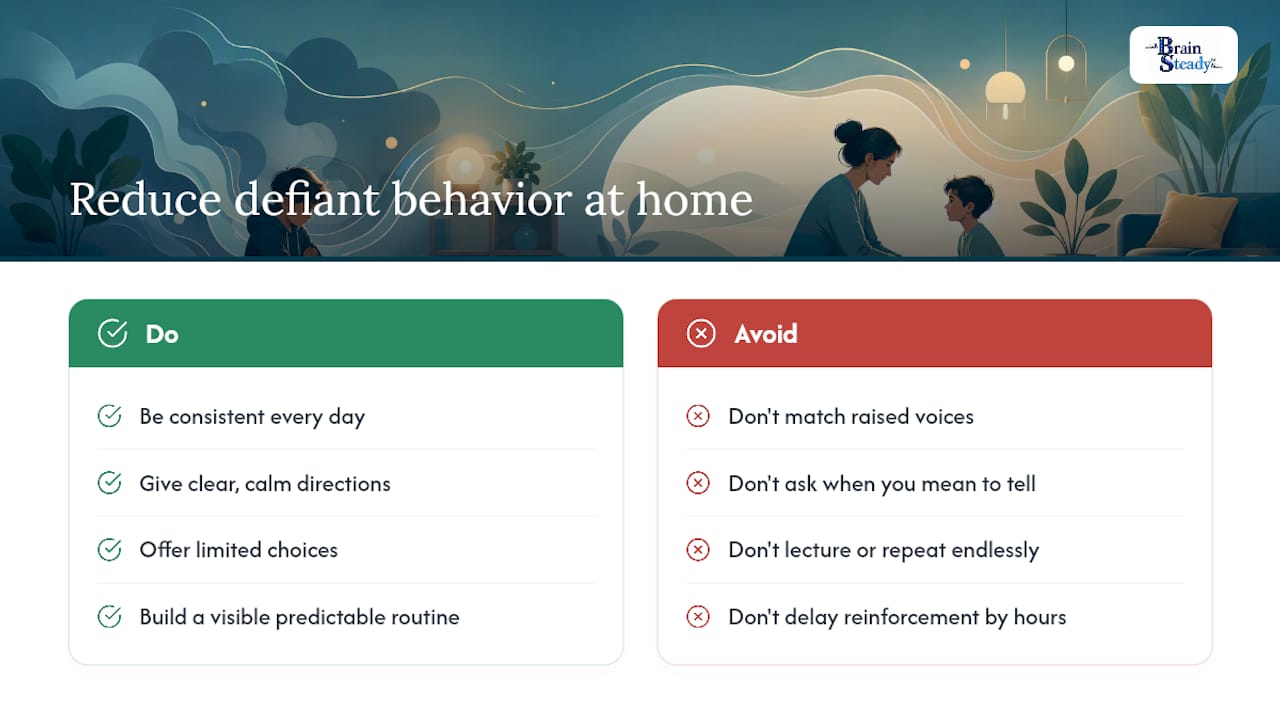
Consistency beats intensity. A calmer, more predictable approach applied every day outperforms a strict crackdown that only shows up after a bad week.
Give clear, calm directions. Instead of a question (“Can you clean your room?”), state it plainly: “It’s time to clean your room now.” Fewer words, delivered once, in a normal tone, land better than a lecture.
Offer limited choices. “Do you want to brush teeth first or put on pajamas first?” gives a child a sense of control without opening the door to a debate about whether bedtime happens at all.
Build predictable routines. Kids with oppositional defiant symptoms often do better with fewer surprises. A visible schedule for mornings, homework, and bedtime reduces the number of moments where a request feels like it came out of nowhere.
Use immediate, specific positive reinforcement. “You put your shoes away without being asked, that was great” works better than generic praise. A simple token system, where small wins earn points toward a preferred activity, adapts well to both home and classroom settings.
De-escalate instead of matching the intensity. When a child is already yelling, adding your own raised voice pours fuel on it. Lower your volume, state the boundary once, and disengage from the argument rather than repeating yourself.
Reconnect after conflict. Once things calm down, a short check-in, even just five minutes of undivided attention, repairs the relationship and prevents the next blowup from starting on a foundation of resentment.
For more entrenched patterns, evidence-based parent management training is one of the best-supported approaches available. These programs teach caregivers specific skills: consistent consequences, clear rules stated in advance, and reinforcement that happens immediately rather than hours later. That shift in the caregiver-child dynamic is often what breaks the cycle that keeps defiant behavior going. You’ll find a practical starting point in this guide to managing oppositional behavior, and teachers can use similar adaptations covered in these tips for students with oppositional defiant behavior. The positive behavior support examples from Building Block Resolutions offer additional real-world scenarios worth reviewing alongside these steps.
What an Evaluation for ODD Actually Involves
A pediatrician or mental health professional won’t diagnose anything from a single conversation. Expect a process built around multiple perspectives, not just your account of a hard Tuesday.
- Rating scales and questionnaires completed separately by parents and teachers, since behavior that shows up at home might not show up at school, and vice versa.
- A review against DSM-5-TR criteria, checking for four or more symptoms across the three categories, present for six months, in more than one setting.
- Screening for co-occurring conditions like ADHD, anxiety, or learning disorders, since treating those sometimes resolves much of the oppositional behavior on its own.
- A referral pathway to a child psychologist or psychiatrist if the primary care visit suggests something beyond typical developmental defiance. Medication isn’t a standalone treatment for ODD, but it’s sometimes used when a co-occurring condition like ADHD is diagnosed alongside it.
Before the appointment, gather specific examples rather than general impressions. Write down two or three incidents with dates, and ask your child’s teacher for their own observations. This kind of preparation, recommended by the Child Mind Institute, gives the clinician something concrete to evaluate instead of a vague sense that things have been hard.
Supporting Your Child’s Brain Health Alongside Behavioral Strategies
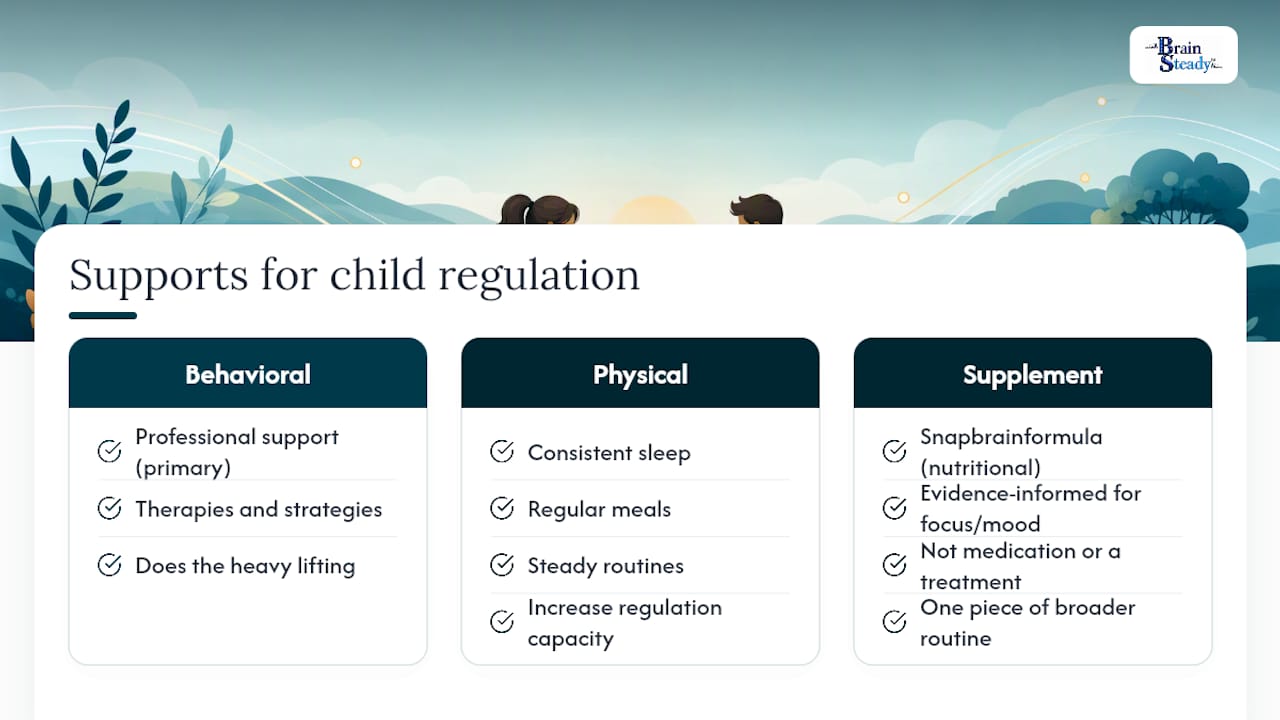
Behavioral strategies and professional support do the heavy lifting when oppositional defiant symptoms are frequent and disruptive. Basic physical supports, consistent sleep, regular meals, steady routines, matter too, since a well-rested, well-nourished child has more capacity for emotional regulation on any given day.
Snapbrainformula focuses on evidence-informed nutritional support for focus, mood, and emotional balance. It is not medication, and it is not a treatment for oppositional defiant disorder. Think of it as one piece of a broader routine, alongside sleep, structure, and the parenting strategies covered above, not a replacement for any of them. For a deeper look at what contributes to these behaviors in the first place, the breakdown of root causes behind oppositional defiant disorder is worth reading alongside your evaluation notes.
Why Small, Consistent Changes Matter More Than Big Gestures
Parenting a child with persistent oppositional defiant symptoms is exhausting in a way that’s hard to explain to anyone who hasn’t lived it. You’re not failing when a strategy doesn’t work on the first try. Behavior change, especially the kind rooted in temperament and neurobiology, moves slowly and unevenly.
What tends to help is picking one or two strategies, staying consistent with them for weeks rather than days, and looping in the school and a clinician rather than trying to solve everything alone. Track small wins. Progress in this area rarely looks dramatic in the moment, but it adds up.
— Ellory
A Gentle, Nonmedical Option Worth Knowing About
If you’re already working with a pediatrician or therapist and looking for additional lifestyle support, nutritional supplements are available to support focus, mood, and emotional balance in children, teens, and adults.

This is nutritional support, not medication or a treatment for oppositional defiant disorder, and it works best as one piece of a broader plan that includes behavioral strategies and, when needed, professional care. Always talk to your child’s clinician before adding any supplement, especially if your child takes other medications or has a diagnosed condition. If you want to see the full product lineup and decide whether it fits your family’s routine, visit Snapbrainformula to explore the options available.
This article is general information, not a substitute for advice from a qualified doctor. Consult a qualified healthcare professional about your own circumstances before acting on anything here.
Sources
- Oppositional Defiant Disorder - StatPearls - NCBI Bookshelf
- Oppositional defiant disorder (ODD) - Symptoms and causes - Mayo Clinic
- Behavior or conduct problems in children | CDC
- Children and mental health - NIMH
FAQ
When Does ODD Typically Start in Children?
Oppositional defiant disorder usually appears before age 8, though patterns can become more noticeable as demands increase in elementary school and adolescence.
Is Medication Used to Treat Oppositional Defiant Disorder?
Medication isn’t a primary treatment for ODD itself, but it may be prescribed for co-occurring conditions like ADHD or depression when those are also diagnosed.
How Do You Teach a Child With Oppositional Defiant Symptoms?
Clear, brief directions, limited choices, predictable routines, and immediate positive reinforcement work better than lectures or repeated warnings, and evidence-based parent management training builds on these same principles.
Can Adults Have Oppositional Defiant Symptoms?
ODD is diagnosed in childhood, but unaddressed patterns of argumentativeness, irritability, and blaming others can persist into adulthood and affect relationships and work if never treated.
Does BrainSteady Treat Oppositional Defiant Disorder?
No. Snapbrainformula offers nutritional support for focus and mood, not medication or treatment for any diagnosed condition, and should complement, not replace, professional care.
