
Oppositional defiant disorder is a persistent pattern of angry, irritable, and defiant behavior that goes beyond a child’s occasional pushback and starts interfering with daily life at home or school. If what you’re seeing happens most days over several months, across more than one setting, start with calm, consistent caregiver strategies now and ask your pediatrician about a formal evaluation against DSM-5-TR criteria.
TL;DR:
- Most children with ODD do not develop conduct disorder, but severe or untreated cases with callous traits may increase long-term risks.
- Behavioral treatments like Parent Management Training and Parent-Child Interaction Therapy show strong evidence and typically require multiple weekly sessions for effectiveness.
- Co-occurring conditions such as ADHD or anxiety often drive oppositional behaviors, and addressing these underlying issues can reduce ODD symptoms before specific behavioral plans start.
- Consistent caregiver strategies like brief commands, predictable routines, and calm consequences can be effective in managing symptoms before diagnosis.
- Early intervention, ideally before years of conflict harden behavioral patterns, can significantly improve long-term outcomes and prevent escalation.
Table of Contents
- Symptoms and Diagnostic Criteria for Oppositional Defiant Disorder
- What Causes Oppositional Defiant Disorder?
- How Is Oppositional Defiant Disorder Diagnosed?
- ADHD, Anxiety, and Other Conditions That Often Travel With ODD
- Evidence-Based Treatments: What Actually Works
- Caregiver Strategies You Can Start Today
- ODD vs. Normal Defiance: Where’s the Line?
- Why Early Intervention Changes the Long-Term Picture
- Does ODD Look Different in Boys, Girls, and Different Age Groups?
- How ODD Ripples Through Family, School, and Friendships
- Can Oppositional Defiant Disorder Turn Into Conduct Disorder?
- Where Medication Fits (and Where It Doesn’t)
- Finding Support as a Family
- A Word From Our Team on Living With This Diagnosis
- Nutritional Support Alongside Professional Care
- Sources
- FAQ
Symptoms and Diagnostic Criteria for Oppositional Defiant Disorder
Clinicians organize oppositional defiant disorder symptoms into three clusters, and seeing where your child’s behavior lands helps you talk to a doctor with more precision than “he’s just difficult lately.”
- Angry/irritable mood: frequent temper loss, being easily annoyed, and a chronic chip-on-the-shoulder resentfulness that shows up even on ordinary days.
- Argumentative/defiant behavior: arguing with adults, actively refusing to comply with rules, deliberately annoying others, and blaming other people for their own mistakes.
- Vindictiveness: spiteful or vengeful behavior, seen at least twice in six months, that goes beyond a heated moment and looks like a grudge.
Pro Tip: A single blowup after a bad day at school is not a diagnosis. Clinicians look for patterns repeated across weeks and settings, not isolated incidents.
The diagnostic threshold matters here. The DSM-5-TR criteria require at least four symptoms present for six months or longer. For children under 5, those behaviors need to show up most days; for kids 5 and older, at least once a week. Symptoms also have to occur with someone other than a sibling, and they need to cause real friction, whether that’s strained relationships, school trouble, or family stress. That last part, the impairment piece, is what separates a strong-willed kid from a diagnosable condition.
What Causes Oppositional Defiant Disorder?
No single cause explains oppositional defiant disorder, and that matters because it takes the blame off any one parent or any one kid. Genetics play a real role. Twin and family studies point to a moderate hereditary component, meaning temperament and emotional reactivity can run in families the same way height or eye color does.
Environment shapes how that temperament plays out. Inconsistent discipline, high family conflict, or a caregiver managing their own untreated depression or anxiety can all amplify oppositional patterns, though none of these alone cause ODD. Prenatal exposures, complications around birth, and chaotic or under resourced community environments show up as contributing risk factors too. Think of it less as one broken part and more as several dials that, turned up together, raise the odds.
How Is Oppositional Defiant Disorder Diagnosed?
A pediatrician can screen for concerns, but a full diagnosis typically comes from a child psychologist or child psychiatrist who evaluates behavior across home, school, and social settings, not just in a single office visit. That comprehensive look matters because, as the Children’s Hospital of Philadelphia notes, several other issues, including sleep problems, undiagnosed learning difficulties, and anxiety, can produce behavior that looks exactly like defiance on the surface.
Before your appointment, gather:
- A two to four week log noting the date, setting, trigger, and what happened before and after each incident.
- Notes or emails from teachers describing classroom behavior.
- A recent pediatric checkup ruling out sleep or medical contributors.
- Any prior evaluations for ADHD, anxiety, or learning differences.
Ask your pediatrician directly for a referral to a child mental health specialist if the pattern has lasted six months or longer.
ADHD, Anxiety, and Other Conditions That Often Travel With ODD
Oppositional defiant disorder rarely shows up alone. ADHD, anxiety disorders, mood disorders, and learning differences are common companions, and untangling which condition is driving which behavior changes the entire treatment plan. A comorbidity study published in PMC found that multicomponent interventions, ones that address the parent, the child, and the school setting together, work better than treating ODD in isolation.

Here’s the part parents often miss: a child fighting an undiagnosed attention problem or a sleep deficit will look defiant even when the real issue is exhaustion or an inability to sustain focus on a task. Treating the ADHD or fixing the sleep schedule sometimes reduces oppositional behavior on its own, before any behavior-specific plan even starts. Expect your clinician to build a combined plan rather than treating ODD as the only target.
Evidence-Based Treatments: What Actually Works
Behavioral treatment, not medication, is the front-line approach for oppositional defiant disorder. Two programs carry the strongest evidence base.
Parent Management Training (PMT) teaches caregivers specific skills: giving clear, calm instructions, using consistent nonviolent consequences, and rewarding cooperative behavior deliberately rather than only reacting to problems. Parent-Child Interaction Therapy (PCIT) takes this further with live coaching, often through an earpiece while a therapist watches a parent and child interact, correcting patterns in real time. Both approaches, along with structured problem-solving skills training for the child, form the core evidence-based treatment set recommended for ODD.
- PMT and PCIT typically run for multiple weekly sessions, though timelines vary by program and severity.
- Group-based and even online delivery formats have shown outcomes comparable to in-person sessions in some trials, which matters if specialists are scarce where you live.
- Reviews of programs like PMT, Incredible Years, Triple-P, and PCIT show measurable short-term gains, though benefits can fade without booster sessions or ongoing reinforcement at home.
Medication does not treat oppositional defiant disorder directly. It has a role only when a co-occurring condition, ADHD most commonly, needs pharmacological support, and even then it works alongside behavioral treatment, not instead of it.
Pro Tip: Ask any prospective therapist directly whether they’re trained in PMT or PCIT by name. Generic “behavioral therapy” without one of these structured models tends to produce weaker, less consistent results.
Caregiver Strategies You Can Start Today
You don’t need to wait for a diagnosis to start reducing conflict at home. These strategies work whether or not your child ends up meeting full DSM-5-TR criteria.
- Give short, neutral commands. “Shoes on, please” lands better than a five-clause explanation of why shoes matter right now.
- Offer limited choices. “Do you want to brush teeth first or put on pajamas first?” hands back a sliver of control without opening a negotiation.
- Build predictable routines. Kids who know what comes next have fewer opportunities to test limits out of anxiety or uncertainty.
- Follow through with calm, consistent consequences. The consequence matters less than the fact that it happens every single time, without a raised voice.
- Catch the good moments on purpose. Specific praise, “I noticed you asked instead of yelling,” reinforces the behavior you want to see repeated.
- Repair after conflict. A short, calm reconnection once everyone has cooled down, even just five minutes of shared attention, rebuilds the relationship the blowup strained.
Co-regulation, meaning you staying calm so your child can borrow your composure, is one of the most consistently cited caregiver skills in behavioral intervention research. If a task is genuinely too demanding, whether that’s a chore requiring sustained focus or a noisy environment overwhelming the senses, adjusting the environment often works faster than adding another consequence.
Pro Tip: If noncompliance clusters around specific triggers, like sustained homework time or sensory-loaded environments, try shortening the task or adding a break before assuming it’s pure defiance.
Escalate to professional help immediately if you see safety concerns, aggression that’s increasing despite consistent strategies at home, or clear impairment at school or in friendships that isn’t improving after a few weeks of steady effort. For more on turning consistency into a household rhythm, our guide on effective parenting strategies for behavior disorders walks through specific scripts you can borrow.
ODD vs. Normal Defiance: Where’s the Line?
Every toddler says no. Every teenager rolls their eyes. The line between typical development and oppositional defiant disorder comes down to three things: frequency, persistence, and impact, not any single incident.
A five-year-old melting down because screen time ended is developmentally normal. A five-year-old who melts down most days, argues with every adult request, and has been asked to leave two playdates in a month because of vindictive behavior toward other kids is showing a pattern worth evaluating. The distinction isn’t about how loud the tantrum is. It’s about whether the behavior has settled into a predictable, near-daily rhythm that’s straining relationships across more than one setting.
Parents sometimes worry that seeking an evaluation means admitting failure, or worse, labeling their child unfairly. It doesn’t. A clinical evaluation exists to distinguish a temporary rough patch, a reaction to a stressful move or a new sibling, from a more entrenched pattern that responds well to structured treatment. Getting clarity early tends to open doors, not close them. If the behaviors you’re tracking meet the frequency and duration thresholds outlined earlier and they’re causing real friction at home or school, that’s the signal to move from “wait and see” to “let’s get this assessed.”
Why Early Intervention Changes the Long-Term Picture
Oppositional defiant disorder affects an estimated 3 to 6 percent of children at any given time, and the trajectory from there depends heavily on when families get support. Many kids who receive behavioral treatment early see real improvement, sometimes enough that symptoms no longer meet diagnostic thresholds by adolescence.
Left unaddressed, though, a smaller subset of children see symptoms deepen rather than fade. Untreated patterns can calcify into more entrenched conflict at home, worsening school performance, and a higher risk of mood difficulties or conduct problems down the road. The window where behavioral treatment works best tends to be earlier rather than later, largely because parent-child interaction patterns are more flexible before years of conflict have hardened into habit on both sides. This is the practical argument for acting on a persistent pattern now instead of hoping a child “grows out of it” without any support.
Does ODD Look Different in Boys, Girls, and Different Age Groups?
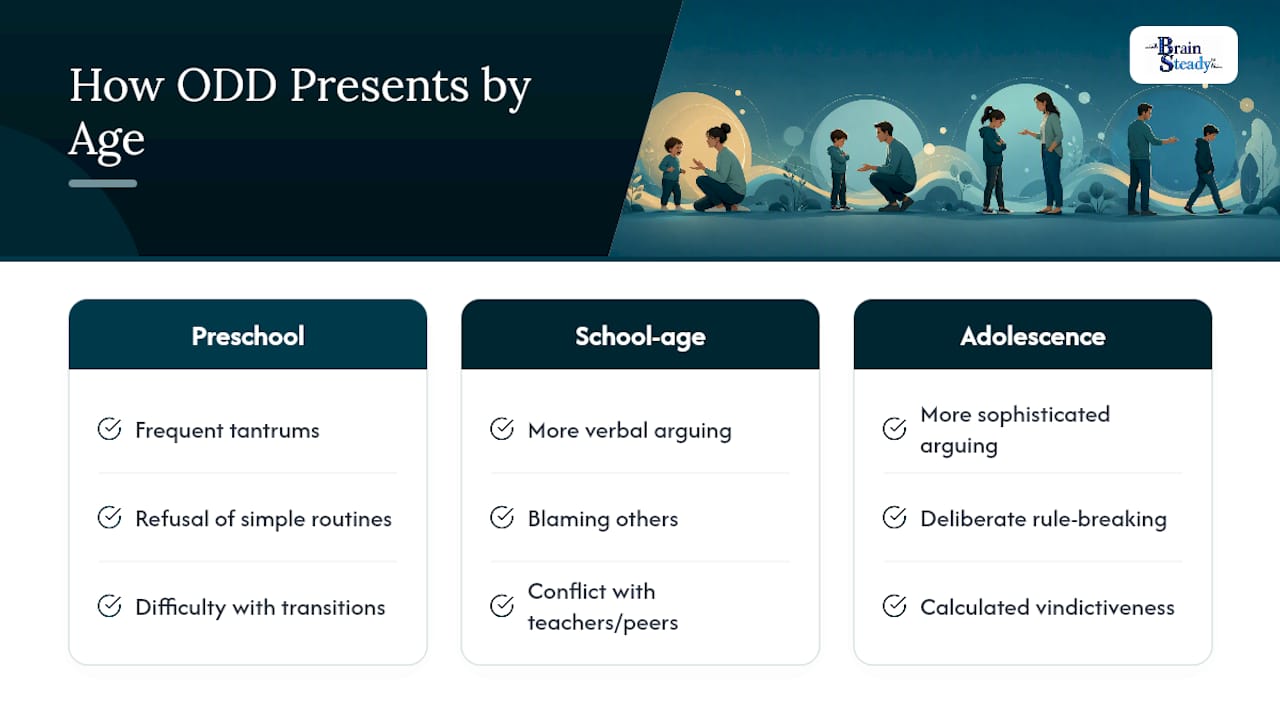
Presentation shifts noticeably as kids grow, and missing that shift is one reason ODD sometimes goes unrecognized for years. In preschoolers, oppositional defiant disorder often shows up as frequent tantrums, refusal to follow simple routines, and difficulty transitioning between activities. School-age children tend to show more verbal arguing, blaming others, and conflict with teachers and peers. By adolescence, the behavior often becomes more verbally sophisticated, sharper arguing, deliberate rule-breaking, and a more calculated edge to the vindictiveness criteria.
Gender differences show up in style more than severity. Boys are more frequently identified with ODD in childhood, and their symptoms often lean toward overt behaviors, physical outbursts, direct defiance, loud confrontation. Girls with ODD more often show relational patterns: exclusion, gossip, or quieter but persistent stonewalling and refusal. Because clinicians and teachers have historically been trained to notice the louder, more disruptive presentation, girls with oppositional defiant disorder can go unrecognized longer, sometimes not flagged until conflict at school becomes unavoidable. If your daughter is dismissed as “just moody” while showing the same frequency and duration of symptoms a diagnosed boy would show, it’s worth pushing for the same level of evaluation.
How ODD Ripples Through Family, School, and Friendships
Oppositional defiant disorder rarely stays contained to one relationship. At home, the daily friction of arguing, refusal, and blame wears down parents, siblings, and the overall tone of the household, often leaving caregivers exhausted and second-guessing every decision. Marriages and co-parenting relationships absorb real strain when partners disagree about how to respond to defiant behavior.
At school, the impact shows up as disciplinary referrals, strained teacher relationships, and sometimes academic decline, not because the child can’t do the work, but because conflict with authority figures eats into instructional time. Socially, the vindictiveness and argumentative patterns that define ODD tend to push peers away over time. Other kids, and sometimes their parents, start avoiding playdates or group activities, which isolates a child at exactly the age when peer relationships matter most for developing social skills. None of this happens because a child is choosing to sabotage their own relationships. It happens because the skills needed to manage frustration and read social cues haven’t caught up yet, which is precisely what evidence-based treatment targets.
Can Oppositional Defiant Disorder Turn Into Conduct Disorder?
This is the question that keeps parents up at night, and it deserves a direct answer: most children with oppositional defiant disorder do not go on to develop conduct disorder. The behaviors in ODD, arguing, irritability, defiance, stay within the realm of relationship conflict. Conduct disorder involves more serious violations, including aggression toward people or animals, property destruction, or serious rule violations like running away or truancy.
That said, untreated and severe ODD, particularly cases involving significant callous or unemotional traits, does carry an elevated risk of progressing toward conduct disorder or later antisocial patterns in a minority of cases. This is exactly why early behavioral intervention isn’t just about making home life calmer right now. It’s a genuine window to interrupt a trajectory before it hardens. The presence of consistent, evidence-based treatment during childhood is one of the more reliable protective factors identified in the research on long-term outcomes.
Where Medication Fits (and Where It Doesn’t)
Medication is not a first-line treatment for oppositional defiant disorder, and no drug is FDA-approved specifically to treat it. That surprises a lot of parents who assume there’s a pill for every childhood behavior diagnosis. There isn’t one here.
Where medication does play a legitimate role is in treating co-occurring conditions. If a child has comorbid ADHD, stimulant or non-stimulant medications targeting attention and impulse control can reduce the friction that fuels oppositional episodes, sometimes substantially. If anxiety or depression is part of the clinical picture, appropriate medication for those conditions may ease the emotional dysregulation that makes defiant behavior worse. In both cases, medication supports the underlying condition; it doesn’t replace Parent Management Training, PCIT, or problem-solving skills training as the direct treatment for the oppositional behavior itself. Any conversation about medication should happen with a prescribing psychiatrist who’s also coordinating with whoever is delivering the behavioral treatment, not in isolation.
Finding Support as a Family
You don’t have to build a treatment plan alone from a search engine at midnight. Start with your child’s pediatrician for a referral to a child psychologist or psychiatrist experienced in behavioral assessment. Many children’s hospitals and university medical centers run dedicated behavioral health clinics with waitlists shorter than a private specialist’s.
Parent training programs, including PMT and PCIT, are often available through community mental health centers at lower cost than private practice, and some insurance plans cover them fully. School counselors and special education coordinators can also loop in classroom-based supports, particularly if learning difficulties are part of the picture. For everyday, practical reading between appointments, our guides on teaching strategies for students with oppositional behavior and starting evidence-based ODD care offer concrete next steps. Outside resources on early childhood boundary-setting, like this piece on toddler development, and comprehensive guides on managing ADHD in children, can round out your reading list if attention or developmental questions overlap with what you’re seeing.
A Word From Our Team on Living With This Diagnosis
Caregiver burnout is real, and the guilt that follows a hard day with a defiant child is almost universal among the parents we hear from. Oppositional defiant disorder is not a report card on your parenting. Track small wins, a calmer bedtime, one fewer blowup this week, because progress with ODD rarely looks dramatic in the moment. Our role is education and support, never a replacement for the clinician actually treating your child.
— Ellory
Nutritional Support Alongside Professional Care
Nutritional supplements may offer a supportive layer designed to support mood balance and emotional regulation as part of the everyday routine surrounding a behavioral treatment plan, not instead of one.

Some families prefer capsules for older kids and teens who can swallow them comfortably; others find a liquid formula easier for younger children or anyone who struggles with pills. SNAP BrainSteady™ Capsules start at $74.95 for a one-time purchase, while the BrainSteady™ Liquid Formula starts at $34.95 one-off, giving families flexibility in how they add nutritional support to a child’s day. Always talk with your child’s clinician before adding any supplement to a treatment plan already in progress. If you’re ready to explore which format fits your family’s routine, browse both product lines and see which one makes sense alongside the strategies your care team recommends.
Sources
For deeper clinical detail, the StatPearls overview of oppositional defiant disorder covers full diagnostic criteria, and the evidence review of behavioral treatment programs breaks down what the research says about PMT, PCIT, and related approaches.
This article is general information, not a substitute for advice from a qualified doctor. Consult a qualified healthcare professional about your own circumstances before acting on anything here.
- Oppositional Defiant Disorder - StatPearls (NCBI Bookshelf)
- Evidence-based treatments for ODD (PubMed entry)
- Comorbidity and treatment outcomes in ODD (PMC article)
- Oppositional Defiant Disorder: Evidence-Based Review of Behavioral Treatment Programs
FAQ
What Are the Symptoms of Oppositional Defiant Disorder in Adults?
ODD is a childhood-onset diagnosis, but unaddressed patterns can persist into adulthood as chronic irritability, difficulty accepting authority, and a tendency to blame others for conflict, often reframed by clinicians as adult manifestations of earlier oppositional traits rather than a new adult diagnosis.
What Triggers ODD in a Child?
There’s no single trigger; a combination of temperament, inconsistent discipline, family stress, and in some cases prenatal or neurobiological factors raises the risk, and specific incidents like a stressful transition can bring existing patterns to the surface.
How Do You Discipline a Child With ODD?
Consistent, calm, non-punitive consequences work better than harsh discipline. Short neutral commands, limited choices, predictable routines, and positive reinforcement for cooperation, the core skills taught in Parent Management Training, consistently outperform escalating punishment.
Does ODD Go Away With Age?
Many children improve significantly with early behavioral treatment, and some no longer meet diagnostic criteria by adolescence, though a minority of untreated or severe cases can persist or progress toward more serious conduct problems, which is why early intervention matters.
