
Norepinephrine is a chemical your body makes to keep you alert, focused, and ready to respond to whatever’s in front of you. It works as both a neurotransmitter in the brain and a hormone in the bloodstream, produced mainly by a brainstem structure called the locus coeruleus and by the adrenal medulla. Its core jobs are alertness, attention, and cardiovascular readiness. Balanced signaling supports steady focus and emotional control, but persistent attention or mood problems deserve a real evaluation, not a guess about brain chemistry.
TL;DR:
- Peripheral norepinephrine levels measured in blood or urine do not accurately reflect brain signaling activity, as central and peripheral systems are largely separate.
- Norepinephrine’s effects depend on receptor type and circuit context, making its role in conditions like anxiety and ADHD complex and not reducible to simple “high” or “low” levels.
- Proper norepinephrine regulation relies on lifestyle factors such as consistent sleep, movement, routine, and nutrition, rather than supplements or self-dosing.
- Medical use of norepinephrine as a drug involves hospital-grade IV infusions for severe hypotension, not dietary or over-the-counter strategies.
- Supporting natural norepinephrine balance benefits from targeted lifestyle adjustments and, if necessary, consultation with a healthcare professional before considering supplements like BrainSteady.
Table of Contents
- Where Norepinephrine Comes From: Biosynthesis and Sources
- How Norepinephrine Works: Receptors and Neuromodulation
- Effects on Alertness, Attention, and Memory: The Inverted-U Model
- Norepinephrine, Stress, and ADHD: Why It’s Not a Simple Story
- Clinical and Medical Uses of Norepinephrine
- Supporting Balanced Norepinephrine Naturally
- When to Seek Professional Help
- A Practical Take on Norepinephrine for Real Families
- Where BrainSteady Fits Into a Norepinephrine-Aware Routine
- Where to Read More
- FAQ
Where Norepinephrine Comes From: Biosynthesis and Sources
Your body builds norepinephrine through a short, elegant chain of conversions. It starts with tyrosine, an amino acid you get from protein-rich foods like eggs, chicken, and dairy. Enzymes convert tyrosine into L-DOPA, then into dopamine, and finally an enzyme called dopamine beta-hydroxylase converts dopamine into norepinephrine. This is the same pathway that produces dopamine, which is part of why the two chemicals are so often discussed together, even though they behave differently once they’re released.
Two separate systems produce norepinephrine, and they don’t do the same job.
- Peripheral production comes from sympathetic nerve endings throughout the body and from the adrenal medulla, which releases norepinephrine into the bloodstream as part of the fight-or-flight response, according to NCBI’s overview of norepinephrine physiology.
Once released, norepinephrine doesn’t just float around indefinitely. It gets packaged into vesicles by a transporter called VMAT before release, then cleared from the synapse by the norepinephrine transporter, or NET, which pulls it back into the neuron for recycling. What doesn’t get recycled gets broken down by two enzymes, monoamine oxidase (MAO) and catechol-O-methyltransferase (COMT). This clearance system is exactly what many ADHD medications and antidepressants target, since blocking NET keeps norepinephrine active in the synapse longer.
Here’s something that trips up a lot of people trying to self-diagnose: peripheral norepinephrine, the kind measured in blood or urine tests, doesn’t reliably reflect what’s happening in your brain. The blood brain barrier keeps central and peripheral pools largely separate, so a lab showing “normal” adrenaline and norepinephrine levels tells you very little about noradrenergic activity in your prefrontal cortex. Researchers and clinicians treat central LC activity and peripheral adrenergic tone as functionally distinct systems, which is one reason there’s no simple blood test for “low norepinephrine” as a brain condition.
How Norepinephrine Works: Receptors and Neuromodulation
Norepinephrine doesn’t flip a single switch. It works through a family of receptors that each produce different, sometimes opposite, effects depending on where they sit and what state your nervous system is already in.
There are three main receptor families involved:
- Alpha-1 receptors generally increase excitability in target neurons and play a role in vascular constriction outside the brain.
- Alpha-2 receptors often act as brakes. Presynaptic alpha-2 autoreceptors sit on the norepinephrine-releasing neuron itself and dial back further release once levels climb, a built-in feedback loop that prevents runaway signaling.
- Beta receptors (beta-1, beta-2, beta-3) drive heart rate increases, smooth muscle changes, and some of the sharper cognitive effects tied to arousal and stress.
What makes norepinephrine unusual compared to a fast neurotransmitter like glutamate is that it mostly works as a neuromodulator. Rather than simply turning a neuron on or off, it adjusts how strongly that neuron responds to its other inputs, a process researchers call gain control. Think of it less like a light switch and more like the contrast dial on a screen: norepinephrine sharpens the difference between signal and noise, making relevant information stand out and irrelevant information fade.
This shows up concretely in how the locus coeruleus fires. It has two distinct modes, and they produce different behavior:
- Tonic firing is the steady, background rate that sets your overall arousal level, whether you’re drowsy, alert, or wired.
- Phasic firing consists of short bursts tied to specific salient events, like a sudden noise, an unexpected error, or a moment that demands quick attention. These bursts relate directly to detection performance on demanding tasks.
Pro Tip: If you’ve ever noticed you focus better after a short walk or a cold splash of water than after forcing yourself to “concentrate harder,” that’s phasic norepinephrine at work. Brief, novel stimulation nudges the system into a more responsive state faster than sheer willpower does.
The practical implication matters more than the biochemistry itself: because norepinephrine tunes existing circuits rather than acting alone, small shifts in context, stress, sleep, or receptor sensitivity can change how someone responds to the exact same situation from one day to the next. That variability is normal. It’s not evidence that something is broken.
Effects on Alertness, Attention, and Memory: The Inverted-U Model
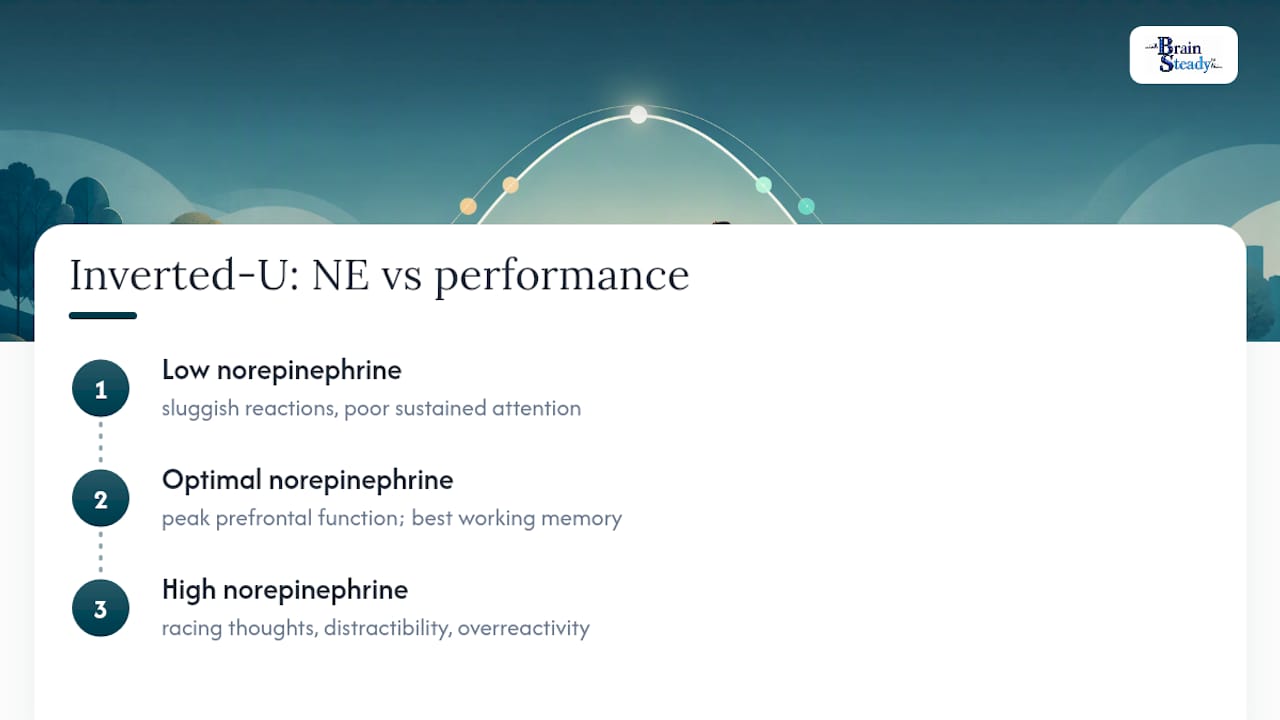
More norepinephrine is not automatically better. Cognitive performance follows what researchers call an inverted-U curve: too little noradrenergic activity leaves you foggy and unfocused, too much leaves you scattered and reactive, and peak prefrontal cortex function sits somewhere in the middle, according to research on the inverted-U model of norepinephrine effects.
The locus coeruleus tracks your sleep-wake cycle closely. Firing rates run high during wakefulness, drop during light sleep, and go essentially silent during REM sleep, which is part of why the LC-NE system functions as a core arousal driver. That baseline arousal level sets the stage for everything else norepinephrine does during the day.
The inverted-U in practice: Both excessively high and excessively low norepinephrine activity can impair the same prefrontal functions, including working memory, response inhibition, and cognitive flexibility, according to research reviewing the inverted-U framework. The direction of impairment differs, but the outcome, worse performance, looks similar from the outside.
On the low end, hypo-arousal tends to look like sluggish reaction times, trouble sustaining attention on repetitive tasks, and a kind of mental fog that coffee only partially fixes. On the high end, hyper-arousal shows up as racing thoughts, jumpiness, trouble filtering distractions, and a tendency to overreact to minor setbacks. Neither extreme is a diagnosis on its own. Both are physiological states that shift with sleep debt, illness, caffeine, stress load, and time of day.
Human experiments back this up in a striking way. In one line of research, blocking beta receptors with propranolol impaired people’s ability to detect target stimuli, while boosting norepinephrine availability with reboxetine, a reuptake inhibitor, actually improved detection of emotionally salient information, according to research on adrenergic manipulation and attention. Pushing the system in either direction changes performance, which is exactly what the inverted-U model predicts. Norepinephrine’s role in modulating attention and working memory is well documented, but the effect depends entirely on where someone starts on that curve, not just whether norepinephrine goes up or down. If you want a deeper look at how this plays out in everyday learning and alertness, norepinephrine’s impact on learning and clarity is worth a closer read.
Norepinephrine, Stress, and ADHD: Why It’s Not a Simple Story
Norepinephrine surges the moment your brain detects a threat, real or perceived, and that surge is useful. It sharpens attention, speeds reaction time, and mobilizes energy. Problems tend to show up not from having norepinephrine, but from the system staying activated too long or firing at the wrong moments, particularly in the circuit connecting the locus coeruleus to the prefrontal cortex.
That LC to PFC circuit behaves differently under acute stress versus chronic stress. A short burst sharpens focus. Sustained activation, the kind that comes from ongoing chronic stress, tends to degrade prefrontal control over emotional and attentional responses rather than sharpen it. This is a circuit-timing problem as much as a chemical-level problem.
A few things determine how any individual experiences noradrenergic activity, and none of them reduce to a single number:
- Receptor sensitivity varies from person to person, so identical norepinephrine levels can produce different subjective experiences.
- Timing and duration of activation matter as much as intensity. A brief spike and a sustained plateau look completely different behaviorally, even with similar peak levels.
- Circuit context shapes outcomes. The same neurotransmitter acting on a well-regulated prefrontal circuit produces a different result than it does on a circuit already under strain from poor sleep or chronic stress.
Experts increasingly push back against the “chemical imbalance” framing precisely because norepinephrine functions as a neuromodulator whose effects depend on receptor subtype, circuit architecture, and environmental context, not on some universal scale, according to a review of noradrenergic signaling in anxiety. Framing anxiety as simply “too much norepinephrine” or ADHD as simply “too little” oversimplifies a system that operates very differently across regions of the same brain.
Pharmacological evidence supports that nuance. Norepinephrine reuptake inhibitors (NRIs) and serotonin-norepinephrine reuptake inhibitors (SNRIs) raise synaptic norepinephrine availability and help some people with ADHD or depression, while alpha-2 agonists like guanfacine calm hyperarousal by strengthening prefrontal inhibitory control, and beta blockers reduce the physical symptoms of anxiety, like a racing heart, without necessarily changing the underlying emotional experience. That these different drug classes, working in opposite directions on the same neurotransmitter, can each help different people is itself proof that there’s no single “correct” norepinephrine level to chase. Current research on norepinephrine and cognitive function points to disrupted signaling as one contributing factor in attention difficulties, alongside dopamine and broader circuit issues, not a standalone explanation for ADHD.
Clinical and Medical Uses of Norepinephrine
Outside the brain, norepinephrine has a very different, very concrete job: it’s a hospital-grade drug used to keep blood pressure from collapsing in life-threatening situations. It’s classified as the first-line vasopressor for septic shock and other forms of distributive shock, meaning it’s usually the first medication a critical care team reaches for when someone’s blood pressure drops dangerously low, according to StatPearls’ clinical overview of norepinephrine.
A few practical facts about how this looks in a hospital setting:
- It’s given as a continuous IV infusion, never as a pill, because it has a very short half-life and needs constant titration to keep blood pressure in a safe range.
- Dosing is adjusted minute to minute based on continuous blood pressure monitoring, typically through an arterial line.
- Common adverse effects include hypertension, arrhythmias, and reduced blood flow to the extremities; if it leaks outside the vein (extravasation), it can cause serious local tissue injury.
This medical use has nothing to do with dietary or lifestyle approaches to supporting norepinephrine balance, and that distinction matters. Norepinephrine as a drug is a high-alert medication administered exclusively by trained clinical staff in monitored settings, under FDA-approved indications for shock and severe hypotension. It is never self-administered, never available over the counter, and not something anyone should attempt to replicate through supplementation. The everyday strategies covered next work through entirely different mechanisms, supporting your body’s own production and regulation of norepinephrine rather than delivering the compound directly.
Supporting Balanced Norepinephrine Naturally
You can’t dose your way to a specific norepinephrine level, and you shouldn’t try. What you can do is give your body the raw materials and conditions it needs to regulate this system the way it’s designed to. Consistent lifestyle factors, sleep, physical activity, predictable routines, and balanced nutrition, support natural norepinephrine rhythms and cognitive performance, and they’re the foundation to get right before considering anything else.
-
Protect your sleep schedule, not just your sleep hours. The locus coeruleus tracks your circadian rhythm closely, and irregular bedtimes disrupt that tracking even if total sleep time stays the same. Aim for the same wake-up time daily, weekends included, since consistency matters more than any single “perfect” bedtime.
-
Use movement as a regulation tool, not just exercise. A brisk 10 to 15 minute walk, especially outdoors and especially in the morning, provides a mild, controlled arousal boost that can shift someone out of a foggy, understimulated state without overshooting into jitteriness.
-
Build protein into meals consistently. Since norepinephrine synthesis starts with tyrosine, meals that include protein sources like eggs, poultry, fish, or legumes give your body the raw material it needs throughout the day, rather than relying on caffeine or sugar spikes for alertness.
-
Keep routines predictable, especially for kids. Predictable transitions, consistent mealtimes, and clear expectations reduce the number of small, unpredictable stressors that keep the noradrenergic system on edge throughout the day.
-
Build in deliberate stress-reduction time. Whether that’s quiet time, a walk, or simply not scheduling every hour, unstructured downtime gives an overactivated system room to settle back toward baseline.
Pro Tip: If mornings are chaotic in your house, try moving movement earlier rather than adding more of it. A short walk or stretch right after waking often does more for daytime focus than a longer workout scheduled for later, because it lines up with when the locus coeruleus is already ramping up its activity.
Some nutrients come up often in discussions of neurotransmitter support, and it’s worth understanding what the evidence actually shows rather than treating any of them as a fix. NAC (N-acetylcysteine) supports antioxidant pathways that may influence broader neurotransmitter balance. Taurine plays a role in regulating neuronal excitability. Vitamin B6 is a required cofactor in the enzymatic pathway that converts dopamine into norepinephrine, making it structurally relevant to the process described earlier. Phosphatidylserine is a phospholipid involved in cell membrane function that’s been studied for its role in supporting cognitive processes tied to attention and stress response. None of these compounds are treatments for a diagnosed condition, and none should be started without a conversation with a pediatrician, physician, or psychiatrist, especially for kids or anyone already taking medication. For more on how nutrition and daily habits intersect with this system, practical tips for supporting norepinephrine balance covers this in more depth, and this guide to natural sleep and hormone support offers additional practical strategies for the sleep piece specifically.
When to Seek Professional Help
Everyday ups and downs in focus and mood don’t require a doctor’s visit. Certain patterns do.
- Seek a primary care or mental health evaluation if attention problems, mood swings, or behavioral difficulties are persistent, interfering with school, work, or relationships, and not explained by a temporary stressor like illness or a major life change.
- Don’t rely on lab tests to self-diagnose a “norepinephrine imbalance.” Blood and urine tests measure peripheral levels that don’t reliably reflect brain signaling, and there is no standard clinical test that diagnoses attention or mood disorders through norepinephrine levels alone. A clinical assessment, not a lab value, is what actually identifies the issue.
- Talk to a prescriber before combining supplements with medication. NAC, taurine, B6, and phosphatidylserine can interact with certain psychiatric or cardiovascular medications, and a prescriber needs the full picture before you add anything new, especially for children.
- Treat certain physical symptoms as emergencies, not lifestyle issues: severe or sudden hypotension, fainting, chest pain, or an irregular heartbeat need urgent medical attention right away, since these can reflect serious cardiovascular or adrenergic system problems beyond the scope of everyday brain-health strategies.
A Practical Take on Norepinephrine for Real Families
The science here is genuinely reassuring once you sit with it. Norepinephrine isn’t a dial you’re failing to turn correctly, and a bad week of focus or a short fuse doesn’t mean your brain chemistry is broken. It means a system that’s supposed to respond to context is doing exactly that, responding to sleep debt, stress, or an unpredictable schedule.
I think the biggest mistake caregivers make is treating attention or mood struggles as a fixed trait to diagnose from a distance, instead of a pattern to observe over time. A kid who melts down after a chaotic, poorly slept week isn’t necessarily showing a hidden disorder. A parent who’s sharp and reactive during a stretch of bad sleep isn’t experiencing a permanent personality shift. Watch the pattern, adjust the fixable pieces, sleep, movement, routine, and see what changes before assuming the worst.
None of this replaces professional evaluation when a pattern is persistent or disruptive. It just means the first, most useful move is often the boring one: fix the sleep schedule, add a short walk, tighten up the routine, and see what happens before reaching for a bigger explanation.
— Ellory
Where BrainSteady Fits Into a Norepinephrine-Aware Routine
Once sleep, movement, and routines are in place, some families and adults look for extra nutritional support, and that’s where brain health supplements like BrainSteady can play a role. Such supplements are formulated as a complement to those foundations, not a substitute for them and not a medication or treatment for any diagnosed condition.

BrainSteady includes NAC, taurine, vitamin B6, and phosphatidylserine, the same nutrients discussed above for their roles in antioxidant support, neuronal regulation, and the enzymatic pathway that produces norepinephrine from dopamine. What makes this approach practical rather than speculative is that it targets the raw materials and cofactors your body already uses, instead of promising to directly raise or lower a neurotransmitter level no supplement can safely control. If you’re weighing whether it fits your family’s routine, talk to your pediatrician or physician first, especially if anyone in the household takes medication, and then explore the BrainSteady product details to see the full ingredient breakdown and get started.
Where to Read More
For readers who want to go deeper into the mechanisms covered here, a few sources stand out. The NCBI Bookshelf overview of norepinephrine covers biosynthesis and receptor physiology in detail. The inverted-U model review explains the prefrontal cortex research behind the arousal curve. For cognition and ADHD-relevant findings, the PMC review on norepinephrine and cognition is a solid next step. Clinical readers can consult StatPearls’ vasopressor guidance for medical administration details.
FAQ
What does norepinephrine do to a person?
It increases alertness, sharpens attention, prepares the body for quick action, and raises heart rate and blood pressure as part of the stress response. It also helps modulate working memory and emotional processing through its effects on the prefrontal cortex.
What does a lack of norepinephrine feel like?
Low noradrenergic activity often feels like fogginess, sluggish reaction time, and trouble sustaining attention on repetitive tasks, but these symptoms overlap with poor sleep, fatigue, and other conditions, so they shouldn’t be self-diagnosed as a norepinephrine deficiency.
Is norepinephrine high or low in anxiety?
Anxiety generally involves overactive noradrenergic signaling, particularly heightened locus coeruleus activity and receptor sensitivity in stress circuits, but researchers caution that this isn’t a simple “too much norepinephrine” problem since receptor subtype and circuit context both shape the outcome.
What is the role of norepinephrine in ADHD?
Norepinephrine helps regulate attention, working memory, and response inhibition, and disrupted noradrenergic signaling is one contributing factor researchers link to ADHD-related attention difficulties, alongside dopamine and other circuit-level differences, rather than a single standalone cause.
