
For most children, the recommended daily magnesium intake varies by age and sex, increasing from infancy to teenage years. Supplemental magnesium (from pills, gummies, or liquid drops) has separate, lower safety ceilings that don’t apply to magnesium from food. Talk to your pediatrician before starting any supplement.
Here’s the full RDA/AI breakdown from the NIH Office of Dietary Supplements:
- 0 to 6 months: an amount around 30 mg/day (Adequate Intake)
- 7 to 12 months: an amount around 75 mg/day (Adequate Intake)
- 1 to 3 years: an amount near 80 mg/day
- 4 to 8 years: an amount near 130 mg/day
- 9 to 13 years: an amount near 240 mg/day
- 14 to 18 years, male: an amount near 410 mg/day
- 14 to 18 years, female: an amount near 360 mg/day
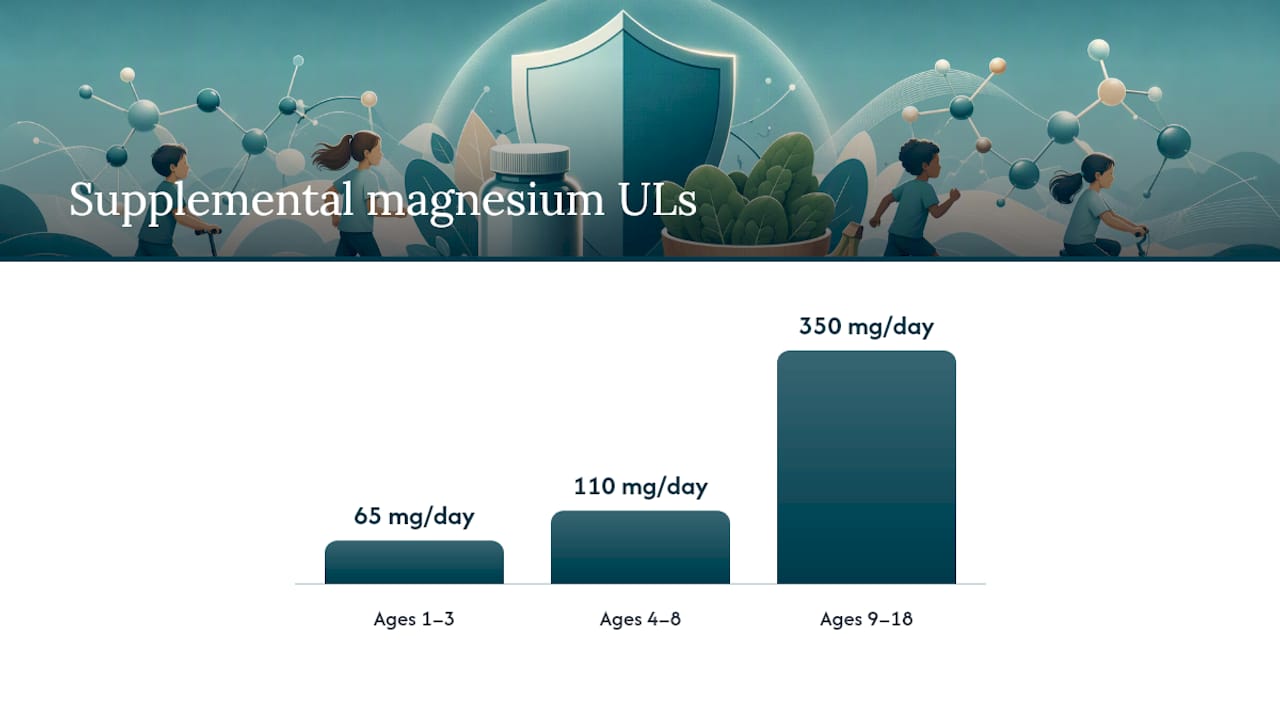
Supplemental Tolerable Upper Intake Levels (UL) are lower and apply only to pills, powders, or medications, not to food: 65 mg/day for ages 1 to 3, 110 mg/day for ages 4 to 8, and 350 mg/day for ages 9 to 18. Prioritize magnesium-rich meals first, and loop in your pediatrician before adding a supplement.
Key Takeaways
Meeting a child’s magnesium needs works best through age-appropriate food choices first, with supplements reserved for confirmed gaps and pediatrician-guided dosing.
| Point | Details |
|---|---|
| RDAs scale with age and sex | Needs range from 30 mg for infants to 410 mg for teen boys, per NIH Office of Dietary Supplements data. |
| ULs apply to supplements only | Food-sourced magnesium isn’t capped; supplemental limits run from 65 mg (ages 1 to 3) to 350 mg (ages 9 to 18). |
| Food beats supplements by default | Pumpkin seeds, almonds, spinach, and black beans build toward RDAs without overdose risk. |
| Serum testing has blind spots | Normal blood levels can mask low total-body magnesium, so symptom history matters more. |
| Snapbrainformula supports the food-first approach | Its child and teen formulations are designed to complement diet, not replace pediatrician-guided supplementation decisions. |
Table of Contents
- How Much Magnesium Do Kids Really Need, and Why Does It Change?
- What Foods Give Kids the Most Magnesium?
- When Should Parents Consider a Magnesium Supplement?
- What Are the Risks of Too Much Magnesium in Kids?
- What Symptoms Suggest a Child Might Need More Magnesium?
- What Should You Bring to a Pediatric Appointment About Magnesium?
- The Gap Between the RDA Chart and What Actually Happens at Dinner
- A Responsible Next Step for Families Considering Support
- Frequently Asked Questions
- Sources
How Much Magnesium Do Kids Really Need, and Why Does It Change?
The numbers above aren’t arbitrary. They come from three overlapping concepts nutrition scientists use: the RDA (Recommended Dietary Allowance), the AI (Adequate Intake), and the EAR (Estimated Average Requirement). The RDA is the daily amount that covers the needs of roughly 97 to 98 percent of healthy people in a given age and sex group. The AI is used instead of an RDA when there isn’t enough data to calculate a precise average requirement, which is why infant values are labeled AI rather than RDA. The EAR is the midpoint estimate, the amount that would meet the needs of exactly half a population, and it’s the building block researchers use to calculate the RDA itself.
| Age Group | RDA/AI (mg/day) |
|---|---|
| 0 to 6 months | 30 (AI) |
| 7 to 12 months | 75 (AI) |
| 1 to 3 years | 80 |
| 4 to 8 years | 130 |
| 9 to 13 years | 240 |
| 14 to 18 years, boys | 410 |
| 14 to 18 years, girls | 360 |
Notice the jump for teen boys. That 50 mg gap between boys and girls at 14 to 18 isn’t a rounding quirk. It reflects faster lean tissue and bone accretion during male adolescent growth spurts, which pulls more magnesium into muscle and skeletal stores during those years, according to the National Academies’ Dietary Reference Intakes report.
It’s worth knowing that some of these figures were extrapolated from a limited number of balance studies, meaning researchers tracked magnesium intake versus excretion in small groups and used reference body weights to scale results across ages. That’s not a weakness so much as an honest limitation. The RDA is built to cover the needs of nearly all healthy kids in that age range, but individual requirements still vary with activity level, growth rate, and overall diet quality.
What Foods Give Kids the Most Magnesium?
Food-first is the safer, simpler default. Magnesium from food doesn’t carry the same overdose risk as supplements because your kidneys regulate absorption from meals far more efficiently than from concentrated doses, per guidance from the Linus Pauling Institute.
Kid-friendly sources that pack a real magnesium punch:
- Pumpkin seeds: about 37 mg per tablespoon
- Almonds: roughly 80 mg per ounce (about 23 almonds)
- Cooked spinach: around 78 mg per half cup
- Peanut butter: about 25 mg per tablespoon
- Black beans: roughly 60 mg per half cup, cooked
- Whole grain bread: about 23 mg per slice
Processing strips magnesium fast. Refining wheat into white flour removes most of the germ and bran, where magnesium concentrates, which is one reason whole grains beat white bread and white rice on this metric.
Three easy swaps: pumpkin seeds sprinkled on yogurt, a spinach and black bean quesadilla, or peanut butter on whole grain toast instead of white.
When Should Parents Consider a Magnesium Supplement?
Supplements aren’t the first move. They’re a follow-up conversation once diet and a doctor’s evaluation point toward an actual gap. A few scenarios where a pediatrician might reasonably recommend one:
- Confirmed or suspected deficiency identified through clinical evaluation, not just a hunch.
- Malabsorption conditions like celiac disease or inflammatory bowel disease that reduce mineral uptake.
- Chronic gastrointestinal losses, such as prolonged diarrhea or certain laxative use.
- Highly restrictive diets that cut out major magnesium sources like nuts, legumes, or whole grains.
- Certain medications that increase magnesium excretion, which your pediatrician can flag.
If a supplement is warranted, the label matters more than the marketing. Magnesium oxide has a high percentage of elemental magnesium by weight but tends to absorb poorly and cause more loose stools. Magnesium citrate absorbs better but can still have a laxative effect at higher doses. Magnesium glycinate is generally gentler on the stomach and often preferred for kids who need steady dosing without GI upset.
Pro Tip: Check the label for “elemental magnesium” in milligrams, not just the total compound weight. A 500 mg magnesium oxide tablet might only supply about 300 mg of actual elemental magnesium, since some of that weight is the oxide component itself.
What Are the Risks of Too Much Magnesium in Kids?
The Food and Nutrition Board sets clear supplemental ceilings, and they’re intentionally conservative: 65 mg/day for ages 1 to 3, 110 mg/day for ages 4 to 8, and 350 mg/day for ages 9 to 18. These limits cover pills, powders, and medications only. Magnesium naturally occurring in food isn’t included because healthy kidneys clear excess dietary magnesium efficiently, making food-based overdose extremely rare in healthy children.

Supplemental magnesium above the UL usually shows up first as gastrointestinal distress: diarrhea, nausea, and abdominal cramping. Push doses higher and the risks escalate to low blood pressure and, in rare severe cases, irregular heart rhythm. Any of those warrant an urgent call to your pediatrician or poison control.
A few interaction and condition cautions deserve equal weight here. Children with impaired kidney function face a meaningfully higher risk of dangerous magnesium buildup, since the kidneys are what clear the excess. Certain diuretics and long-term proton pump inhibitor use can also shift magnesium balance in ways that complicate supplementation. None of these situations are a reason to guess. They’re a reason to loop in a clinician before starting anything.
What Symptoms Suggest a Child Might Need More Magnesium?
Muscle cramps, restless or poor-quality sleep, fatigue, irritability or anxiety, and trouble concentrating can all appear with low magnesium status. They also overlap heavily with dozens of other common childhood issues, from iron deficiency to simple overtiredness, which is exactly why guesswork isn’t a great diagnostic strategy.
Here’s the catch with testing: a standard serum magnesium blood test often comes back normal even when a child has genuinely low total-body magnesium. That’s because less than 1 percent of the body’s magnesium circulates in the blood; the rest sits in bone and inside cells, invisible to a routine serum draw. That’s why clinicians tend to weigh symptom history and dietary patterns more heavily than a single lab value.
If testing feels warranted, a pediatrician may look beyond basic serum magnesium toward a broader metabolic panel, or simply track symptoms alongside a diet trial before ordering more invasive testing.
What Should You Bring to a Pediatric Appointment About Magnesium?
Walk in prepared and you’ll get a faster, more useful conversation. Bring:
- A three-day diet log, so your pediatrician can spot magnesium gaps quickly.
- A symptom diary noting frequency and timing of cramps, sleep issues, or mood changes.
- A current medication list, including anything that affects mineral balance.
- Recent growth metrics, since rapid growth phases shift magnesium needs.
Clinicians who do recommend supplementation typically start low, watch for GI tolerance over several days, and adjust from there rather than jumping to a high fixed dose. Liquid formulations often win out for younger kids because they allow more precise, gradual dosing.
Pro Tip: If a supplement is started, track bowel habits for the first week. Loose stools are the most common early sign the dose needs to come down, not up.
Where Snapbrainformula Fits Into the Bigger Picture
Snapbrainformula’s educational mission centers on helping families understand the link between nutrition and brain chemistry, including how minerals like magnesium interact with mood and focus. Ellory contributes research-grounded analysis to that mission, not clinical advice.
For related reading, see how diet and brain supplements interact with mental well-being and natural approaches to calming an anxious mind.
The Gap Between the RDA Chart and What Actually Happens at Dinner
The conventional advice on kids’ magnesium tends to stop at the chart: here’s the RDA, don’t exceed the UL, done. That’s accurate but incomplete. The real gap isn’t in the numbers, it’s in the assumption that parents will translate “240 mg for a 10 year old” into an actual grocery list. Most won’t, because milligram math doesn’t survive contact with a picky eater.
What the research actually supports is a much simpler priority order: fix the plate before you touch the pill bottle. A kid who eats pumpkin seeds, black beans, and whole grain toast a few times a week is closer to their RDA than most supplement marketing implies, and without any UL risk at all. Supplements earn their place only after a real dietary gap or a clinical reason shows up, not as a default insurance policy.
Where I’d push back hardest on common advice: serum magnesium testing gets treated like a definitive yes/no answer when it’s closer to a coin flip for detecting true deficiency. If your pediatrician orders it, treat the result as one data point among several, not a verdict.
A Responsible Next Step for Families Considering Support
If you’ve read this far, you already know food comes first and pediatrician guidance comes before any bottle. Snapbrainformula’s formulations for children, teens, and adults were built with that same sequence in mind: evidence-informed support for mood, focus, and emotional balance, designed to complement a solid diet rather than replace it.

Snapbrainformula’s product pages and educational blog walk through how each formulation is designed, including how specific nutrients support cognitive health and which supplements are commonly used for neurotransmitter balance. Bring any product you’re considering to your pediatrician first, then browse the Snapbrainformula supplement lineup to see which formulation fits your family’s needs and start that conversation with real information in hand.
Frequently Asked Questions
What is a safe magnesium dosage for kids by age? Safe intake follows the NIH RDA/AI values: 30 mg for infants under 6 months, up to 410 mg for teen boys aged 14 to 18. Supplemental doses should stay under the age-specific UL, which tops out at 350 mg for ages 9 to 18.
Can a child get too much magnesium from food alone? It’s uncommon. Healthy kidneys regulate absorption from dietary sources efficiently, which is why the Tolerable Upper Intake Level applies only to supplements and medications, not meals.
What are early signs of magnesium deficiency in children? Muscle cramps, restless sleep, fatigue, irritability, and trouble concentrating can all signal low magnesium, though these symptoms overlap with many other common childhood conditions.
Is magnesium glycinate better than magnesium oxide for kids? Magnesium glycinate tends to cause fewer digestive side effects than magnesium oxide, though oxide contains a higher percentage of elemental magnesium by weight. Tolerability often matters more in practice for younger children.
Should I test my child’s magnesium levels before giving a supplement? A serum magnesium test alone often won’t catch a true deficiency, since most magnesium in the body is stored in bone and cells rather than blood. Discuss symptoms and diet history with your pediatrician alongside any testing.
This article is general information, not a substitute for advice from a qualified doctor. Consult a qualified healthcare professional about your own circumstances before acting on anything here.
Sources
- Magnesium - Health Professional Fact Sheet (NIH ODS)
- Dietary Reference Intakes: Magnesium (National Academies / NCBI)
- Magnesium (Linus Pauling Institute, Oregon State University)
Recommended
- How to Build Effective Routines for Children with Neurodevelopmental Disorders – SNAP Brain Health Supplements
- 10 Supplements to Help Calm Your Mind Naturally – SNAP Brain Health Supplements
- Top 7 Brain Supplements to Support Neurotransmitter Balance – SNAP Brain Health Supplements
- Top 7 Supplements to Ease Your Anxiety Effectively – SNAP Brain Health Supplements
