
The relationship between gluten and autism spectrum disorder is one of the most searched and most misunderstood topics in autism care. Here is the short answer: current scientific evidence does not support a gluten-free diet as a primary treatment for core ASD symptoms like social communication difficulties or repetitive behaviors. That said, the picture is more nuanced than a flat “it doesn’t work.” Some autistic individuals do have gastrointestinal conditions, including celiac disease, where gluten removal is medically necessary. Others experience digestive symptoms that may improve on a restricted diet. And sensory processing differences shape what many autistic children will and won’t eat, which affects how gluten fits into their diet at all.
Before you make any dietary changes for your child or yourself, here is what the evidence actually supports:
-
Gluten-free diets show negligible effects on core ASD behaviors in randomized controlled trials
-
Gastrointestinal symptoms, not behavioral symptoms, are the more consistent area of reported improvement
-
Celiac disease and non-celiac gluten sensitivity can co-occur with autism and warrant proper screening
-
Food selectivity driven by sensory processing differences affects most autistic children’s diets independently of any gluten-specific concern
-
Unsupervised elimination diets carry real nutritional risks, particularly for children who already eat a narrow range of foods
Table of Contents
-
What biological mechanisms might connect gluten to ASD symptoms?
-
What do clinical trials actually show about gluten-free diets for ASD?
-
How do sensory differences shape what autistic children eat?
How common are gut problems and celiac disease in autism?
Gastrointestinal symptoms are significantly more prevalent in autistic individuals than in the general population. Constipation, diarrhea, abdominal pain, and bloating appear frequently, and these symptoms can worsen behavioral presentations because pain and discomfort are hard to communicate, especially for nonverbal children. When a child cannot explain that their stomach hurts, that distress often surfaces as irritability, self-injury, or increased stimming.
Celiac disease, an autoimmune condition triggered by gluten, occurs at variable rates in autistic populations across studies. A case-control analysis of 140 pediatric patients found that immune reactivity to gluten was linked to behavioral and psychometric changes in some individuals with autism, affecting communication and social interaction. Importantly, antibodies against gluten in ASD differ from those seen in classic celiac disease, which complicates straightforward diagnosis. Non-celiac gluten sensitivity, a condition without the autoimmune markers of celiac disease but with real digestive and systemic symptoms, adds another layer of complexity.
The overlap between GI symptoms and autism-related behaviors makes diagnosis genuinely difficult. A child with undiagnosed celiac disease may show behavioral regression, increased anxiety, or sleep disruption, symptoms that look like ASD-related changes but are driven by gut inflammation. Screening for celiac disease before attributing GI symptoms purely to autism is not optional; it is a clinical necessity.
| GI Symptom | Reported in ASD Populations | Clinical Implication |
|---|---|---|
| Constipation | Frequently reported | May worsen behavioral symptoms; requires dietary and medical management |
| Diarrhea | Frequently reported | Can indicate food intolerance or celiac disease; warrants screening |
| Abdominal pain | Common | Often underreported due to communication barriers |
| Bloating | Common | May signal gut microbiota imbalance or gluten sensitivity |
| Gut permeability (“leaky gut”) | Hypothesized in subset | Central to opioid excess theory; not universally confirmed |
Key considerations for GI assessment in autism:
-
Rule out celiac disease with serology (tTG-IgA) before starting a gluten-free diet
-
Distinguish between food selectivity-driven nutritional gaps and true food intolerance
-
Track GI symptoms alongside behavioral changes to identify patterns
-
Involve a pediatric gastroenterologist when symptoms are persistent or severe
What biological mechanisms might connect gluten to ASD symptoms?
Several theories attempt to explain why gluten might affect behavior in autistic individuals. None has been definitively proven, but they are worth understanding because they inform why families pursue gluten-free diets and why researchers keep studying the question.
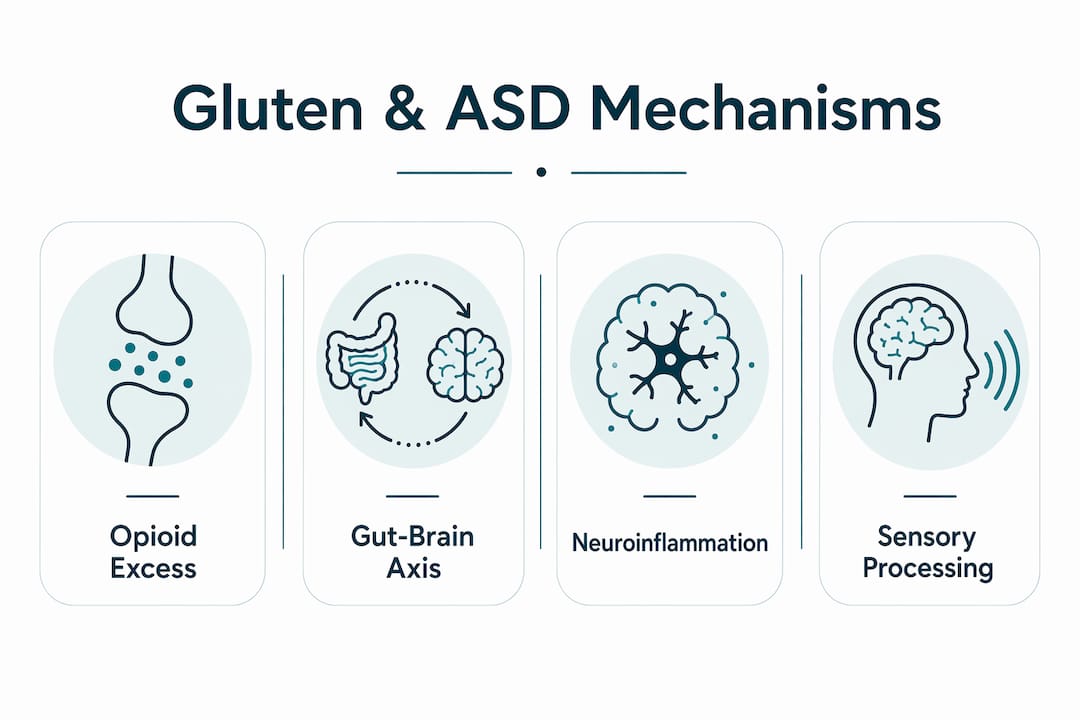
The opioid excess hypothesis is the most widely cited mechanism. Gluten and casein (the protein in dairy) are incompletely digested in some individuals, producing peptides with opioid-like activity. The theory holds that in children with increased intestinal permeability, these peptides cross the gut lining, enter the bloodstream, and eventually cross the blood-brain barrier, where they interfere with neurotransmitter function and contribute to behaviors associated with autism. Two studies reviewed in a scoping review of 27 articles found decreased peptide levels and improved autism symptoms after GFCF diet implementation, offering partial support for this pathway.

The gut-brain axis is a second framework. The gut and brain communicate bidirectionally through the vagus nerve, immune signaling, and microbial metabolites. Autistic individuals often show altered gut microbiota composition, and abnormalities in carbohydrate digestion and absorption have been documented in a subset of ASD children between ages 6 and 17. Whether gluten specifically drives these microbiota changes or whether the changes are downstream of broader dietary patterns remains unclear.
Neuroinflammation is a third angle. Immune dysregulation is well-documented in autism, and some researchers hypothesize that gluten triggers low-grade inflammatory responses that affect brain function. This is distinct from celiac disease’s autoimmune mechanism but may share some pathways.
| Mechanism | Core Claim | Evidence Strength |
|---|---|---|
| Opioid excess hypothesis | Gluten-derived peptides act on the CNS via leaky gut | Moderate (supported by peptide studies; not universally replicated) |
| Gut-brain axis disruption | Altered microbiota and carbohydrate digestion affect behavior | Moderate (consistent with broader gut-brain research) |
| Neuroinflammation | Gluten triggers immune responses affecting brain function | Preliminary (theoretical; limited direct evidence in ASD) |
| Immune reactivity to gluten | Antibodies to gluten differ in ASD vs. celiac disease | Emerging (case-control data; needs larger studies) |
Sensory processing differences add another layer. Digestive discomfort from gluten-containing foods may heighten sensory sensitivity, creating a feedback loop where eating becomes more aversive and food selectivity increases. Understanding sensory processing challenges in autism helps clarify why gut symptoms and behavioral symptoms are so difficult to disentangle.
What do clinical trials actually show about gluten-free diets for ASD?
This is where the evidence gets specific, and where a lot of popular claims fall apart under scrutiny.
A critical systematic review published in 2026 found that the effect size for ASD behavioral symptoms from a gluten-free casein-free diet was negligible (d=0.16, 95% CI: −0.04 to 0.36). Gastrointestinal symptoms showed more meaningful improvement (d=0.41, p=.04), which is a meaningful distinction. The diet may help the gut; it does not reliably change core autism behaviors.
A separate meta-analysis of 8 randomized controlled trials with 297 participants found a more encouraging signal: GFCF dietary intervention was associated with statistically significant reductions in stereotypical behaviors (SMD = −0.41, 95% CI: −0.68 to −0.15) and improvements in cognition (SMD = −0.46, 95% CI: −0.91 to −0.01). No significant changes were observed in social communication or other symptom categories. The authors acknowledged that most included studies were single-blind, limiting the strength of conclusions.
What the data actually shows: GI symptom improvement from GFCF diets has an effect size reported for GI symptom improvement was moderate, while behavioral symptom improvement was negligible. The gut responds more consistently than behavior does.
A scoping review of 27 articles covering studies published between 2013 and 2024 found that evidence for the GFCF diet in autism is mixed and limited. Systematic review results indicate negligible benefit for ASD behaviors (d=0.16, 95% CI: −0.04 to 0.36), with more meaningful improvement in GI symptoms (d=0.41, p=.04). This distinction is key: GI outcomes show some response, while behavioral symptoms do not. Several factors complicate these findings, including small sample sizes, varying study durations, and inconsistent outcome measures. The clinical consensus: a gluten-free diet has not been proven effective for autism’s core features but may help those with confirmed GI issues or celiac disease.
How do sensory differences shape what autistic children eat?
Food selectivity in autism is not picky eating. That distinction matters clinically and practically. Research shows that children with atypical oral sensory over-sensitivity refuse more foods, eat fewer vegetables, and maintain narrower food repertoires than their neurotypical peers. The driver is sensory, not preference in the conventional sense.

Autistic children often have hypersensitivity to taste, smell, texture, and temperature. A food that smells slightly “off” to a neurotypical child may be genuinely overwhelming to an autistic child. Textures that most people barely notice, like the slight chewiness of whole grain bread, can trigger a gag response. This is why many autistic children gravitate toward foods with consistent, predictable sensory profiles: white bread, plain pasta, crackers. These foods happen to be high in gluten.
Food selectivity also functions as a sensory regulation strategy. Eating the same foods in the same way reduces unpredictability and anxiety. When a caregiver tries to eliminate gluten-containing “safe foods” without a careful transition plan, the result is often increased distress, food refusal, and nutritional risk, not improved behavior.
Pro Tip: Before removing any food group, spend 5–7 days tracking exactly what your child eats, including textures, temperatures, and brands they accept. This baseline helps a dietitian identify which nutrients are at risk and which “safe foods” might serve as gluten-free substitutes with similar sensory properties.
The nutritional risks of food selectivity are real even before any elimination diet begins. Children who eat primarily refined carbohydrates often have inadequate intake of fiber, iron, calcium, and B vitamins. Removing gluten-containing foods without replacing them with nutritionally equivalent alternatives can deepen these gaps. Gluten-free processed foods are frequently lower in fiber and B vitamins than their conventional counterparts, and they are often more expensive.
Multidisciplinary support matters here. A feeding therapist, occupational therapist, and registered dietitian working together can address the sensory drivers of food selectivity while protecting nutritional status. Trying to manage this alone, through elimination diets without professional guidance, is where families most often run into trouble. Practical sensory processing tips for autism can help caregivers build a foundation before tackling dietary changes.
How to manage gluten and diet in autism safely
If you are considering a gluten-free diet for an autistic child or adult, the process matters as much as the decision. Here is what evidence-based practice actually looks like.
Start with clinical screening. Before eliminating gluten, get a celiac disease panel (tTG-IgA, total IgA) and a basic nutritional assessment. If celiac disease is confirmed, a strict gluten-free diet is medically necessary. If it is not, you are making a lifestyle choice that carries nutritional trade-offs, and you should go in with eyes open.
Work with a registered dietitian. Unsupervised elimination diets in children who already eat a narrow range of foods can create or worsen deficiencies in calcium, vitamin D, iron, zinc, and B vitamins. A dietitian can identify safe gluten-free substitutes that match the sensory profile of foods your child already accepts, monitor nutritional status over time, and adjust the plan as needed.
Set clear, measurable goals. If you are trying the diet to address GI symptoms, track those symptoms specifically. If you are hoping for behavioral changes, use a structured behavior log so you can evaluate whether changes are real and sustained. Vague impressions of improvement are not reliable, especially when you are also changing routines and paying more attention to mealtimes.
Respect sensory needs. Forcing a child to eat new foods, even nutritionally superior ones, without a gradual sensory introduction plan typically backfires. Introduce gluten-free alternatives slowly, alongside accepted foods, using the same textures and flavors your child already tolerates. Structured mealtime routines reduce anxiety and improve food acceptance over time.
Know what health authorities actually say. No major U.S. health authority, including the American Academy of Pediatrics or the CDC, recommends a gluten-free diet as a standard intervention for autism. The recommendation from clinical nutrition experts is consistent: screen for medical conditions first, support nutritional adequacy, and involve a multidisciplinary team before starting any restrictive diet. Guidelines from clinical practice emphasize sensory considerations over forced dietary variety and accept consistent intake of “safe foods” when nutrition and hydration are adequate.
Consider the whole picture. Dietary intervention is one piece of a broader support plan that may include behavioral therapy, occupational therapy, speech therapy, and, for some families, nutritional supplementation to address gaps. No single intervention addresses all of autism’s complexity, and a gluten-free diet is no exception.
A few practical checkpoints for families considering this path:
-
Confirm or rule out celiac disease before starting
-
Baseline nutritional labs: iron, ferritin, vitamin D, calcium, B12
-
Identify gluten-free “safe food” alternatives with matching sensory profiles
-
Set a defined trial period (typically 3–6 months) with specific outcome measures
-
Schedule follow-up labs at 3 months to catch emerging deficiencies early
-
Keep the rest of the child’s routine as stable as possible during the dietary transition
Supporting brain health alongside dietary changes
Dietary changes are one piece of a larger puzzle. For families navigating autism, gut health, and sensory challenges, nutritional support that addresses gaps in brain chemistry can complement whatever dietary approach you choose.

Snapbrainformula offers evidence-informed supplements designed for children, teens, and adults to support mood, focus, and emotional balance, including formulations relevant to the nutritional gaps common in autism. When a restricted diet limits intake of key nutrients, targeted supplementation can help fill those gaps under clinical guidance. Explore SNAP brain health supplements to learn how nutritional support fits into a comprehensive autism care plan.
Key Takeaways
The evidence on gluten and autism consistently shows that GI symptoms respond more reliably to dietary changes than core ASD behaviors do, making medical screening and nutritional oversight the non-negotiable first steps before any elimination diet.
| Point | Details |
|---|---|
| GI symptoms vs. core ASD behaviors | Gluten-free diets show more consistent GI benefit (d=0.41) than behavioral benefit (d=0.16) in systematic reviews. |
| Celiac disease screening first | Always test for celiac disease before starting a gluten-free diet; undiagnosed celiac can drive behavioral symptoms. |
| Sensory-driven food selectivity | Food refusal in autism is usually sensory-based, not preference-based, and shapes which foods a child will accept. |
| Nutritional risk is real | Unsupervised gluten elimination in children with narrow diets can worsen deficiencies in calcium, iron, and B vitamins. |
| No universal recommendation | No major U.S. health authority recommends gluten-free diets as a standard autism treatment; individualized assessment is essential. |
Recommended
-
Understanding Sensory Processing Challenges in Autism – SNAP Brain Health Supplements
-
Understanding Sensory Processing Challenges in Autism – SNAP Brain Health Supplements
-
10 Essential Sensory Processing Tips for Autism Support – SNAP Brain Health Supplements
-
The Ultimate Guide to ASD and Sensory Processing for Parents – SNAP Brain Health Supplements
