
Executive function refers to the set of mental skills, mainly working memory, inhibitory control, and cognitive flexibility, that let you hold information in mind, resist distraction, and shift between tasks or ideas. These skills develop from infancy through young adulthood and remain shaped by experience throughout life. Executive function can decline under stress, sleep loss, or certain conditions, but it can also be strengthened. The rest of this guide covers how it develops, what impairs it, how it’s assessed, and what actually helps.
TL;DR:
- Executive function relies on three core skills: working memory, inhibitory control, and cognitive flexibility, which work together like air traffic control.
- Development extends from infancy through young adulthood, with significant improvements in childhood and stability in adulthood, but some decline can occur in later life.
- Conditions such as sleep deprivation, acute stress, and illness can temporarily impair executive function, while structural brain injuries tend to cause lasting decline.
- Support strategies tailored to age and setting, like routines for children or environmental modifications for adults, are more effective than generic cognitive drills.
- Lifestyle habits like sleep, exercise, and stress management have the strongest evidence for improving executive function, supplemented by targeted skills practice and environmental supports.
Table of Contents
- What Are the Core Components of Executive Function?
- How Does Executive Function Develop Across the Lifespan?
- What Conditions and Situations Impair Executive Function?
- What Are the Signs of Poor Executive Function?
- How Is Executive Function Assessed?
- What Actually Improves Executive Function?
- What Strategies Work Best by Age and Setting?
- Where Do Nutritional Supports Fit Into an Executive Function Plan?
- A Closing Thought on Supporting Executive Function
- Support Executive Function With Snapbrainformula’s Evidence-Informed Formulas
- Sources
What Are the Core Components of Executive Function?
Executive function isn’t one skill. It’s three, working together like a coordination system that decides what gets attention, what gets ignored, and when to change course. The Harvard Center on the Developing Child compares this system to air traffic control, managing a constant stream of competing information so a person can act on purpose rather than on autopilot.
Working memory is the ability to hold information in mind and use it, not just store it. A kid following a three-step instruction (“get your shoes, grab your backpack, meet me at the door”) is running working memory. So is an adult holding a phone number in mind while typing it into a contact list, or mentally tracking a conversation’s earlier point while formulating a reply.
Inhibitory control is the brake pedal. It’s what lets someone stay quiet during a meeting instead of blurting out a half-formed thought, or keep working through a task while a phone buzzes on the desk. Without it, impulses win by default.
Cognitive flexibility is the ability to shift between tasks, rules, or perspectives. Switching from writing an email to answering a colleague’s question, then back to the email without losing the thread, is cognitive flexibility in action. So is adjusting a plan when a meeting gets moved or a recipe is missing an ingredient.
These three core executive functions support higher-order skills like planning, reasoning, and problem-solving, according to a comprehensive review by neuroscientist Adele Diamond. Planning a birthday party, for instance, draws on working memory to track the guest list and budget, inhibitory control to stay on task instead of getting sidetracked by unrelated errands, and cognitive flexibility to adjust when the venue falls through.
Researchers also separate executive functions into “hot” and “cool” categories, and the distinction matters more than it might seem:
- Cool EFs operate in low-stakes, non-emotional contexts, like solving a puzzle or sorting cards by rule.
- Hot EFs kick in when emotion or reward is involved, like resisting a tempting purchase or managing frustration during a disagreement.
A person can have strong cool EF (they ace a logic problem) and weak hot EF (they melt down when a plan changes and their favorite restaurant is closed). That gap explains why someone can be brilliant at spreadsheets but struggle to calmly navigate a canceled flight. Interventions and accommodations that ignore this split often miss the point entirely.
How Does Executive Function Develop Across the Lifespan?
Executive function isn’t fixed at birth, and it doesn’t finish developing until surprisingly late. The trajectory runs from early, fragile beginnings in infancy through a long adolescent construction phase, into relative stability in adulthood, and then, for some people, a gradual decline in later life.
Infancy and early childhood (0 to 5 years) lay the groundwork. Basic working memory and simple inhibitory control emerge around age 3 to 4, which is why toddlers struggle so visibly with waiting or switching activities. Peekaboo, sorting games, and simple pretend play are actually EF workouts disguised as fun.
Middle childhood (6 to 12 years) brings rapid gains. Kids get better at holding multi-step directions in mind, resisting impulses in structured settings like a classroom, and shifting between subjects or rules. This is also when EF differences between kids become more visible, since school demands sustained attention and organization in ways early childhood doesn’t.
Adolescence (13 to 19 years) is a paradox. The prefrontal cortex, the brain region most responsible for executive control, is still maturing and won’t fully finish until the mid-twenties. Meanwhile, the brain’s reward system matures earlier, which creates a gap: teens can reason abstractly but still act impulsively, especially under peer pressure or emotional intensity. That’s a hot EF problem layered on top of an unfinished cool EF system.
Adulthood (20s through 50s) is generally when executive function peaks and stabilizes, assuming health, sleep, and stress stay in a reasonable range. This is also the period where EF is most vulnerable to situational disruption, since work and caregiving demands are highest.
Older adulthood (60s and beyond) often brings a gradual slowing in cognitive flexibility and processing speed, even without disease. Some decline is a normal part of aging; sharp, progressive decline is not, and that distinction matters for knowing when to seek evaluation.
A few points hold true across every stage:
- Prefrontal cortex networks stay plastic and developable through supportive environments and deliberate practice, not just genetics.
- Chronic stress or instability in early childhood can blunt EF development, while responsive caregiving supports it.
- EF performance at any age depends heavily on physical and emotional health, not just cognitive training.
What Conditions and Situations Impair Executive Function?
Executive dysfunction is a symptom cluster, not a diagnosis on its own. It shows up across a wide range of conditions and temporary states, which is exactly why pinning down the cause matters more than just naming the symptom.
ADHD is the condition most tightly linked to executive dysfunction, but the two aren’t the same thing. ADHD carries specific DSM-5 diagnostic criteria centered on inattention, hyperactivity, and impulsivity, while executive function struggles are broader and can appear with or without an ADHD diagnosis, according to CHADD. Someone can have significant EF challenges from anxiety or chronic stress and never meet ADHD criteria at all.
Executive dysfunction also shows up independent of ADHD, or as a secondary effect of other conditions entirely, including autism spectrum conditions, learning disabilities, and mood disorders. This is a key reason a single label rarely tells the full story.
Causes generally split into two buckets, and the distinction changes what “treatment” even means:
- Reversible or situational causes: sleep deprivation, acute stress, depression, anxiety, hormonal shifts, dehydration, and even short-term illness. Executive function impairments tied to sleep loss or acute stress tend to improve once the underlying issue resolves.
- Progressive or structural causes: traumatic brain injury, stroke, and neurodegenerative conditions like Alzheimer’s disease or other dementias, where executive decline tends to worsen over time without intervention.
A practical example: someone who’s been getting five hours of sleep for three weeks straight and starts missing deadlines and losing their train of thought mid-sentence is likely dealing with a reversible cause. Someone in their seventies who’s suddenly struggling to manage bills they handled easily for decades warrants a different level of concern.
Medical or psychiatric evaluation is worth considering when EF problems appear suddenly, worsen over weeks or months rather than staying stable, or occur alongside memory loss, mood changes, or physical symptoms. A primary care visit is a reasonable starting point, with referral to neuropsychology or psychiatry if the picture is unclear.
What Are the Signs of Poor Executive Function?
Executive dysfunction looks different depending on age and setting, which is part of why it gets missed or misattributed to laziness, defiance, or simple forgetfulness. Here’s what it commonly looks like at different life stages:
- In children: trouble starting tasks without repeated prompting, disorganized backpacks or desks, losing track of multi-step instructions halfway through, and emotional outbursts when routines change unexpectedly.
- In teens and young adults: chronic procrastination on long-term projects, poor time estimation (consistently underestimating how long something takes), difficulty breaking a big assignment into steps, and forgotten commitments despite good intentions.
- In working adults: missed deadlines despite real effort, feeling constantly behind even with a manageable workload, difficulty switching between tasks without losing momentum, and a cluttered inbox or to-do list that never seems to shrink.
- In older adults: mismanaged bills or bank accounts that were handled fine a few years earlier, increased errors in familiar routines like cooking or driving, and difficulty adapting when a normal routine gets disrupted.
None of these signs alone means something is wrong. Everyone has an off week. The signal worth paying attention to is a pattern that’s persistent, doesn’t match the person’s usual baseline, and interferes with daily functioning across more than one setting.
How Is Executive Function Assessed?
No single test captures how someone actually functions day to day, and that’s the biggest thing to understand before pursuing an assessment. A Frontiers in Psychology review on multimethod evaluation found that the strongest approach combines performance-based tests, rating scales, and real-world observation, since each method catches something the others miss.
Performance tests measure specific EF skills under controlled conditions:
- The Stroop test measures inhibitory control by asking someone to name the ink color of a word while ignoring the word itself (like the word “red” printed in blue ink).
- The Trail Making Test measures cognitive flexibility by having someone connect numbered and lettered circles in alternating sequence.
- The Wisconsin Card Sorting Test measures flexibility and rule-learning by requiring a person to figure out a sorting rule that changes without warning.
Rating scales capture everyday behavior instead of lab performance. The BRIEF (Behavior Rating Inventory of Executive Function) and Russell Barkley’s adult EF scales ask parents, teachers, or the person themselves to rate real-world behaviors like organization, emotional control, and task completion. These carry stronger ecological validity than lab tests alone, since a clean Stroop score doesn’t always predict who actually remembers to pay rent on time.
Statistically speaking: the gap between lab performance and daily function is exactly why rating scales exist. A person can perform normally on a 15-minute test in a quiet room and still struggle constantly with a chaotic, multi-demand home or work environment. That mismatch is common enough that clinicians increasingly treat performance tests as necessary but not sufficient.
Computerized testing batteries and neuroimaging (like fMRI studies of prefrontal activity) offer research value but have real limits for individual clinical decisions. They’re expensive, not always widely accessible, and don’t always translate cleanly into “here’s what this means for your Tuesday.”
The most reliable approach layers a short battery of performance tasks, a validated rating scale, and structured observation over several days or weeks. Anyone considering a formal evaluation, particularly for a child struggling in school or an adult whose symptoms are affecting work or relationships, should ask about neuropsychological testing through a psychologist or neuropsychologist rather than relying on a single online quiz or screening tool.
What Actually Improves Executive Function?
Executive function responds to intervention, but not in the way most brain-training ads suggest. The research is fairly consistent on this point: foundational lifestyle habits do more heavy lifting than most people expect, and generic cognitive drills do less than most apps claim.
Start with the basics that actually move the needle
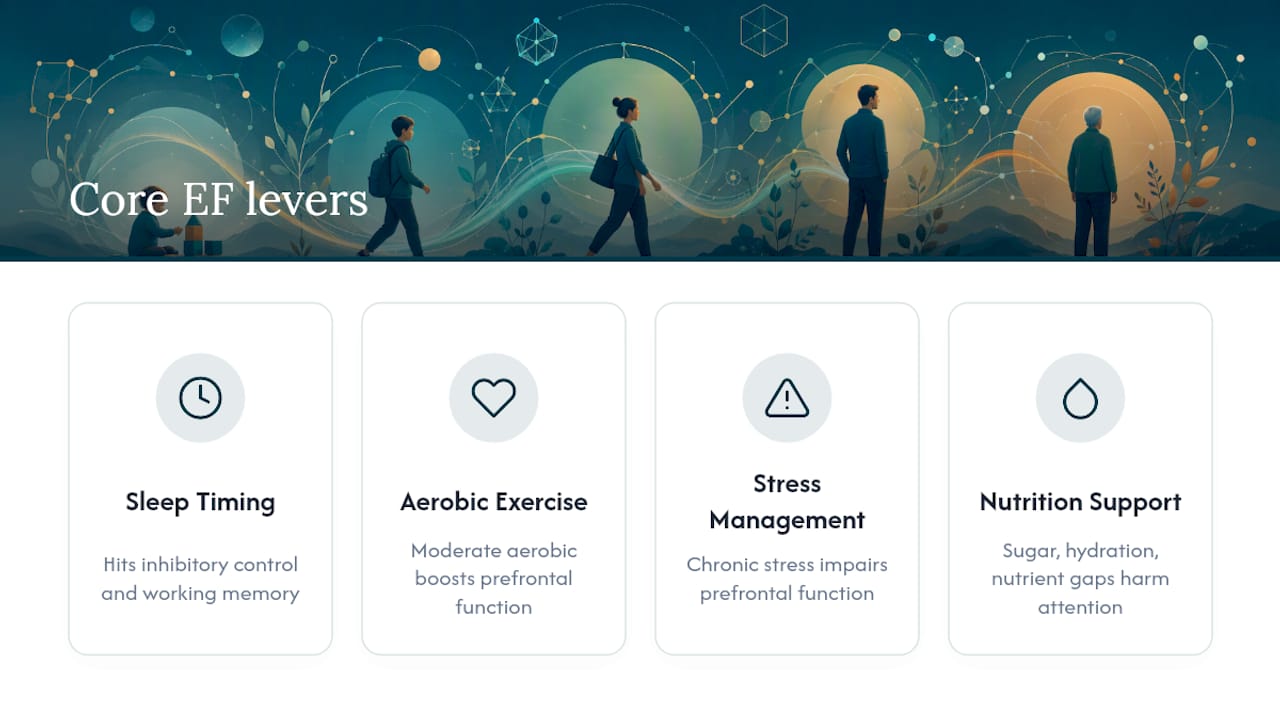
Sleep is probably the single most underrated EF lever. Sleep deprivation hits inhibitory control and working memory disproportionately hard, which is why a bad night’s sleep makes everyone a little more impulsive and a little more forgetful the next day. Consistent sleep timing, not just total hours, tends to matter more than people assume.
Aerobic exercise has one of the more consistent evidence bases for supporting executive function across age groups, likely through effects on blood flow and neurochemical activity in the prefrontal cortex. It doesn’t need to be intense. Regular, moderate movement, like brisk walking most days, shows benefits that outlast a single workout.
Stress management matters because chronic stress hormones actively impair prefrontal function, which is the opposite of helpful when the goal is more control, not less. This is a two-way relationship: poor EF makes stress harder to manage, and stress makes EF worse, which can create a spiral without some kind of interruption. Structured techniques, like those covered in stress management coaching, can help break that cycle when self-directed efforts stall.
Nutrition plays a supporting role too. Blood sugar swings, dehydration, and nutrient gaps all show up as attention lapses and irritability, which look a lot like an EF problem even when the root cause is something more basic.
Targeted interventions beyond lifestyle
Once the foundational pieces are in place, more specific strategies can layer on top:
- Metacognitive strategy training teaches people to plan, monitor, and evaluate their own thinking, for example, learning to pause and ask “what’s my plan here?” before starting a task rather than diving in blind.
- Scaffolded practice breaks a skill into smaller, gradually harder steps with support that fades as competence builds, rather than expecting mastery all at once.
- ADHD-specific treatments, including behavioral therapy and, where appropriate, medication, directly target the neurological basis of EF deficits in ADHD and often produce more targeted gains than general brain training.
- Motivational design matters more than most people realize. Interventions work better when they build in engagement and reward, because the very deficits being treated, like persistence and follow-through, are what make sticking with a program hard in the first place.
The National Academies’ review on executive function interventions is blunt about generic brain-training apps: personalized, motivationally engaging training beats repetitive, one-size-fits-all drills. A puzzle app that never adjusts difficulty or context rarely transfers to real-life organization or follow-through.
External aids and environmental supports
Some of the most effective EF supports aren’t cognitive exercises at all. They’re structural changes that reduce how much EF a task demands in the first place:
- Timers and visual countdowns for transitions between tasks.
- Written checklists instead of relying on memory for multi-step routines.
- Designated physical spots for keys, wallets, and daily essentials to cut down on lost-item searches.
- Calendar alerts set several days ahead of deadlines, not just the day of.
- “Cognitive offloading,” meaning deliberately writing things down rather than trying to hold them in working memory.
Pro Tip: Pair one environmental change with one skill-building practice at a time. Adding a checklist while also starting a new exercise routine and trying a meditation app all at once usually backfires. EF improvement sticks better when it’s incremental.
A word on expectations: no single intervention is a cure. Layered, ecological approaches that combine environmental changes with targeted skills practice consistently outperform any single strategy used alone. Progress also tends to be uneven. Someone might see quick gains in organization but slower improvement in emotional regulation under stress, because those draw on different parts of the EF system. That’s normal, not a sign the approach isn’t working.
What Strategies Work Best by Age and Setting?
The right EF support depends heavily on who needs it and where the struggle shows up most. A strategy that works for a distracted eight-year-old rarely translates cleanly to a forgetful adult juggling a full-time job.
- For young children: build EF through play rather than drills. Games with changing rules (like Simon Says or Red Light, Green Light) practice inhibitory control naturally, while consistent daily routines reduce the working-memory load of figuring out “what happens next.” Parents can scaffold by narrating steps out loud (“first we put on shoes, then we grab the bag”) until the sequence becomes automatic.
- In school settings: breaking assignments into smaller chunks with clear checkpoints reduces the planning burden on students who struggle with multi-step projects. Visual schedules, color-coded folders, and written (not just spoken) instructions help enormously. For children with documented EF challenges, an IEP or 504 plan can formalize accommodations like extended time or reduced homework load.
- For working adults: time-blocking, where specific hours are assigned to specific tasks rather than working from an open-ended list, reduces the constant decision-making that drains working memory. Externalizing systems (shared calendars, project boards, written checklists) offload memory demands onto tools instead of the brain. Some workplaces also offer formal accommodations, like flexible deadlines or reduced multitasking expectations, for documented conditions.
- For older adults and caregivers: regular health monitoring matters, since untreated hearing loss, poor sleep, or medication side effects can all mimic or worsen EF decline. Simplifying routines, using pill organizers, and keeping a consistent daily structure reduces cognitive load. Staying socially and mentally engaged, through conversation, hobbies, or structured activities, supports the same prefrontal networks that keep EF stable longer.
Caregivers and educators managing these accommodations day to day often benefit from structured behavior management approaches that build consistent scaffolding into daily routines rather than reacting case by case.
Where Do Nutritional Supports Fit Into an Executive Function Plan?
Nutritional support belongs in the same category as sleep and exercise: a foundational input the brain needs to function well, not a substitute for behavioral strategies or clinical care when those are indicated. Brain chemistry, including neurotransmitter balance, plays a documented role in attention, mood regulation, and impulse control, all of which feed directly into executive function.
Snapbrainformula’s approach treats nutritional formulas as one layer in a broader plan, alongside routines, environmental supports, and professional guidance where needed. That means:
- Nutritional supports work best paired with sleep, exercise, and structured routines, not as a standalone fix.
- Anyone on medication, pregnant or nursing, or considering a supplement for a child should discuss dosing and interactions with a pediatrician or physician first.
- Families managing ADHD or related conditions often benefit from reviewing how ADHD and executive function impairments connect before deciding what combination of supports fits their situation.
- Emotional regulation, a “hot” EF skill, often needs its own dedicated strategies alongside any nutritional or cognitive support, as covered in resources on ADHD and emotional dysregulation.
A Closing Thought on Supporting Executive Function
Executive function support rarely works as a single fix, and expecting one is where a lot of frustration comes from. Two people with nearly identical struggles can respond to completely different combinations of sleep changes, environmental tweaks, and skill practice, and that variability is normal, not a sign something is being done wrong.
What tends to hold up best is layering: changing the environment to demand less from working memory, while also practicing the underlying skills directly. Neither alone tends to go as far. And when progress stalls despite consistent effort, that’s usually the moment to loop in a pediatrician, psychologist, or physician rather than assuming more willpower is the missing ingredient. Executive function is a skill set, not a character trait, and it responds to the right kind of support at the right time.
— Ellory
Support Executive Function With Snapbrainformula’s Evidence-Informed Formulas
Snapbrainformula gives you a foundational layer to pair with the routines and strategies covered above, not a replacement for them. Where generic supplements make vague brain-health claims, Snapbrainformula formulates its capsule and liquid options specifically around the neurotransmitter and nutrient pathways tied to focus, mood, and emotional regulation, built for children, teens, and adults navigating real executive function challenges.

Executive function support works best as a combination: sleep, movement, environmental scaffolding, and, for many families, a nutritional layer that fills specific gaps. If ADHD, anxiety, or emotional regulation struggles are part of the picture, daily mental exercises paired with the right nutritional foundation tend to produce steadier results than either approach alone. Supplements are an adjunct, not a substitute for clinical care, so anyone managing a diagnosed condition or considering options for a child should talk with a pediatrician or physician about fit and dosing first.
Ready to see which formula matches your family’s needs? Visit Snapbrainformula to explore product options and educational resources built around the science covered in this guide.
Sources
- A Guide to Executive Function: What is it, and how is it developed? (Harvard Center on the Developing Child)
- Executive Functions (Adele Diamond) — PMC
- Interventions to improve executive function (NCBI Bookshelf/National Academies)
