
Executive dysfunction is the umbrella term for trouble managing thoughts, emotions, and actions, showing up as stalled starts, scattered planning, and follow-through that falls apart under pressure. It usually traces back to ADHD, a brain injury, a mood disorder, or plain exhaustion, and it is never a character flaw. The good news: it responds to specific, evidence-informed strategies, and this guide walks through what to try first.
TL;DR:
- Executive dysfunction involves difficulties in working memory, impulse control, flexibility, initiation, planning, and emotional regulation, often caused by ADHD, brain injury, or neurodegenerative conditions.
- Signs include trouble starting tasks, losing track of steps, time blindness, and emotional outbursts, with patterns varying widely across individuals.
- Accurate diagnosis depends on thorough evaluation of onset, patterns, and possible underlying causes, using tools like neuropsychological testing and informant reports.
- Treatments should target the root cause and may include medication, cognitive rehab, therapy, occupational support, and environmental modifications.
- Practical strategies such as breaking tasks into micro-steps, externalizing memory, and time-boxing can significantly reduce daily friction for those experiencing executive dysfunction.
Table of Contents
- What Is Executive Dysfunction, Exactly?
- Signs of Executive Dysfunction You’ll Recognize in Daily Life
- What Causes Executive Dysfunction?
- How Executive Dysfunction Gets Diagnosed
- Treatment and Rehabilitation Options That Actually Help
- Daily Strategies That Reduce Executive Dysfunction Friction
- Executive Dysfunction After Brain Injury: What’s Different
- When to Seek Help and What to Bring to the Appointment
- Nutritional Support and Educational Resources From Snapbrainformula
- A Few Words for Parents and Adults Living With This
- Where Brainsteady Fits Into Daily Support
- Sources
What Is Executive Dysfunction, Exactly?
Executive dysfunction describes a set of difficulties with the mental skills that let you plan, start, and finish things, not a diagnosis you can be handed on its own. According to Cleveland Clinic, it’s a behavioral symptom marked by trouble managing thoughts, emotions, and actions, often showing up as struggles with planning, working memory, organization, and getting started, rather than laziness or low intelligence. That distinction matters for how you approach it.
Executive function is not one skill. It’s a set of separate but connected mental processes that work together, and each one can break down on its own.
- Working memory holds information active in your mind while you use it, like remembering three steps of a recipe while you cook.
- Inhibition lets you stop an impulse or resist a distraction, like not checking your phone mid task.
- Cognitive flexibility lets you shift between tasks or adjust when plans change, like switching from a math worksheet to reading without melting down.
- Initiation is the spark that gets a task moving, which is often the hardest part for people with executive dysfunction.
- Planning and organization cover breaking a goal into steps and sequencing them logically.
- Emotional regulation governs how well you manage frustration, disappointment, or overwhelm without it derailing everything else.
A peer-reviewed review in PMC describes these skills as a constellation supported by distributed brain networks, not a single “control center.” The prefrontal cortex does the heaviest lifting, but it works in constant conversation with the parietal cortex, basal ganglia, thalamus, and cerebellum. Damage or disruption anywhere along that circuit, whether from injury, chronic stress, or a developmental difference like ADHD, can produce similar-looking symptoms even though the underlying cause is completely different. That’s why two people who both “can’t get started” might need very different kinds of help.
Signs of Executive Dysfunction You’ll Recognize in Daily Life
Executive dysfunction rarely announces itself with a single dramatic symptom. It shows up as a pattern of small frictions that pile up across school, work, home, and family life, and the specific mix looks different for every person.
- Trouble starting tasks. A teenager stares at a blank homework page for forty minutes, not because she doesn’t understand the assignment, but because she cannot find the first move.
- Losing track of steps or belongings. An adult heads upstairs to grab a folder and comes back down with neither the folder nor a memory of why he went up there.
- Time blindness. Someone genuinely believes a shower and getting dressed take ten minutes, then is shocked, again, when it takes forty.
- Planning failures. A project that needed to be broken into five steps gets attempted all at once, three days before it’s due.
- Difficulty with transitions. A child in the middle of a video game has a full meltdown when asked to stop for dinner, not out of defiance but because switching mental gears is genuinely hard.
- Emotional outbursts disproportionate to the trigger. A missing sock turns into tears or shouting because the nervous system is already maxed out from a dozen smaller frustrations that day.
- Perseveration. Someone gets stuck redoing the same step of a task repeatedly, unable to move forward even when they know it’s not working.
- Chronic lateness or missed deadlines, despite genuinely caring about the people or work involved.
Picture a parent juggling a work deadline, a kid’s permission slip, and dinner. The permission slip gets forgotten not from indifference but because working memory can only hold so much before something drops. Picture an employee who is brilliant in meetings but can’t turn ideas into a finished report. Picture a household where laundry sits half folded for three days because the task lost momentum partway through.
None of these signs alone confirms executive dysfunction, and missing one doesn’t rule it out either. The pattern matters more than any single incident, and the pattern usually includes some combination of stalled starts, lost time, and emotional spillover that feels bigger than the moment deserves.
What Causes Executive Dysfunction?
The same outward symptoms, forgetting appointments, struggling to start a task, snapping under stress, can come from very different sources, and figuring out which one applies changes what actually helps.
- Neurodevelopmental conditions. ADHD is the most common driver, and executive dysfunction is present from childhood, tends to fluctuate with interest and novelty, and often runs in families. Autism frequently overlaps here too, sometimes alongside sensory and routine-related challenges.
- Acquired brain injury. Traumatic brain injury (TBI) and stroke can cause a sudden, sharp drop in executive function that wasn’t there before. According to the NCBI Bookshelf, executive dysfunction is among the most common and disabling outcomes after TBI, often present even after a mild concussion, because the frontal networks and their white-matter connections are especially vulnerable to shearing forces.
- Neurodegenerative disease. Conditions like Alzheimer’s and other dementias produce a slower, progressive decline in planning and organization, often alongside memory changes.
- Mood disorders. Depression and anxiety both blunt executive function, but the pattern tracks mood: symptoms worsen during depressive or anxious episodes and often improve when the underlying condition is treated.
- Reversible or situational causes. Poor sleep, certain medications, substance use, and acute stress or burnout can all mimic executive dysfunction and typically resolve once the underlying issue is addressed.
The Cleveland Clinic’s overview of executive function notes that ADHD, autism, mood disorders, and acquired conditions like TBI, stroke, or degenerative disease all disrupt frontal lobe networks in their own way, which is why the same symptom checklist can point to such different root causes. A teenager who has struggled with starting homework since third grade is telling a different story than a 45-year-old who suddenly can’t manage his calendar after a car accident.
That overlap is exactly why CHADD is careful to describe executive dysfunction as a symptom rather than a standalone diagnosis. Careful evaluation matters because a burnout-driven slump needs rest and reduced demands, while ADHD-driven difficulty usually needs structure, and sometimes medication, to see real improvement.
How Executive Dysfunction Gets Diagnosed
Getting assessed starts with a conversation, not a scan. A clinician will usually ask about onset (lifelong versus sudden), patterns across settings, and how much daily life is disrupted, often supported by standardized rating scales filled out by the person and sometimes a family member or teacher.
- Screening tools. Brief bedside cognitive tests can flag concerns quickly. The Montreal Cognitive Assessment (MoCA) tends to catch executive problems that the more widely used Mini-Mental State Exam (MMSE) can miss, since MMSE leans heavier on memory and orientation.
- Neuropsychological testing. For a fuller picture, psychologists use structured batteries. The PMC review points to tools like the EXAMINER battery and the Behavioral Assessment of the Dysexecutive Syndrome (BADS), which test planning, inhibition, and flexibility under conditions closer to real-life demands than a simple questionnaire.
- Informant reports. A parent, partner, or teacher’s observations often reveal patterns the person themselves doesn’t notice, especially around emotional regulation or time management.
- Imaging and labs. These aren’t routine for everyone. They’re reserved for cases where a clinician suspects a structural cause, like a recent head injury, stroke, or a neurodegenerative process, and needs to confirm or rule it out.
Who you see depends on the likely cause. A neurologist is the right call after a head injury, stroke, or when a progressive decline is suspected. A neuropsychologist runs the detailed testing that maps strengths and weaknesses across specific cognitive domains. A psychiatrist helps when ADHD, depression, or anxiety look like the primary driver, especially if medication is on the table. An occupational therapist focuses less on diagnosis and more on rebuilding daily function, teaching compensatory strategies for the specific tasks that have become hard.
Treatment and Rehabilitation Options That Actually Help
Treatment works best when it’s matched to the underlying cause rather than applied as a one-size-fits-all fix. Stimulant or non-stimulant medication can meaningfully improve executive function in ADHD, but it does little for executive dysfunction caused by a stroke or chronic burnout, where the mechanism is completely different.
- Medication, when a clinician determines it’s appropriate, works best as one piece of a broader plan, not a stand-alone fix. It requires ongoing oversight to track benefits and side effects.
- Cognitive behavioral therapy (CBT) helps reframe the shame and anxiety that build up around chronic disorganization, and ADHD-adapted CBT specifically targets planning and follow-through skills.
- ADHD coaching focuses on building external systems, accountability, and habits rather than digging into the past, which makes it a practical complement to therapy.
- Cognitive rehabilitation is central after brain injury or stroke. A review of neurorehabilitation approaches by Cicerone and colleagues found that programs training problem-solving, compensatory strategies, and cognitive-behavioral techniques can improve executive skills after acquired injury, with individualized, multidisciplinary programs producing the strongest outcomes.
- Occupational therapy rebuilds specific daily-living skills, from managing a medication schedule to organizing a workspace.
- Speech-language therapy sometimes plays a role too, particularly when executive challenges intersect with communication or problem-solving after a brain injury.
- Vocational rehabilitation helps adults adapt work tasks and environments when returning to a job after injury or a major diagnosis.
- Caregiver and family education rounds this out. Family members who understand the “why” behind the behavior respond with structure instead of frustration, which changes the whole household dynamic. Reading more on how ADHD and executive function impairments overlap can help caregivers calibrate expectations.
Daily Strategies That Reduce Executive Dysfunction Friction
The tactics that move the needle most aren’t complicated productivity hacks. They’re small structural changes that take the decision-making and memory load off an already-overtaxed brain.
Start with micro-steps. Instead of “clean the kitchen,” write “put three dishes in the sink.” The goal is to make the first move so small it feels almost silly to skip, because initiation, not motivation, is usually the real barrier.
- Break every task into steps small enough to finish in under five minutes.
- Write the very first micro-step somewhere visible, like a sticky note on the door or the top of a to-do list.
- Celebrate finishing the micro-step itself, not just the full task.
Next, externalize memory. A brain with executive dysfunction is unreliable as a filing system, so stop asking it to be one. Use a single visible capture system, a whiteboard by the door, a shared family calendar, or a notes app checked at the same time daily, and put everything there instead of trying to remember it.
Engineer the environment to remove friction before it starts. Set up a “launch pad” by the door for keys, badge, and bag. Use clear bins instead of opaque drawers so contents are visible at a glance. Designate one basket as the “anti doom pile” catch-all for loose papers, so clutter has a home instead of spreading everywhere.
Time strategies matter just as much. Use time-boxing, assigning a task a fixed block of time rather than an open-ended “get to it eventually.” Keep a visible timer running so time stops being an abstraction. Schedule demanding tasks during your “golden hours,” whatever window of the day your focus naturally runs highest. And use implementation intentions, simple “when-then” rules like “when I finish breakfast, then I open my laptop,” which research on task initiation suggests works better than vague intentions to “try to start earlier.”
Body doubling, working alongside another person even on an unrelated task, is one of the most consistently reported tactics among neurodivergent adults for getting started and staying on track. The social presence alone seems to anchor focus.

Pro Tip: Swap your phone’s digital timer for an analog visual timer, like a Time Timer, for tasks that involve transitions. Watching a colored disk shrink gives kids and adults a concrete sense of time passing that a digital countdown just doesn’t deliver, and it cuts the decision fatigue of checking a screen repeatedly.
Try one tactic for seven days before judging it. Pick a single recurring problem, like morning departures or homework starts, apply one strategy consistently, and track what changes. Small, honest experiments beat sweeping overhauls every time.
Executive Dysfunction After Brain Injury: What’s Different
Executive dysfunction following a stroke or traumatic brain injury tends to hit harder and faster than developmental forms, because the frontal-subcortical circuits that coordinate planning, inhibition, and flexibility are disrupted all at once rather than developing differently from the start. The NCBI Bookshelf notes this disruption is a leading reason executive problems persist even after physical recovery looks complete, and even mild TBI can leave lasting effects due to shearing damage in white matter connections.
Rehabilitation after acquired injury prioritizes safety first. That means assessing whether someone can safely manage medications, finances, or driving before anything else. From there, the focus shifts to compensatory strategies, external systems that substitute for what the brain can no longer do automatically, alongside structured cognitive retraining exercises that rebuild specific skills like sequencing or self-monitoring. The strongest outcomes tend to come from multidisciplinary care involving neurology, neuropsychology, and occupational and physical therapy working together rather than any single specialist working alone. For readers managing physical recovery alongside cognitive changes, this overview of stroke rehabilitation covers what to expect from that side of care.
Caregivers play an outsized role here. A few adjustments make a real difference:
- Simplify instructions into one step at a time instead of multi-part requests.
- Build predictable daily structure, since unpredictability taxes an already-strained system.
- Pace activities and build in rest, since fatigue sharply worsens executive symptoms after brain injury.
- Watch closely for sudden changes in cognition or behavior, since recovery trajectories vary widely and new decline deserves prompt medical attention.
When to Seek Help and What to Bring to the Appointment
Some situations call for urgent evaluation, not a wait-and-see approach.
- Sudden cognitive change, especially confusion, disorientation, or a sharp drop in function that wasn’t there days or weeks earlier.
- Safety incidents, like leaving the stove on repeatedly, getting lost in familiar places, or missing critical medications.
- New focal neurologic signs, such as slurred speech, one-sided weakness, or vision changes, which need emergency care immediately.
For non-urgent concerns, a short tracker helps a clinician get the full picture faster. Note when symptoms started, how often they happen, specific recent examples, current medications, sleep patterns, and mood over the past few weeks. Bring direct questions: “Could this be ADHD, a mood issue, or something else?” “What testing would clarify that?” “What’s a realistic timeline for improvement?” Expect follow-up to involve either a referral for testing or a trial of a targeted strategy with a recheck in a few weeks.
Nutritional Support and Educational Resources From Snapbrainformula
The company focuses on evidence-informed nutritional supplements alongside educational content on ADHD, executive functioning, and brain chemistry, built for parents, caregivers, and adults trying to make sense of daily struggles. Supplements from Snapbrainformula are designed as an adjunct, not a replacement for clinical evaluation, therapy, or medication when those are needed. Nutrition can support overall brain health, but it works alongside professional care, not instead of it. Readers looking for more context on overlapping conditions can explore Snapbrainformula’s guide to conditions that often co-occur with ADHD for a deeper look at how these challenges intersect.
A Few Words for Parents and Adults Living With This
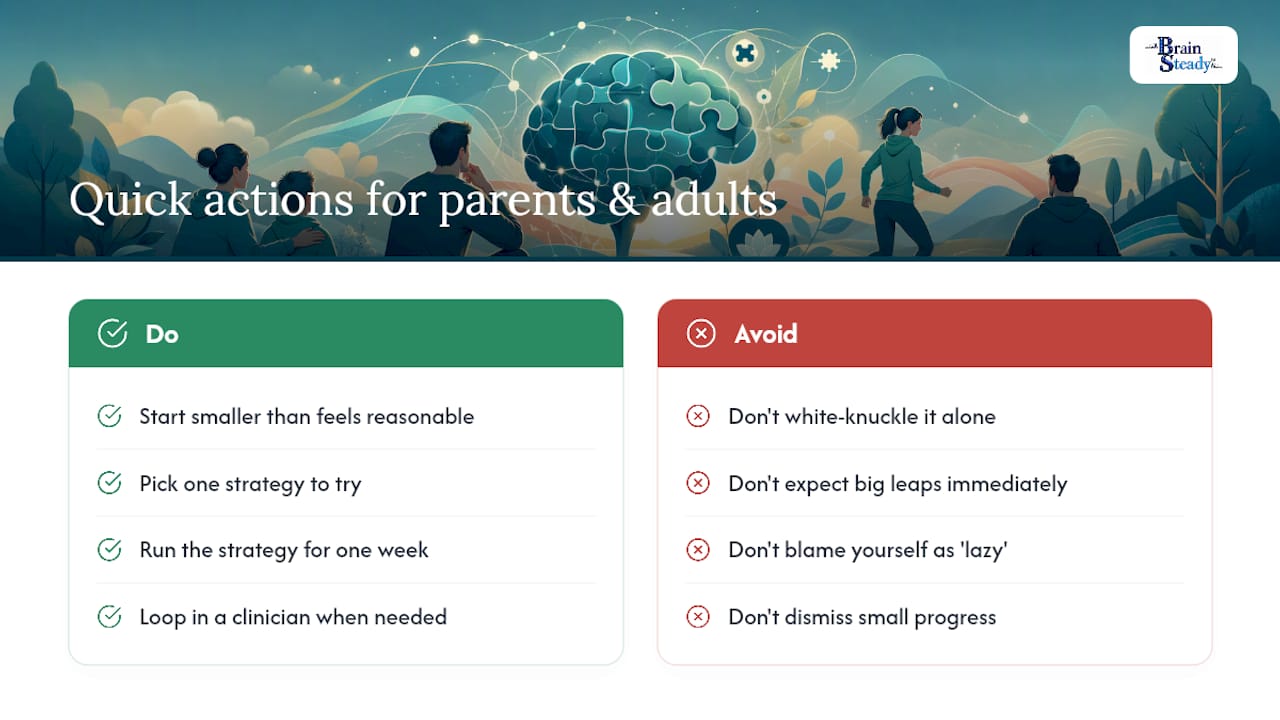
Executive dysfunction wears people down in ways that are hard to explain to someone who hasn’t lived it. If you’re a parent watching your kid melt down over a missing worksheet, or an adult who has been called lazy your whole life for a brain that simply processes tasks differently, the exhaustion is real, and so is the shame that often comes with it. Neither is deserved.
Start smaller than feels reasonable. Pick one strategy, run it for a week, and notice what shifts, even slightly. If the struggles are disrupting school, work, or family life on a regular basis, loop in a clinician rather than trying to white-knuckle through it alone. Progress here tends to come in inches, not leaps, and that’s still real progress.
— Ellory
Where Brainsteady Fits Into Daily Support
Managing executive dysfunction usually means stacking several supports at once: structure, professional guidance when needed, and sometimes nutritional care that backs overall brain function. Supplements are made in capsule and liquid form for a broad range of users, built around ingredients chosen to support mood, focus, and emotional balance as part of a broader daily routine, not as a stand-alone fix.

These products aren’t medication and they don’t replace therapy, coaching, or clinical treatment when those are called for. They’re meant to sit alongside the strategies covered above, one more piece of a routine that already includes visible timers, micro-steps, and maybe a good coach or therapist. If you want to see the current product lineup and the ingredient reasoning behind it, visit the Snapbrainformula website and check whether one of their formulas fits into your family’s routine.
This article is general information, not a substitute for advice from a qualified doctor. Consult a qualified healthcare professional about your own circumstances before acting on anything here.
Sources
- Executive Dysfunction: What It Is, Symptoms & Treatment — Cleveland Clinic
- Executive Dysfunction — Rabinovici et al., PMC review article
- Traumatic brain injury — NCBI Bookshelf
