
Emotional regulation is the ability to notice a strong feeling, understand what it’s doing to your body and mind, and bring yourself back to a steady baseline. It draws on brain circuits, neurotransmitters, and learned skills together, not willpower alone. Difficulty here is common across ages and diagnoses, and it responds to specific, evidence-based strategies rather than stricter discipline.
TL;DR:
- Managing high arousal states requires reducing sensory input and practicing physiological calming techniques before attempting cognitive reappraisal.
- Environmental consistency, routines, and sensory supports significantly improve emotional regulation, especially for children and those with sensory processing issues.
- Evidence-based therapies like CBT, DBT, and ACT can moderately improve regulation skills, but they work best when combined with physiological and environmental fixes.
- Physiological factors such as neurochemistry and brain circuit balance largely determine an individual’s ability to regulate emotions, especially under stress or fatigue.
- Traditional advice to “calm down” or “use your words” often fails during high arousal, emphasizing the importance of prioritizing body regulation first.
Table of Contents
- What does emotional regulation actually look like day to day?
- Why does regulating emotions come easier for some people than others?
- What strategies actually reduce emotional dysregulation?
- How can parents, teachers, and clinicians teach these skills?
- When does emotional dysregulation need professional support?
- Where BrainSteady fits into the bigger picture
- Why most advice on this topic misses the point
- Sources
What does emotional regulation actually look like day to day?
Clinicians describe regulation as a four-step process: you identify what you’re feeling, select a response, implement it, and monitor whether it’s working. Skip a step, or lack the skill to execute one, and the whole loop breaks down.
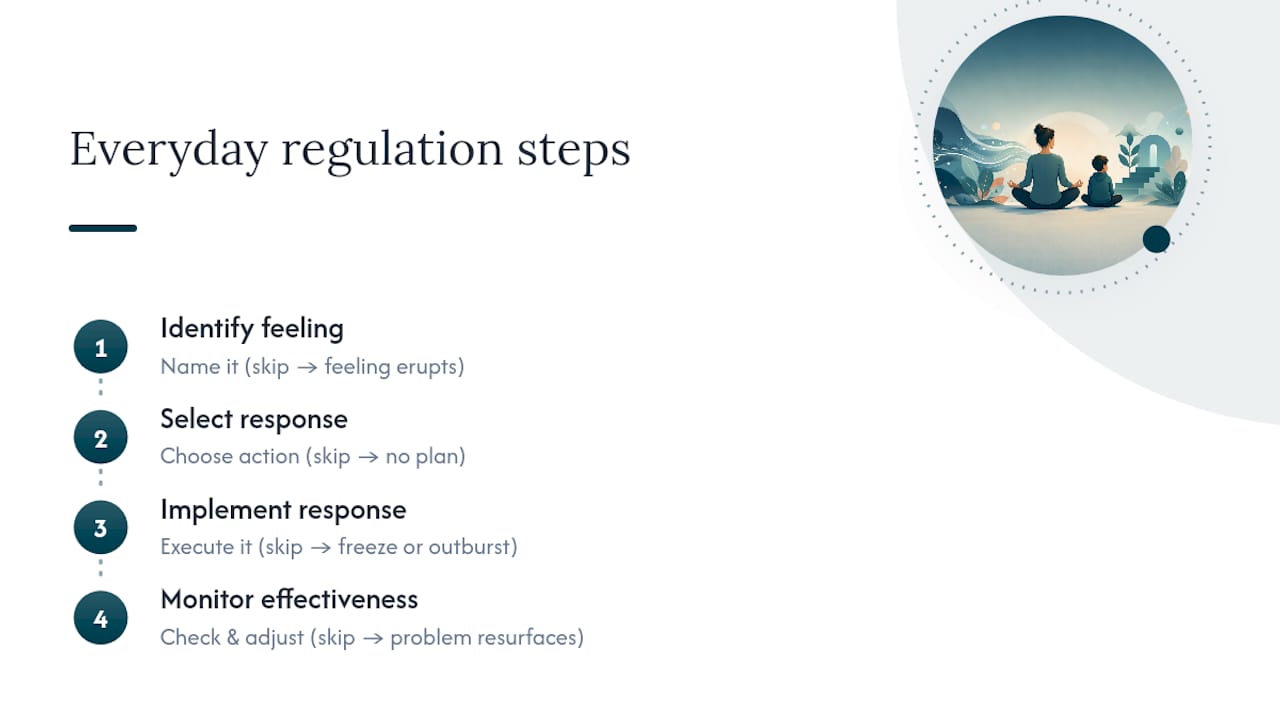
That breakdown looks different depending on age and temperament. A toddler who can’t yet name “frustrated” melts down over a broken cracker because identification never happens; the feeling just erupts. A teenager facing social rejection might go silent for hours, shutting down rather than acting out, because implementation freezes even when identification works fine. An adult juggling a deadline and a sick kid snaps at a coworker over something trivial, monitoring failing under sheer load.
None of these are the same as suppression, which is pushing a feeling down without addressing it. Real regulation changes the emotion’s intensity or trajectory; suppression just delays the bill, often with a bigger one due later.
Why does regulating emotions come easier for some people than others?
Two brain regions do most of the heavy lifting: the prefrontal cortex, which plans and inhibits impulses, and the amygdala, which flags threat and triggers arousal. Regulation depends on the prefrontal cortex staying “online” enough to modulate the amygdala’s alarm. Under stress, fatigue, or in a still-developing brain, that balance tips toward reaction.
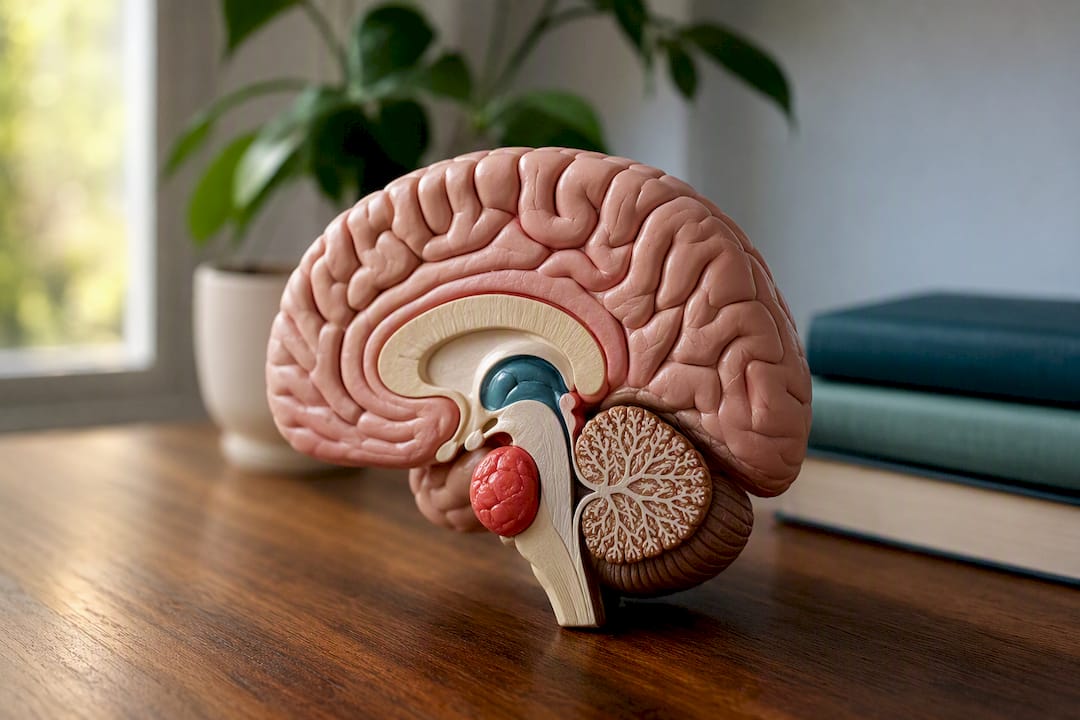
Neurochemistry shapes the tipping point. Dopamine and serotonin help stabilize mood and motivation; norepinephrine drives the alertness spike behind a racing heart or sudden irritability; GABA and glutamate set the brain’s excitatory/inhibitory balance, the ratio between “go” and “stop” signals. Research on neuromodulator crosstalk ties disruptions in this balance to conditions like autism and anxiety, where the brain’s stop signal doesn’t arrive fast enough or strong enough.
Add in sensory over-responsivity (a nervous system that registers ordinary noise or touch as overwhelming), the executive-function limits common in ADHD, poor sleep, and chronic stress, and you get a nervous system running hotter with less capacity to cool down. This is a wiring and physiology issue, not a character flaw.
What strategies actually reduce emotional dysregulation?
The evidence here is genuinely encouraging. A 2024 meta-analysis covering 40 psychosocial interventions and nearly 3,900 participants ages 0 to 23 found a small-to-medium improvement in emotion regulation (d = 0.37, 95% CI [0.22, 0.51], p < .001). That’s not a miracle number, but it’s real and reproducible, and it comes from structured approaches like Cognitive Behavioral Therapy (CBT), Dialectical Behavior Therapy (DBT), Acceptance and Commitment Therapy (ACT), and behavior parent training, not vague “try harder” advice.
Different tools solve different problems, so matching strategy to situation matters more than picking a favorite technique.
When arousal is high (racing heart, shutdown, meltdown):
- Lower sensory load first: dim lights, reduce noise, offer deep pressure or a weighted blanket before attempting any conversation.
- Try opposite action from DBT: if the urge is to flee or lash out, deliberately do the physical opposite, like sitting down and softening posture.
- Practice slow breathing or basic heart-rate variability techniques; both measurably calm the physiological alarm before words help.
When the problem is rumination or looping thoughts:
- Label the emotion specifically (“I’m anxious about the meeting,” not just “I feel bad”). Naming reduces amygdala reactivity.
- Use cognitive reappraisal: reframe the meaning of the trigger (“this feedback is data, not a verdict”).
- Try behavioral activation: get moving physically, even a short walk, to interrupt the mental loop.
- Use “cope-ahead” planning: rehearse the tough scenario and your response before it happens, a core DBT skill.
Environmental fixes belong in the mix too: consistent sleep, regular movement, and steady nutrition all support the same prefrontal capacity that regulation depends on.
Pro Tip: Never lead with reappraisal or logic during a high-arousal moment. If the body is still flooded with cortisol and adrenaline, words bounce off. Calm the body first, reason second.

How can parents, teachers, and clinicians teach these skills?
Skills stick best when the environment supports them consistently, not just when a crisis hits.
At home and school, predictable routines and visual schedules reduce the number of surprises a nervous system has to absorb in a day. A designated calm-down spot, chosen and set up before it’s needed, gives kids somewhere to go besides “explode” or “shut down.” Sensory processing supports matter here too, since many children need physical regulation before they can access any cognitive skill.
Teaching itself works best through modeling, rehearsal, and low-stakes practice:
- Narrate your own regulation out loud (“I’m frustrated, so I’m taking three breaths”).
- Use discrete, repeated practice for younger children learning to name feelings.
- Role-play tricky scenarios with older kids and teens before they happen for real.
A quick classroom script for de-escalation: acknowledge the feeling (“this is hard right now”), offer two calm choices, and give space without demanding instant compliance. Re-entry after a shutdown should be quiet and low-pressure, not a debrief on what went wrong.
Pro Tip: Practice regulation skills when everyone is calm. Nobody learns a new skill well in the middle of a crisis, kids or adults.
Caregivers looking for more structured activities can find additional guidance in this step-by-step emotional intelligence guide.
When does emotional dysregulation need professional support?
Basic supports don’t fix everything, and that’s expected, not a failure. Seek professional help when there are safety risks (self-harm, aggression that injures others), when impairment repeats across settings (home, school, work) despite consistent structure, or when weeks of basic strategies produce no change.
Effective treatment options include adapted CBT or DBT for the person’s developmental level, parent-mediated behavioral programs, and biofeedback for physiological arousal. Medication is sometimes appropriate alongside therapy when clinically indicated, particularly for co-occurring ADHD or anxiety. A comprehensive review of interventions for neurodevelopmental conditions supports combining these approaches rather than relying on one alone, since effect sizes for any single intervention tend to be modest. Multi-modal care, several supports working together, consistently outperforms a single fix.
Where BrainSteady fits into the bigger picture
Snapbrainformula focuses on evidence-informed nutritional support because brain chemistry and behavior are inseparable; dopamine, serotonin, and norepinephrine all depend partly on nutritional building blocks. Supplements are an adjunct, not a substitute for skills training or therapy. For deeper background on how these systems interact with ADHD and anxiety, see recognizing overlapping symptoms of ADHD and anxiety or explore additional everyday regulation techniques.
Why most advice on this topic misses the point
The biggest failure in how emotional regulation gets discussed is the assumption that better willpower fixes it. It doesn’t. The meta-analytic evidence puts the average benefit of structured psychosocial intervention at a modest d = 0.37, which tells you something important: even the best-studied therapies produce real but incomplete change. Anyone promising a quick fix is overselling.
The conventional advice, “calm down,” “use your words,” “just breathe,” fails specifically because it asks for a cognitive skill (reappraisal, verbal labeling) at the exact moment the nervous system is least capable of it: during high arousal. Sensory and physiological calming has to come first, especially for people with sensory over-responsivity or executive-function differences.
If you take one thing from this, prioritize environment and physiological regulation before skills training. Fix the conditions, sleep, sensory load, routine, before layering on cognitive strategies. That order, more than any single technique, is what the research actually supports.
For readers managing high-functioning anxiety alongside regulation struggles, practical anxiety strategies from Kin Wellness cover similar physiological-first ground worth reading.
— Ellory
Sources
- Effect of Psychosocial Interventions on Children and Youth Emotion Regulation: A Meta-Analysis
- Neuromodulator regulation and emotions: insights from the crosstalk of cell signaling
- Interventions for Emotional Dysregulation and Associated Factors in Neurodevelopmental Disorders: A Comprehensive Review
