
Conduct disorder is a persistent pattern of aggression, deceit, property destruction, or serious rule violations that goes well beyond normal misbehavior or defiance, and only a qualified clinician can diagnose it. If your child or anyone nearby is in immediate danger, call 911 or a crisis line now rather than waiting for an appointment. Otherwise, the right next step is a comprehensive evaluation, not blame.
TL;DR:
- Conduct disorder affects 3% to 9% of children and adolescents, with boys displaying more physical aggression and property destruction, and girls more lying and running away.
- Causes include a combination of genetic, brain development, prenatal exposures, and family instability, but no single factor is responsible.
- Diagnosis requires at least three problematic behaviors over 12 months, with an assessment involving multiple sources and screening for related conditions like ADHD or mood disorders.
- Effective treatment emphasizes family and community interventions, such as parent management training and cognitive behavioral therapy, with medication supporting only comorbid conditions.
- Early intervention, especially before age 10 with callous-unemotional traits, significantly improves long-term outcomes and reduces the risk of progression into antisocial personality disorder.
Table of Contents
- What Are the Signs and Symptoms of Conduct Disorder?
- Why Does Conduct Disorder Happen? Causes and Risk Factors
- How Is Conduct Disorder Diagnosed, and When Should You Seek Help?
- What Treatment for Conduct Disorder Actually Works?
- What’s the Outlook, and What Should You Do This Week?
- Where Snapbrainformula Fits in Your Family’s Information Toolkit
- Conduct Disorder vs. Oppositional Defiant Disorder: What Is the Real Difference?
- Does Conduct Disorder Look Different When It Starts in Childhood vs. Adolescence?
- What Happens If Conduct Disorder Isn’t Treated?
- Can Conduct Disorder Be Prevented Before It Fully Develops?
- How Do Culture and Income Affect Conduct Disorder Diagnosis and Care?
- A Few Honest Words for Parents Right Now
- Nutritional Support as a Complementary Piece of the Puzzle
- Sources
- FAQ
What Are the Signs and Symptoms of Conduct Disorder?
Clinicians group conduct disorder symptoms into four clusters, and a child usually shows a mix of them rather than just one. Recognizing the pattern, not a single bad afternoon, is what separates this diagnosis from a rough patch.
- Aggression toward people or animals: bullying, physical fights, using a weapon, forcing sexual activity on someone, or cruelty to animals.
- Destruction of property: fire setting with intent to cause damage, or deliberately breaking, smashing, or vandalizing things that belong to others.
- Deceitfulness or theft: breaking into someone’s house or car, lying repeatedly for personal gain, or shoplifting and stealing without confrontation.
- Serious rule violations: staying out all night against parental rules before age 13, running away from home overnight more than once, or truancy starting before age 13.
The Merck Manual estimates conduct disorder affects a small but significant percentage of children and adolescents in the United States, which means most classrooms may have at least one child dealing with it, even if it never gets named.
Statistic Callout: Prevalence in the 3% to 9% range means conduct disorder is far more common than most parents assume. It is not rare, and it is not a moral failing.
Boys tend to show more physical aggression and property destruction, while girls more often present with lying, running away, or covert theft, which is one reason the disorder gets missed in girls. Red flags that need attention right away include cruelty to animals, fire setting, weapon use, or any statement about wanting to hurt someone. Those are not “wait and see” behaviors.
Why Does Conduct Disorder Happen? Causes and Risk Factors
No single cause explains conduct disorder, and no parent causes it alone. Research points to an interaction between brain development, genetics, and environment.
Neuroimaging studies link conduct disorder to differences in the amygdala and prefrontal cortex, the brain regions that process threat and regulate impulse control. That biology can make a child quicker to perceive a neutral comment as hostile and slower to inhibit the reaction that follows. A large umbrella review of risk factors found several prenatal and environmental exposures tied to higher likelihood of the disorder:
- Maternal smoking during pregnancy
- Prenatal alcohol exposure, with some reviews showing an odds ratio near 3
- Parental psychiatric disorders, including depression and substance use
- Postnatal second-hand smoke exposure
Family instability, inconsistent discipline, poverty, and involvement with the child welfare system also raise risk, but they act as contributors, not verdicts. Conduct disorder shows high overlap with ADHD, depression, anxiety, and learning disorders, according to StatPearls, which is why any evaluation has to screen for those conditions too. Treating an underlying attention or mood disorder often reduces the disruptive behavior on its own.
How Is Conduct Disorder Diagnosed, and When Should You Seek Help?
A diagnosis requires at least three of the behaviors described above within the past 12 months, with at least one present in the last six months, following DSM-5-TR criteria. Clinicians also assess for a “limited callous-unemotional” specifier, which flags a lack of remorse or empathy and tends to predict a more difficult course.
Diagnosis is never a checklist filled out in one sitting. A thorough assessment typically includes:
- A behavioral history from multiple sources — parents, teachers, and sometimes the child, since one person’s report rarely tells the whole story.
- Standardized rating scales, such as the Child Behavior Checklist or Conners scales, to quantify severity across settings.
- Medical and substance-use screening to rule out other explanations for the behavior.
- School input, including disciplinary records and teacher observations, per StatPearls.
Call emergency services or a crisis line immediately if you see weapon use, sexual coercion, severe self-harm, suicidal statements, or serious violence, according to guidance from Stanford Children’s Health. Before a scheduled visit, bring a written timeline of incidents, any school reports, and specific examples rather than general impressions. That kind of documentation makes the evaluation faster and more accurate.
What Treatment for Conduct Disorder Actually Works?
Family-focused and community-based interventions have the strongest evidence, and medication plays only a supporting role. Understanding what actually moves the needle can save a family months of trial and error.
Parent management training teaches caregivers consistent, non-punitive ways to reinforce good behavior and set limits. Cognitive behavioral therapy helps kids reinterpret ambiguous situations they might otherwise read as threatening, a pattern documented in the Merck Manual. Multisystemic therapy (MST) goes further, working across family, school, and peer group simultaneously, and it has solid evidence for severe cases, though trained teams are not available everywhere.
Medication has a narrow, specific role. It targets comorbid conditions, ADHD, depression, or explosive anger, rather than conduct disorder itself. Therapy and family involvement remain the core of any real treatment plan.
- Request a school meeting to discuss a behavior plan or IEP, since consistent expectations across home and school matter enormously.
- Build predictable routines and clear, calmly enforced boundaries at home.
- Create a safety plan if aggression has occurred, including what to do and who to call.
- Connect with a support group or parent training program in your area; you should not do this alone.
Pro Tip: Skip anything marketed as a “boot camp” or scared-straight program. Stanford Children’s Health notes these punitive, shock-based approaches lack evidence and can make behavior worse, while structured family and school interventions have real research behind them.
Our guide on effective parenting strategies for children with behavior disorders walks through specific scripts and routines that pair well with professional treatment. For classroom-level tactics, teachers and parents can also draw on practical classroom management techniques designed for K-12 settings.
What’s the Outlook, and What Should You Do This Week?
Early onset, before age 10, along with callous-unemotional traits, predicts a tougher road. Some cohorts show up to half of affected youth developing antisocial personality disorder in adulthood, per clinical guidance on antisocial behavior. Early, consistent intervention changes that trajectory more than any other single factor.
This week, focus on four things:
- Write down specific incidents with dates, what happened, and who was involved.
- Call your pediatrician or a behavioral health provider to schedule an evaluation.
- Draft a basic safety plan if aggression is a concern.
- Request a meeting with your child’s school counselor or teacher.
Where Snapbrainformula Fits in Your Family’s Information Toolkit
Snapbrainformula exists to help parents understand the biology behind attention, mood, and emotional regulation, not to replace clinical care. Our educational library covers ADHD, anxiety, and behavior challenges in plain language, including a detailed look at conditions that often co-occur with ADHD. Any nutritional supplement, including our own, supports general brain health and is never a substitute for diagnosis or therapy. Talk to your child’s clinician before adding anything new.
Conduct Disorder vs. Oppositional Defiant Disorder: What Is the Real Difference?
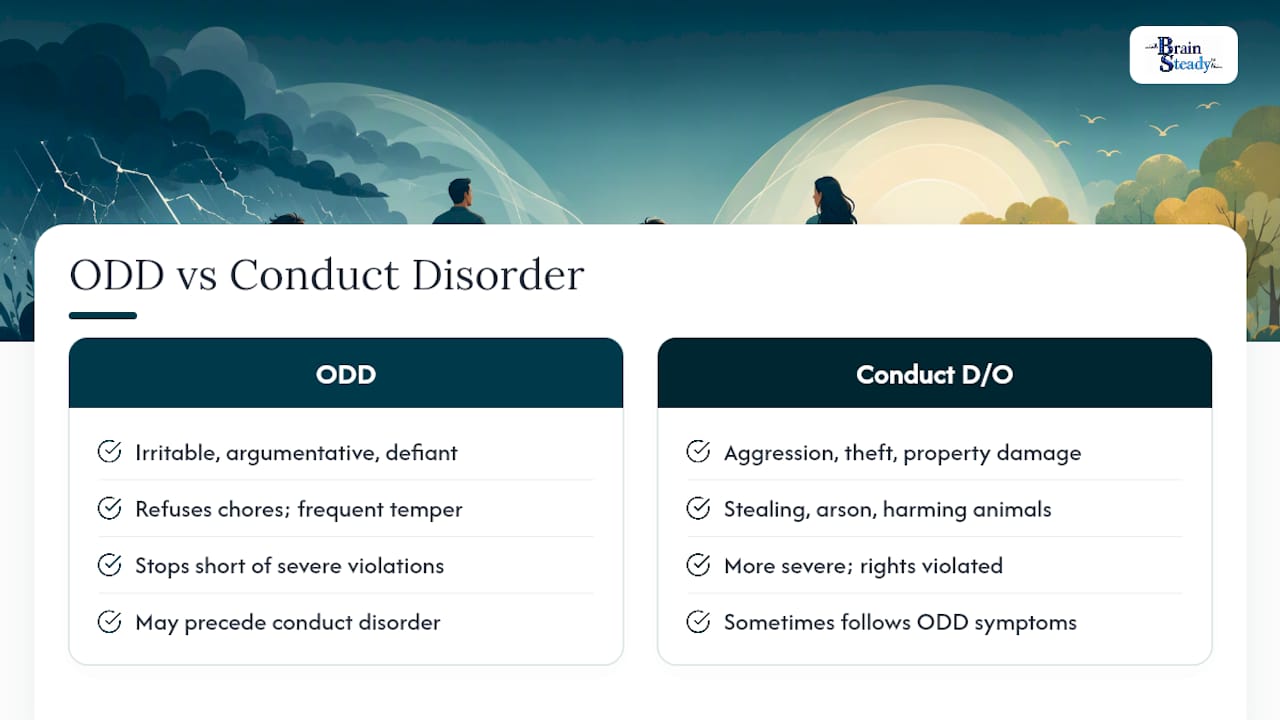
Oppositional defiant disorder involves chronic argumentativeness, irritability, and defiance toward authority, but it stops short of the aggression, theft, and property destruction that define conduct disorder. Think of ODD as a pattern of hostility and refusal, while conduct disorder involves acts that violate other people’s basic rights or break major societal rules.
The distinction matters because the two conditions carry different risk trajectories. According to StatPearls, conduct disorder is the more severe diagnostic construct, and it sometimes develops after a period of ODD symptoms, though not every child with ODD progresses to conduct disorder. A child who argues constantly, refuses chores, and loses their temper easily may be dealing with ODD. A child who has stolen from neighbors, set a fire, or hurt an animal is showing conduct disorder territory.
Parents sometimes use the terms interchangeably, but clinicians treat them differently, and the treatment intensity differs too. ODD often responds well to parent training and consistent limit setting alone. Conduct disorder frequently needs a broader, multisystem approach involving school, family, and sometimes the juvenile justice or child welfare system. Neither diagnosis should be made informally. A comprehensive evaluation, not a label applied after one bad week, is what determines which condition, if either, actually fits.
Does Conduct Disorder Look Different When It Starts in Childhood vs. Adolescence?
When conduct disorder symptoms appear before age 10, clinicians call it childhood-onset, and this version tends to carry a more serious prognosis. Childhood-onset cases are more likely to involve physical aggression, occur more often in boys, and show stronger links to neurodevelopmental factors like ADHD and early temperament difficulties.
Adolescent-onset conduct disorder, appearing after age 10, tends to be less severe and more closely tied to peer influence and social context. Many adolescent-onset cases resolve as the young person matures and peer dynamics shift, without progressing to adult antisocial behavior. Childhood-onset cases show a stronger association with persistence into adulthood, according to guidance from the antisocial behavior clinical review.
This distinction shapes treatment planning directly. A child with childhood-onset symptoms usually needs earlier, more intensive intervention, potentially including multisystemic therapy, because the behavioral pattern is more entrenched and tied to broader developmental vulnerabilities. An adolescent showing new-onset defiance and rule breaking might respond well to shorter-term family therapy and closer monitoring of peer relationships. Knowing which pattern your child fits helps you and your care team set realistic expectations, rather than assuming every case needs the same level of intervention.
What Happens If Conduct Disorder Isn’t Treated?
Untreated conduct disorder carries real long-term risk, and the most serious concern is progression to antisocial personality disorder in adulthood. Antisocial personality disorder involves a lifelong disregard for others’ rights, difficulty maintaining relationships and employment, and frequently, contact with the legal system. Not every child with conduct disorder develops this outcome, but early onset and callous-unemotional traits raise the odds substantially.
Beyond the clinical diagnosis, conduct disorder in adolescents correlates with higher rates of school suspension and dropout, substance use, and involvement with juvenile justice systems. Relationships suffer too. Kids who struggle with aggression or deceit often find themselves isolated from peers who might otherwise offer a stabilizing influence, which compounds the original problem.
None of this is destiny. The same research that documents these risks also shows that early, sustained intervention changes outcomes meaningfully. Family-based therapy, school support, and treatment of comorbid conditions all reduce the odds of the worst-case trajectory. The point of naming these long-term risks is not to frighten you. It is to explain why acting now, rather than waiting for the behavior to “grow out of,” carries real weight for your child’s future.
Can Conduct Disorder Be Prevented Before It Fully Develops?
Prevention works best when it targets risk factors early, often years before a child would meet full diagnostic criteria. Programs that strengthen parenting skills, improve early childhood emotional regulation, and address household instability show measurable benefit in reducing the severity of later behavioral problems.
Parent management training, delivered early to families of children showing oppositional or aggressive tendencies, is one of the most consistently supported prevention tools. School-based social-emotional learning programs and early screening for ADHD or learning disorders also catch problems before they compound. Since conduct disorder overlaps heavily with untreated ADHD and mood disorders, addressing those conditions in early elementary school can head off a more severe presentation later.
Pediatricians play an underused role here. Routine well-child visits are a natural point to flag concerning behavior patterns and refer families to parent training or behavioral health support before a crisis develops. Waiting for a formal diagnosis before seeking any support is a common mistake. If your child shows early signs of aggression, defiance, or difficulty with peers, getting support now, even informally through a pediatrician or school counselor, is a legitimate prevention strategy in its own right.
How Do Culture and Income Affect Conduct Disorder Diagnosis and Care?
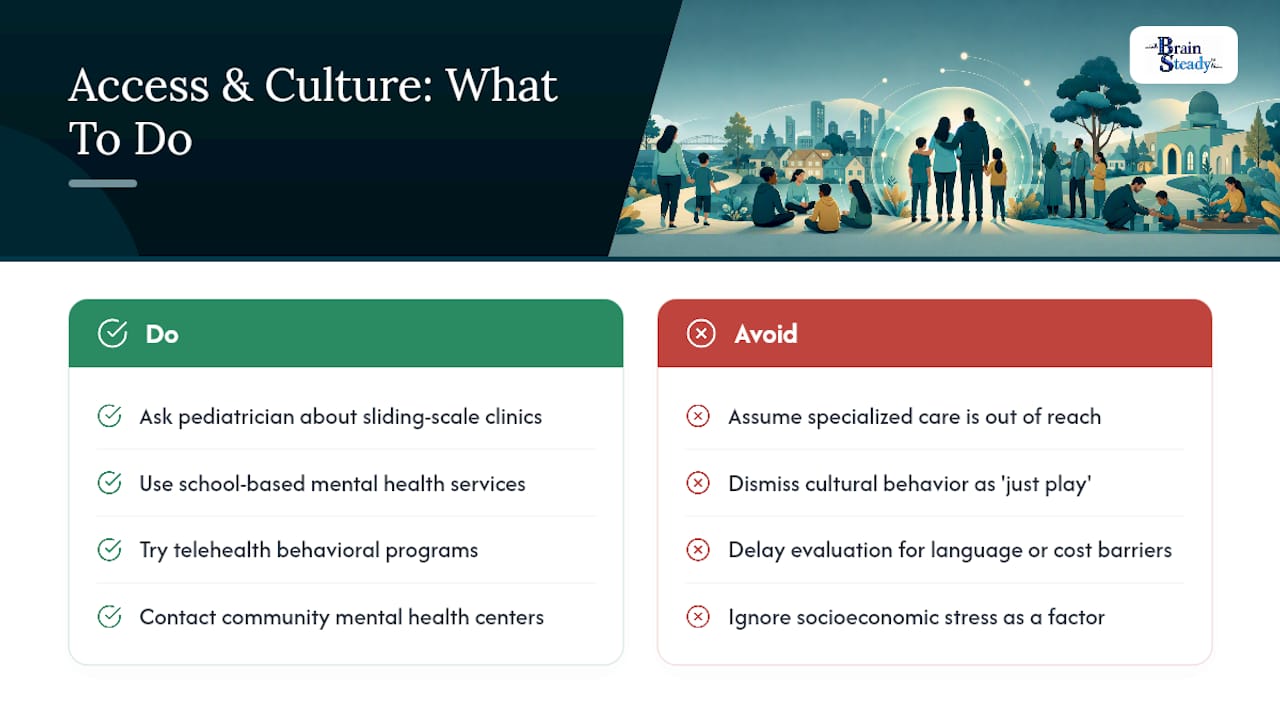
Access to evaluation and treatment for conduct disorder varies significantly based on family income, insurance coverage, and where a family lives. Multisystemic therapy and specialized behavioral health teams concentrate in well-resourced areas, which means rural families and lower-income households often face longer waits and fewer options.
Cultural context also shapes how behavior gets interpreted. What one family or community considers ordinary rough-and-tumble conflict, another might flag as concerning aggression, and clinicians have to account for that variation without dismissing genuine warning signs. Language barriers and differing cultural attitudes toward mental health treatment can delay families from seeking an evaluation at all, sometimes until behavior has escalated significantly.
Socioeconomic stress compounds the clinical picture too. Poverty, housing instability, and exposure to community violence are documented contributors to conduct disorder risk, which means the families most likely to need intensive support are often the ones with the least access to it. Community mental health centers, school-based services, and telehealth behavioral programs have started closing some of that gap, but availability still depends heavily on location. If cost or access is a barrier, ask your pediatrician about sliding-scale clinics or school-based mental health services before assuming specialized care is out of reach.
A Few Honest Words for Parents Right Now
You are not failing your child by searching for this information, and you are not the reason your child is struggling. What actually helps is partnership: with your child’s pediatrician, with the school, and with your child, even when the behavior makes that partnership feel impossible some days. Reach out to a local parent support group or your school counselor this week. You do not have to carry this alone.
— Ellory
Nutritional Support as a Complementary Piece of the Puzzle
Snapbrainformula is not a treatment for conduct disorder, and no supplement replaces therapy, family intervention, or school collaboration. What Snapbrainformula offers is a non-stimulant, all-natural option some families explore alongside professional care, to support general mood balance and focus during a stressful season.

Families managing a child’s emotional regulation often want every reasonable, evidence-informed tool available, and general nutritional brain support can be one small piece of that broader picture when discussed with your child’s clinician first. The SNAP BrainSteady™ Capsules and BrainSteady™ Liquid Formula are nutritional brain support products available for families considering general wellness options, always to be discussed with your child’s clinician before use. Bring either option up at your next appointment so your care team can weigh in before you add anything new to your child’s routine.
This article is general information, not a substitute for advice from a qualified doctor. Consult a qualified healthcare professional about your own circumstances before acting on anything here.
Sources
- Conduct Disorder - Pediatrics - Merck Manual Professional Edition
- Conduct Disorder - StatPearls - NCBI Bookshelf
- Umbrella review of risk factors for conduct disorder (PMC)
FAQ
What Are Examples of Conduct Disorder Behaviors?
Examples include physical fights, bullying, cruelty to animals, deliberate property destruction, shoplifting or breaking into homes, repeated lying for personal gain, and serious rule violations like truancy or running away overnight. A single incident is not enough for diagnosis; clinicians look for a repeated pattern across at least three behaviors within 12 months.
Do Kids Grow Out of Conduct Disorder?
Some do, particularly adolescent-onset cases tied more to peer influence than deep-rooted patterns, but childhood-onset cases carry a higher risk of persisting into adulthood. Early treatment, especially family-based therapy, meaningfully improves the odds of a better long-term outcome rather than relying on a child simply outgrowing it.
What Causes Conduct Disorder?
Conduct disorder results from an interaction of genetics, brain development differences in areas like the amygdala and prefrontal cortex, and environmental factors including prenatal alcohol exposure, maternal smoking, and family instability, according to a meta-analytic review of risk factors. No single cause explains it, and no parent is solely responsible.
How Should I Discipline a Child With Conduct Disorder?
Consistent, calm, non-punitive discipline through structured programs like parent management training works far better than harsh punishment or “boot camp” style approaches, which lack supporting evidence and can worsen behavior. Work with a therapist trained in these methods rather than improvising alone, and coordinate consequences with your child’s school for consistency.
When Should I Seek Emergency Help for My Child?
Call 911 or a crisis line immediately if your child shows weapon use, threats of serious violence, sexual coercion, suicidal statements, or severe self-harm. For non-emergency but persistent concerning behavior, contact your pediatrician to start a comprehensive evaluation rather than waiting for a crisis to develop.
