
Anxiety grounding means anchoring your attention to present-moment sensory input, like sight, touch, or sound, to interrupt anxious thought loops before they spiral. The fastest options to try right now: the 5-4-3-2-1 technique, four to six slow paced breaths, a splash of cold water on your face, or simply pressing both feet flat into the floor. These work in under a minute, but grounding stabilizes you in the moment. It does not replace ongoing care if anxiety keeps coming back hard.
TL;DR:
- Cold exposure and paced breathing are the fastest grounding methods to calm acute anxiety within moments, especially during racing heart or panic episodes.
- The 5-4-3-2-1 technique is the most widely taught sensory grounding exercise and should be practiced regularly for reliability during crises.
- Visual, tactile, and movement-based techniques work differently depending on whether the nervous system is in a fight-flight state, shutdown, or rumination mode, requiring tailored approaches.
- Combining grounding with professional therapy or medication enhances long-term management, as grounding addresses immediate symptoms but not root causes.
- Building a small, varied toolkit across sensory, physical, cognitive, and soothing strategies and practicing them consistently improves their effectiveness when needed most.
Table of Contents
- Seven-Step Rapid Grounding Checklist For An Anxious Moment
- How Do You Do The 5-4-3-2-1 Grounding Technique?
- Temperature, Pressure, And Breath: Fast Body-Based Grounding
- Mental Exercises That Interrupt Racing Thoughts
- Soothing Grounding: Comfort, Music, And Connection
- Which Grounding Technique Fits Your Anxiety State?
- How To Build A Grounding Habit That Actually Works
- When Does Grounding Stop Being Enough?
- Why This Guide Leans On Neuroscience, Not Guesswork
- The Four Categories Of Grounding Techniques, Explained
- Why Does Grounding Actually Calm An Anxious Brain?
- Common Mistakes That Undermine Anxiety Grounding
- How Grounding Fits Alongside Therapy And Medication
- What The Research Actually Supports Here
- Steadier Days Start With The Right Daily Support
- Sources
- FAQ
Seven-Step Rapid Grounding Checklist For An Anxious Moment
When anxiety hits, you don’t need a philosophy lesson. You need a sequence you can follow with shaking hands and a racing mind. Run through these steps in order, but stop wherever you start feeling steadier.
- Do the 5-4-3-2-1 scan. Name 5 things you see, 4 you can touch, 3 you hear, 2 you smell, 1 you taste. Move slowly; there’s no prize for speed.
- Take 4 to 6 paced breaths. Inhale for four counts, exhale for six. The longer exhale signals your body to ease off the alarm.
- Splash cold water on your face or hold ice to your cheeks. This triggers the mammalian dive reflex, which can slow your heart rate within seconds. Skip this if you have a heart condition without checking with a doctor first.
- Press your feet flat into the ground, or clench your fists for five seconds and release. Proprioceptive pressure gives your brain concrete, boring data to focus on instead of racing thoughts.
- Name a calming object within reach and describe three of its features. A coffee mug’s weight, the coolness of the ceramic, the chip in the handle. Detail forces focus.
- Say a short grounding phrase out loud or in your head. Something like “I am here, I am safe right now” or just “this will pass.”
- Take an immediate next action. Sit down if you’re standing, sip some water, or walk slowly to a quieter spot. Small physical acts close the loop your nervous system is looking for.
None of these steps require special training or equipment. That’s the point. Grounding works because it’s simple enough to execute when your working memory is already overloaded by anxiety.
How Do You Do The 5-4-3-2-1 Grounding Technique?
The 5-4-3-2-1 method walks your senses backward from five down to one, and it’s the most widely taught anxiety grounding exercise in clinical settings for a reason: it’s portable and free.
Start with one deep breath, then work through it:
- 5 things you see — a crack in the ceiling, the pattern on your sleeve, a plant across the room.
- 4 things you can touch — your jeans’ fabric, the chair arm, your own hair, a cool wall.
- 3 things you hear — traffic outside, your own breathing, a hum from an appliance.
- 2 things you smell — coffee, laundry detergent, outside air.
- 1 thing you taste — gum, water, or just the inside of your own mouth if nothing else is available.
If you’re in a place without much to smell or taste, like a sterile office or a car, swap in a memory prompt: recall the smell of your kitchen at home, or the taste of your favorite meal. That mental substitution still pulls attention away from the anxious spiral.
Keep an “emergency sensory kit” small enough for a pocket: a strong mint, a smooth stone, a scented lotion, or a rubber band for your wrist, with practical advice on sensory toys for autism that calm and engage kids. For children, simplify the language: “Let’s find five things that are red” or “point to something soft” turns the exercise into a game instead of a chore.
Pro Tip: Practice this once a day when you’re calm, not just during a panic spike. The technique works faster under stress once your brain already knows the pattern.
Temperature, Pressure, And Breath: Fast Body-Based Grounding
Physical grounding works because it gives your nervous system something concrete to respond to, faster than your thinking brain can talk you down. These are the somatic tools worth knowing.
- Cold exposure: Splashing cold water on your face or holding an ice cube against your cheeks activates the mammalian dive reflex, which can shift your heart rate within moments when applied briefly and safely.
- Paced breathing: Try box breathing (inhale 4, hold 4, exhale 4, hold 4) or a simple 4 in, 6 out pattern. The extended exhale matters more than the exact count.
- Proprioceptive pressure: Press your palms together hard for ten seconds, dig your heels into the floor, or hold a heavier object like a weighted blanket or a book against your chest.
- Micro-movement: Walk five steps, stomp your feet twice, or shake out your hands. Movement discharges some of the physical energy anxiety generates.
Clinicians describe this kind of somatic sequencing as fast, in-the-moment relief that works within roughly the first two minutes of acute distress, before you move into slower sensory or muscle-relaxation work. If you have cardiac issues, migraines, or Raynaud’s syndrome, check with a doctor before regularly using cold-based methods, since the reflex they trigger affects heart rate directly.
Mental Exercises That Interrupt Racing Thoughts
Cognitive grounding gives your working memory a job to do, which crowds out room for spiraling thoughts. These techniques ask something of your brain, deliberately.
- Count backward by 7s from 100, or recite the alphabet in reverse. The effort required is the point.
- Name 10 things that are a specific color, like blue, or list the days of the week backward.
- Try the “container” technique: picture placing your worry inside a box, closing the lid, and setting it on a shelf for later. You’re not denying the worry exists, just parking it temporarily.
- Do simple math in your head, like counting up by 3s, if numbers settle you more than words do.
Cognitive tasks work well for rumination, when your mind is stuck replaying the same worry. They’re less useful during dissociation, when you feel foggy, detached, or unreal, because dissociation often needs a stronger sensory jolt (cold, texture, sound) rather than a mental task your brain can’t fully engage with in that state. If counting backward feels impossible or makes you feel further away from your body, switch to a physical technique instead.
Soothing Grounding: Comfort, Music, And Connection
Not every anxious moment calls for something intense. Sometimes what helps most is comfort, low arousal, and a gentle return to feeling human instead of hijacked.
- Use a neutral grounding phrase, like “this feeling is temporary” or “I’ve gotten through this before,” said quietly or in your head.
- Build an “emergency” playlist of songs that reliably calm you, and keep it one tap away on your phone.
- Pet contact helps, if you have an animal nearby. Petting a dog or cat for even a minute can lower physical tension.
- Try a small creative task, like coloring, doodling, or working with a stress ball or textured fabric.
- Step outside barefoot on grass, or sit by a window with natural light. Even a few minutes of contact with nature can shift your state.
- A short check-in with someone you trust, even a two-line text, can offer social co-regulation without needing a long conversation.
Pro Tip: Personalize a soothing ritual you repeat the same way every time, same song, same object, same phrase. Repetition builds a shortcut your nervous system recognizes faster with each use.
Which Grounding Technique Fits Your Anxiety State?
Not every technique fits every kind of anxious moment, and matching the wrong tool to the wrong state wastes precious time. This is where polyvagal theory offers a useful, plain-language map.
Your autonomic nervous system runs in roughly three modes: ventral vagal (calm, socially connected, safe), sympathetic (mobilized, fight-or-flight, racing), and dorsal vagal (shut down, numb, dissociated). Grounding works by nudging you back toward that ventral vagal state from wherever you’ve landed.
- Panic or racing heart (sympathetic activation): reach for cold exposure or paced breathing first. These interrupt the physical alarm fastest.
- Numbness, fog, or feeling unreal (dorsal vagal shutdown): use strong sensory or proprioceptive input, ice, pressure, movement, since your body needs a jolt back into the present.
- Looping worry or replaying a conversation (rumination): cognitive tasks or the full 5-4-3-2-1 sequence work best here, because your mind needs a structured job.
One lay-friendly signal worth knowing: heart rate variability (HRV), the natural variation in time between heartbeats, tends to rise when your parasympathetic system takes over from a stress response. You won’t measure this yourself mid panic attack, but it’s the physiological reason why a longer exhale or a cold splash can calm you within seconds rather than minutes. The general sequence clinicians recommend is stabilize first (0 to 2 minutes), reorient with sensory input next (2 to 5 minutes), then settle further with something like progressive muscle relaxation if you have more time.
How To Build A Grounding Habit That Actually Works
Grounding techniques work better when they’re not brand new the first time you need them under stress. Muscle memory matters here as much as it does in any other skill.
- Practice for two to three minutes daily, ideally when you’re calm, not mid crisis. Pick one technique and run through it like a drill.
- Do a weekly check-in with yourself: which techniques actually helped this week, and which didn’t land? Adjust your go-to list accordingly.
- Pack a portable kit: a small scented item, something textured (a stone, fabric swatch, or stress ball), a strong mint, and a card with your grounding phrase written on it.
- Model it for teens and kids. Practice the 5-4-3-2-1 scan together during a calm car ride or before bed, so it’s familiar language before it’s ever an emergency tool.
Practicing during low-arousal moments is what makes a technique reliable during high-arousal ones. Research on the 5-4-3-2-1 method specifically points to regular practice as what makes it effective when anxiety actually spikes, not just theoretically useful.
Pro Tip: Set a recurring phone reminder labeled “grounding practice” for the same time each day. Consistency beats intensity here.
When Does Grounding Stop Being Enough?
Grounding stabilizes you in a hard moment. It was never designed to resolve what’s driving your anxiety in the first place, and leaning on it exclusively, instead of addressing root causes, can quietly shift from coping into avoidance.
Watch for signs that grounding alone isn’t cutting it: panic episodes that keep escalating despite consistent practice, dissociation severe enough that you lose chunks of time or memory, any thoughts of suicide or self-harm, or anxiety that’s now interfering with work, school, or relationships. None of these are things to manage alone.
If you notice these signs, reach out to a therapist, doctor, or counselor. If you’re in crisis or having thoughts of harming yourself, contact emergency services or a crisis line immediately. Needing more support than grounding can offer isn’t a failure. It’s the normal next step for a nervous system asking for more help than a technique alone can give.
Why This Guide Leans On Neuroscience, Not Guesswork
This guide was built around clinically documented techniques, drawing on 5-4-3-2-1 protocols used in behavioral health settings, polyvagal-informed decision rules, and somatic grounding research on rapid autonomic shifts. Written for the BrainSteady team at Snapbrainformula, the goal is straightforward: give people living with anxiety tools that are actually usable in the moment, not just theoretically sound on paper.
BrainSteady exists to help families and adults understand the link between brain chemistry and everyday regulation, covering topics like ADHD, anxiety, executive functioning, and neurotransmitter balance through education first. Nutritional support never replaces grounding skills or professional care. It sits alongside them.
For related reading, see how breathing exercises pair with grounding, and how mindfulness practices reinforce the same present-moment focus this guide describes.
The Four Categories Of Grounding Techniques, Explained
Clinical resources generally sort grounding into four overlapping categories, and knowing which bucket a technique falls into helps you build a more complete toolkit instead of relying on just one tool.
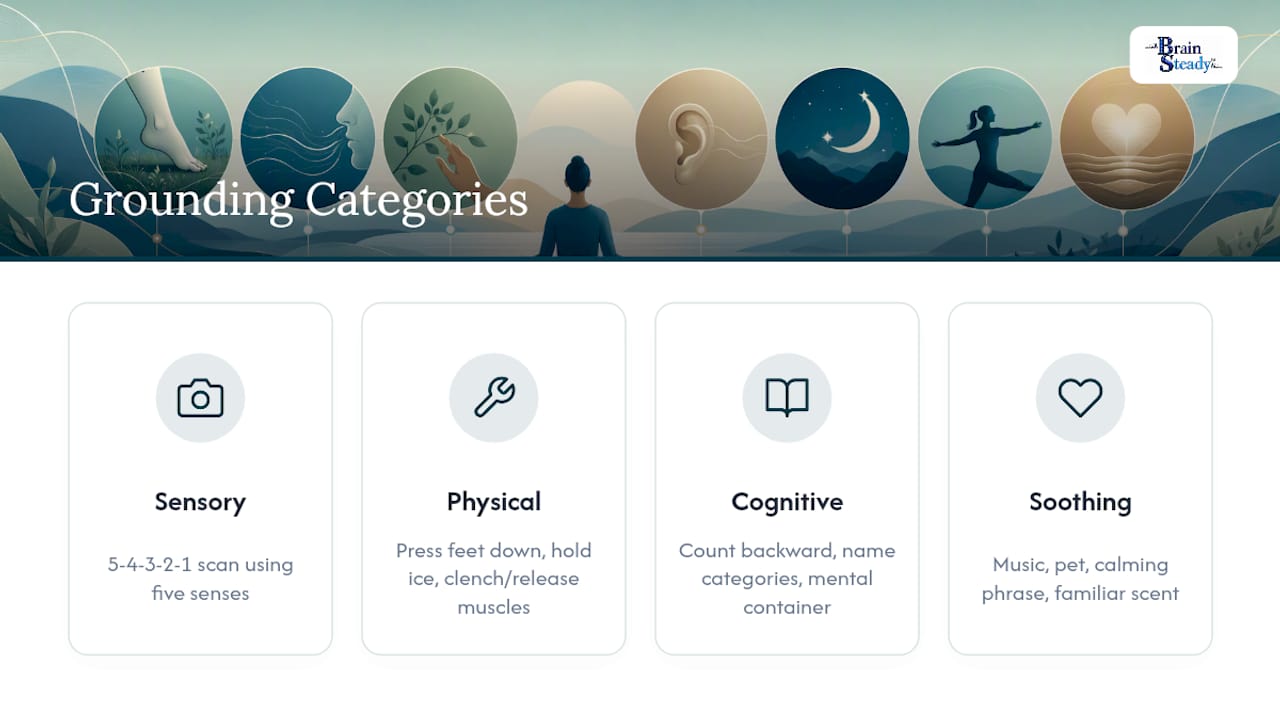
Sensory grounding uses your five senses to anchor you in the present, the 5-4-3-2-1 scan being the clearest example. Physical grounding relies on body sensations and movement: pressing your feet down, holding ice, clenching and releasing muscles. Cognitive grounding gives your mind a structured task, counting backward, naming categories, or picturing a mental container for worry. Soothing grounding leans on comfort and gentle stimulation, music, a pet, a calming phrase, or a familiar scent.
Most people find they lean naturally toward one or two categories. Someone who processes stress verbally might respond fastest to cognitive tasks, while someone whose anxiety shows up as a racing heart might need physical or sensory tools first. Building a toolkit across all four categories, rather than mastering just one, means you have a backup ready when your first choice doesn’t land, which happens more often than people expect, especially with dissociation or severe panic where usual go-to techniques stop working.
Why Does Grounding Actually Calm An Anxious Brain?
Grounding works because anxiety pulls your attention inward, toward racing thoughts, imagined threats, and physical alarm signals, and grounding forcibly redirects that attention outward to concrete, neutral sensory data.
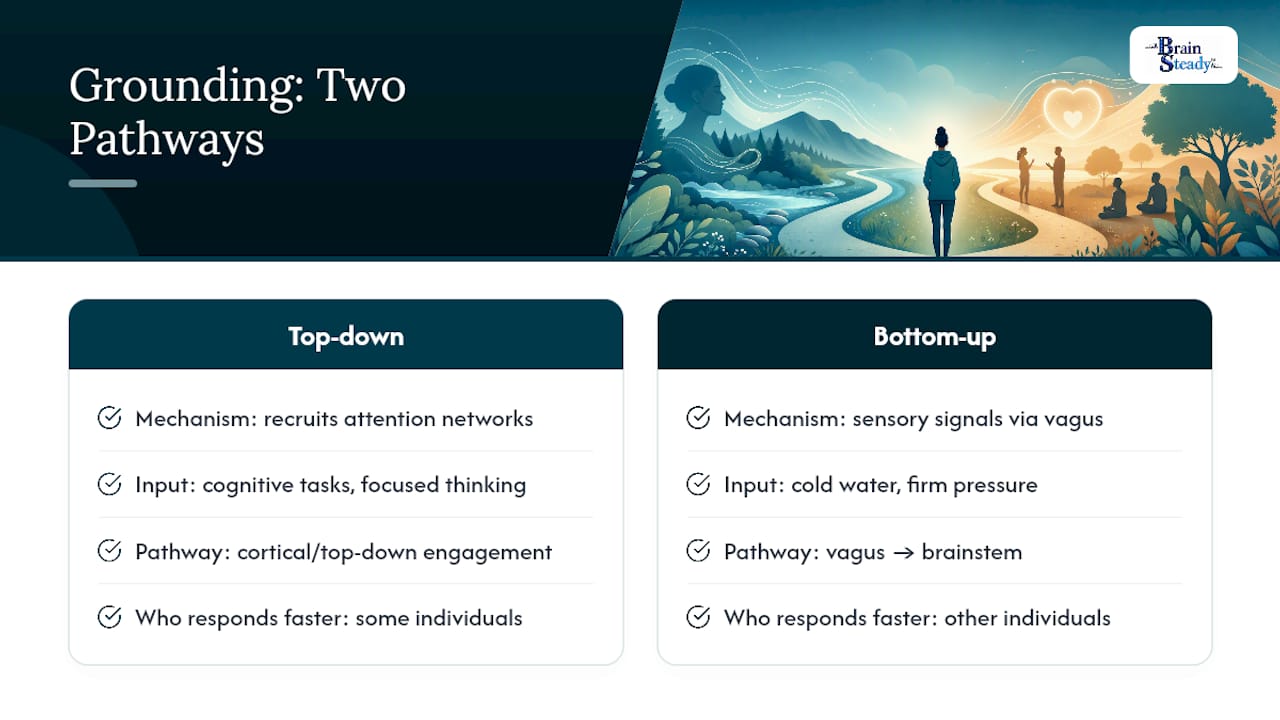
Anxious rumination is associated with overactivity in what neuroscientists call the default mode network, the brain circuitry active during self-referential thinking and mind-wandering. Grounding exercises recruit attention networks instead, which helps quiet that rumination loop by giving your brain a competing, external task to process.
On the body side, sensory input like cold water or firm pressure sends signals through the vagus nerve toward the brainstem, encouraging a shift from sympathetic (fight-or-flight) activation toward a calmer parasympathetic state. This dual pathway explains a pattern many people notice in themselves: some individuals respond faster to cognitive tasks that engage the thinking brain from the top down, while others need physical sensation to reach the nervous system from the bottom up. Neither approach is wrong. They’re just different entry points into the same regulatory system.
This is also where measurable signs like heart rate variability come in. Shifts toward parasympathetic dominance, sometimes tracked through markers like RMSSD in clinical research, reflect the same calming process grounding is designed to trigger. You feel it as your heart rate slowing and your thoughts loosening their grip, which is your nervous system, not just your willpower, doing the work.
Common Mistakes That Undermine Anxiety Grounding
Even solid techniques fail when they’re used the wrong way, and a few patterns show up again and again.
The most common mistake is waiting until a full panic spiral to try grounding for the first time. A technique you’ve never practiced is much harder to execute when your working memory is already flooded. Practice in calm moments so the pattern is familiar under stress.
A close second: using cognitive techniques during dissociation. If you feel foggy, numb, or disconnected from your body, counting backward often won’t reach you. Switch to something physical, cold water, pressure, movement, instead of forcing a mental task your brain can’t fully engage with in that state.
Other frequent missteps include:
- Rushing through the steps instead of actually pausing to notice each sensation.
- Using grounding as the only tool, every time, for every kind of distress, instead of matching technique to state.
- Treating one bad attempt as proof it doesn’t work. Some techniques take a few tries to click.
- Skipping the breath at the start. A single deep breath before starting primes your body to actually receive the calming input that follows.
Grounding isn’t about doing it perfectly. It’s about picking a tool that actually fits the moment you’re in.
How Grounding Fits Alongside Therapy And Medication
Anxiety grounding techniques work best as one piece of a broader approach, not a standalone fix. They’re excellent for in-the-moment stabilization, but they don’t replace the deeper work therapy does or the physiological support medication can offer when prescribed.
If you’re in therapy, mention the grounding techniques you’re using; many therapists, particularly those trained in cognitive behavioral therapy or trauma-focused approaches, will actively build on techniques like 5-4-3-2-1 and incorporate them into a larger treatment plan. Grounding can also make therapy sessions more productive: walking into a session already regulated, rather than mid-spiral, often makes it easier to do the deeper emotional work therapy requires.
If you take medication for anxiety, grounding complements it rather than competing with it. Medication can address the underlying physiological baseline, while grounding gives you an active skill for the moments medication alone doesn’t fully cover. Always loop in your prescribing doctor before making changes to medication, and never use grounding as a reason to stop a prescribed treatment early.
Nutritional support belongs in this same “complementary, not a replacement” category. Whole-family approaches that support mood and everyday brain health can sit comfortably next to grounding practice and clinical care, each addressing a different layer of the picture.
What The Research Actually Supports Here
The honest takeaway from the clinical literature on anxiety grounding is that it’s remarkably effective for what it’s designed to do, which is short-term stabilization, and remarkably oversold when people expect it to do more than that.
Conventional advice tends to hand readers a single technique, usually 5-4-3-2-1, and stop there. That’s a mistake. The polyvagal research makes clear that panic, dissociation, and rumination are physiologically different states, and a technique built for one often falls flat for another. The bigger miss in most grounding advice is skipping the practice piece entirely; a technique you’ve never rehearsed in a calm moment is unreliable exactly when you need it most.
What should you prioritize first? Build a small toolkit across categories, sensory, physical, cognitive, soothing, before you’re in crisis, and practice the boring version of it on an ordinary Tuesday. Where BrainSteady’s nutritional approach fits into that picture is as a steadier baseline underneath the skill, not a substitute for it. A body better supported at the chemistry level may respond to grounding faster, but the skill still has to be there to use.
— Ellory
Steadier Days Start With The Right Daily Support
A nutritional supplement line offers a non-stimulant option to support brain chemistry alongside grounding practice, without positioning itself as a treatment for anxiety.

Grounding techniques handle the moment. What happens between those moments, sleep quality, mood stability, everyday focus, depends heavily on balanced neurotransmitter function, which is exactly what BrainSteady’s formulas are built to support. The SNAP BrainSteady Capsules suit daily adult or family use, with flexible bottle options starting at a moderate price for a three-bottle value pack. For children and teens, the BrainSteady Liquid Formula offers an easier-to-take option, including a version formulated for ages 4 to 8 and a liquid formula for teens 13 and up, starting at an accessible price.
Those using grounding techniques may consider adding nutritional support alongside daily practice and consulting with a clinician if on medication. Browse the full BrainSteady lineup to find the option that fits your household.
Sources
- 5-4-3-2-1 Grounding for Anxiety: How To Do It
- 5-4-3-2-1 Coping Technique for Anxiety
- Polyvagal theory: a journey from physiological observation to neural innervation and clinical insight
- Beyond “Deep Breathing”: 3 Somatic Grounding Techniques for In-the-Moment Relief – Solid Foundation Psychiatry
FAQ
What Are The Five Grounding Techniques For Anxiety?
The five most commonly taught categories are sensory grounding (like 5-4-3-2-1), physical grounding (temperature, pressure, movement), cognitive grounding (counting, categorizing), soothing grounding (music, comfort objects, phrases), and paced breathing. Most people benefit from having at least one technique from each category ready to use.
What Is The 3-3-3 Rule For Anxiety?
The 3-3-3 rule is a simplified variant of sensory grounding: name 3 things you see, 3 sounds you hear, and move 3 parts of your body, like your ankle, fingers, and shoulders. It’s a faster, shorter alternative to the full 5-4-3-2-1 sequence when you need something even quicker.
What Makes A Good Grounding Object For Anxiety?
A good grounding object engages at least one strong sense: a textured stone, a scented lotion, a piece of fabric, or a mint with a strong flavor. The best objects are small enough to carry daily, so they’re on hand before anxiety spikes rather than something you have to go find.
How Do You Get Grounded When You Have Anxiety?
Start with one deep breath, then move through a technique that matches how you feel: cold water or paced breathing for racing panic, strong sensory input for numbness or dissociation, and structured tasks like counting backward for looping worry. Practicing these moves regularly, before you’re in crisis, makes them far easier to access when anxiety actually hits.
Can Nutritional Support Help Alongside Grounding Techniques?
Nutritional formulas like BrainSteady are designed to support balanced neurotransmitter function and steadier everyday mood, not to treat anxiety directly. They’re meant to work alongside grounding practice and professional care, not replace either one.
