
Anxiety is a normal stress response that turns into an anxiety disorder when it becomes excessive, persistent, and disruptive to daily life. Anxiety disorders are common, and they respond well to treatment. If worry, physical tension, or avoidance behavior has lasted for weeks or is interfering with work, sleep, or relationships, that is the signal to get a professional evaluation rather than wait it out.
TL;DR:
- Anxiety disorders affect roughly one-third of people at some point in their lives, with genetics, brain chemistry, and chronic stress as primary causes.
- Symptoms vary across ages, with children showing physical complaints, teens exhibiting irritability, and adults experiencing racing thoughts and sleep issues.
- Effective treatments include cognitive behavioral therapy, SSRIs or SNRIs, and short-term use of benzodiazepines, with most options requiring several weeks to show full benefits.
- Self-help strategies like breathwork, grounding techniques, and lifestyle improvements support management but cannot replace clinical care for severe symptoms.
- Proper diagnosis relies on comprehensive evaluation to rule out medical conditions that mimic anxiety, and long-term outlook improves significantly with appropriate treatment.
Table of Contents
- How Does Anxiety Work, and How Common Is It?
- What Are the Physical, Cognitive, and Behavioral Symptoms of Anxiety?
- What Are the Main Types of Anxiety Disorders?
- What Causes Anxiety, and What Conditions Mimic It?
- How Is Anxiety Diagnosed, and When Should You See a Clinician?
- What Treatments Actually Work for Anxiety?
- Which Self-Help Strategies Actually Help With Anxiety?
- What Role Do Nutrition and Lifestyle Play in Managing Anxiety?
- What Is the Long-Term Outlook for Anxiety Disorders?
- A Closing Note on Taking Anxiety Seriously Without Overreacting to It
- Support Your Brain Chemistry While You Work on the Rest
- Where to Go for More on Anxiety
- Sources
How Does Anxiety Work, and How Common Is It?
Anxiety exists for a reason. It is a future-oriented alarm system that primes your body to handle a threat before it arrives, which is useful when the threat is real and short-lived. The problem starts when that alarm fires too often, too intensely, or in response to situations that pose no actual danger. At that point, adaptive alertness has crossed into a clinical anxiety disorder.
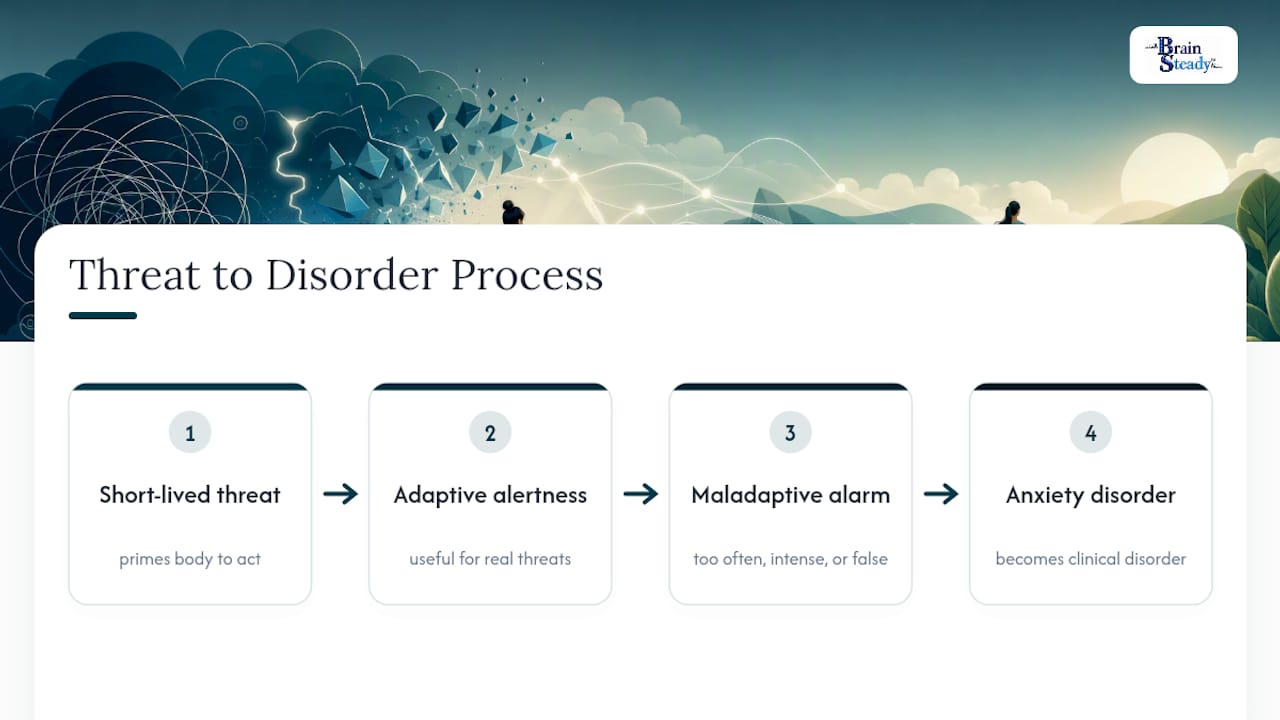
The scale of this is bigger than most people assume. Roughly one-third of U.S. adolescents and adults will experience an anxiety disorder at some point in their lives, and the World Health Organization identifies anxiety disorders as the most common mental health condition worldwide, affecting hundreds of millions of people. Genetics load the gun, brain chemistry (particularly serotonin and norepinephrine signaling) sets the sensitivity, and environment, especially chronic stress, pulls the trigger.
Anxiety disorders affect roughly one in three people at some point in life, yet the WHO notes that many of them never receive treatment despite effective options existing.
What Are the Physical, Cognitive, and Behavioral Symptoms of Anxiety?
Anxiety shows up in the body as much as the mind. Racing heart, sweating, shortness of breath, an upset stomach, and tight muscles are all part of the same nervous system response, whether the trigger is a work deadline or nothing identifiable at all.
Cognitively, anxiety tends to sound like a loop: persistent worry that won’t resolve, intrusive “what if” thoughts, and catastrophizing where a minor setback gets mentally inflated into disaster. Behaviorally, the hallmark is avoidance. Skipping the meeting, the party, the phone call, the doctor’s visit. That avoidance often does more damage to daily functioning than the anxious feeling itself.
Symptoms also shift by age. A comparative look at how anxiety expresses itself across ages shows the pattern clearly:
- Young children often show anxiety as stomachaches, clinginess, or tantrums rather than stated worry.
- Teens tend toward irritability, school avoidance, and social withdrawal.
- Adults more often report racing thoughts, chronic muscle tension, and sleep disruption.
- Older adults may present anxiety as memory complaints or physical symptoms that get mistaken for other medical issues.
If several of these symptoms show up together and stick around, they point toward something more than everyday stress. A closer review of lesser-known symptoms of anxiety disorders is worth a look if your experience doesn’t match the textbook description.
What Are the Main Types of Anxiety Disorders?
Anxiety is not one condition. It’s a family of related disorders, each with a distinct pattern of fear and avoidance:
- Generalized anxiety disorder (GAD): chronic, excessive worry about multiple areas of life, often paired with muscle tension and fatigue.
- Panic disorder: recurring panic attacks, sudden surges of intense fear that peak within minutes and include symptoms like heart palpitations, chest tightness, dizziness, or a fear of dying.
- Social anxiety disorder: intense fear of judgment or embarrassment in social situations, frequently starting in adolescence.
- Specific phobias: focused, disproportionate fear of a particular object or situation, such as heights or needles.
- Agoraphobia: fear of situations where escape might be difficult, which can shrink a person’s world down to just their home.
Post-traumatic stress disorder and obsessive-compulsive disorder share overlapping features with anxiety disorders, though clinicians classify them separately because of their distinct trauma or compulsion-driven mechanisms. Anxiety disorders also cluster with each other: someone with GAD has a meaningfully higher chance of also meeting criteria for panic disorder or social anxiety. A deeper breakdown of social anxiety’s causes, symptoms, and treatment covers one of the most common and most treatable presentations.
What Causes Anxiety, and What Conditions Mimic It?
No single cause explains anxiety disorders. They emerge from a mix of biological, psychological, and social factors working together, which clinicians call the biopsychosocial model.
The main contributors include genetics, brain chemistry, trauma, and chronic stress, plus personality traits like a tendency toward perfectionism or a low threshold for uncertainty. But a proper workup also has to rule out medical conditions that produce anxiety-like symptoms:
- Hyperthyroidism, which speeds up heart rate and metabolism in ways that mimic panic.
- Cardiac arrhythmias, which can cause palpitations indistinguishable from anxiety without testing.
- Substance withdrawal, particularly from alcohol, caffeine, or benzodiazepines.
- Certain medications, including some stimulants and decongestants.
This is why self-diagnosis has real limits. Two people with identical symptoms can have entirely different underlying causes, and treating the wrong one wastes time. A closer look at common misperceptions about anxiety’s symptoms and causes unpacks several of these mix-ups in detail.
How Is Anxiety Diagnosed, and When Should You See a Clinician?
There’s no blood test that diagnoses an anxiety disorder outright, so clinicians build the picture from several angles:
- Clinical interview and history, covering symptom duration, triggers, and family history.
- Physical exam and lab work, mainly to rule out thyroid problems, cardiac issues, or substance-related causes.
- Standardized screening tools, such as the GAD-7 questionnaire, to gauge severity.
- Psychological evaluation, comparing symptoms against diagnostic criteria.
For generalized anxiety disorder specifically, the diagnostic threshold requires excessive, hard-to-control worry on most days for six months or longer, plus at least three associated symptoms like restlessness, fatigue, or sleep trouble. Before an appointment, jot down when symptoms started, what makes them worse, and how they’re affecting work or relationships. Seek care urgently if anxiety comes with chest pain that hasn’t been medically evaluated, thoughts of self-harm, or an inability to function day to day.
What Treatments Actually Work for Anxiety?
Cognitive behavioral therapy (CBT) is the most consistently supported psychotherapy for anxiety disorders, and its exposure-based techniques are especially effective for phobias and panic-related avoidance. Acceptance and commitment therapy (ACT) offers another evidence-backed route, focused on changing your relationship to anxious thoughts rather than eliminating them outright. A clear breakdown of what CBT actually involves is worth reading before a first session.
On the medication side, SSRIs and SNRIs are the first-line long-term option, typically taking four to six weeks to show full effect. Benzodiazepines work almost immediately for acute panic, but they carry real dependence risk, so most guidelines reserve them for short-term or as-needed use rather than daily maintenance.
- CBT, including exposure therapy for phobias and panic-related avoidance
- ACT and other complementary psychotherapy modalities
- SSRIs/SNRIs for sustained symptom control
- Benzodiazepines for short-term, acute relief only
- Combination therapy (medication plus psychotherapy) for moderate to severe cases
Finding the right combination often takes some trial and error, and that’s normal, not a sign that treatment has failed. A comparison of anxiety treatment methods by disorder type breaks down which approach tends to fit which presentation.
Pro Tip: Give a new medication or therapy protocol at least four to six weeks before judging whether it’s working. Anxiety treatment rarely shows its full effect in the first week or two.
Which Self-Help Strategies Actually Help With Anxiety?
Not every coping tool fits every kind of anxiety, and using the wrong one at the wrong moment wastes energy you don’t have to spare.
- The 3-3-3 rule (name three things you see, three sounds you hear, three body parts you can move) works best for dissociative-style anxiety, when you feel foggy or disconnected from your surroundings.
- Breathwork, especially slow, extended exhales, targets physiological hyperarousal: the racing heart and shallow breathing of acute panic.
- Progressive muscle relaxation helps release the chronic tension that builds from prolonged worry.
- Direct action or problem-solving works best when anxiety is tied to a real, identifiable stressor rather than free-floating dread.
Grounding, breathwork, and action-based coping address different mechanisms entirely, so matching the tool to the trigger matters more than defaulting to whichever technique is trendiest. Lifestyle factors, consistent sleep, regular exercise, and moderating caffeine intake, all reduce baseline anxiety sensitivity. None of these substitute for clinical care when symptoms are severe or persistent. For a practical walkthrough of exposure-based grounding techniques, see this guide to overcoming fear in under two minutes.
What Role Do Nutrition and Lifestyle Play in Managing Anxiety?
Diet, sleep quality, and physical activity are adjunctive supports for anxiety management. They influence symptom severity, but they don’t replace therapy or medication as primary treatment.
Educational content focuses on this exact gap: helping families and adults understand how brain chemistry, nutrition, and everyday behavior interact.
- Sleep deprivation measurably worsens anxious symptoms and emotional regulation.
- Regular physical activity supports mood regulation through several overlapping pathways.
- Supplements can play a supportive role, but they carry their own interaction risks and should be discussed with a clinician, especially alongside prescribed medication.
What Is the Long-Term Outlook for Anxiety Disorders?
With appropriate treatment, most people with anxiety disorders see substantial improvement, though some experience recurring episodes during high-stress periods. Seek urgent care for suicidal thoughts, chest pain that hasn’t been medically evaluated, or anxiety severe enough to stop you from functioning. In the U.S., the 988 Suicide and Crisis Lifeline is available by call or text at any hour.
A Closing Note on Taking Anxiety Seriously Without Overreacting to It
Most people either dismiss anxiety as something to push through or treat every anxious moment as a crisis. Neither instinct serves you well. The more useful question is always which specific tool fits which specific moment, and whether the pattern is getting better, worse, or staying put. That pattern, tracked honestly over a few weeks, tells you more than any single bad day ever will. If you want a starting point for building that kind of awareness, Snapbrainformula’s educational resources on anxiety are a reasonable place to begin.
— Ellory
Support Your Brain Chemistry While You Work on the Rest
Therapy and medication remain the front-line tools for anxiety disorders, and nothing here replaces that. But brain chemistry, particularly the nutrients tied to neurotransmitter production, plays a supporting role that most self-help guides skip entirely. This piece is easier to address with nutritional supplements built around mood and emotional balance for kids, teens, and adults alike.
This is adjunct support, not a substitute for clinical evaluation or prescribed treatment. If you’re already working with a clinician, ask how a nutritional supplement might fit alongside your current plan. If you’re just starting to piece together what’s going on, browse Snapbrainformula’s brain health supplements and educational library to see where nutrition might fit into your own approach.
Where to Go for More on Anxiety
- NIMH: Anxiety Disorders — prevalence data and diagnostic criteria.
- WHO: Anxiety Disorders Fact Sheet — global public-health framing.
- Mayo Clinic: Anxiety Disorders — symptoms, causes, and mimics.
- StatPearls / NCBI Bookshelf: Anxiety — clinical detail on panic attacks and treatment.
- MedlinePlus: Anxiety — plain-language overview of disorder types.
Sources
- Anxiety Disorders - National Institute of Mental Health (NIMH)
- Anxiety - StatPearls / NCBI Bookshelf
- Anxiety disorders (WHO fact sheet)
