
If your teen is having anger outbursts, your first priorities are safety, calm de-escalation, and tracking frequency so you can decide whether professional help is the next step. Do that in this order:
- Stay calm and protect everyone’s safety first. Don’t try to reason with a teen mid-explosion.
- Give physical space and remove any siblings or audience from the room.
- Set one clear boundary (“no hitting, no throwing things”) and hold it without lecturing.
- Write down what happened the moment things settle, while details are fresh.
Call emergency services or a crisis line immediately if your teen threatens or uses a weapon, talks about hurting themselves or someone else, or becomes violent toward people or property. Everything else in this guide can wait until the room is quiet.
Key Takeaways
Managing anger outbursts in teens works best when parents combine calm de-escalation in the moment with consistent tracking, evidence-based therapy, and daily regulation practice over time.
| Point | Details |
|---|---|
| Safety comes first | Stay calm, give space, and hold one clear rule (no hitting, no weapons) during any outburst. |
| Skip reasoning at peak anger | The logical brain is offline mid-outburst; save teaching and trigger talk for calm moments. |
| Track frequency and impairment | Outbursts three or more times weekly, or irritability across multiple settings, warrant a clinical evaluation. |
| CBT and parent training lead treatment | Consistent caregiver responses and frustration-tolerance skills outperform reactive punishment. |
| Nutrition can support the plan | Snapbrainformula’s evidence-informed supplements may complement therapy and routines, always alongside a clinician. |
This article is general information, not a substitute for advice from a qualified doctor. Consult a qualified healthcare professional about your own circumstances before acting on anything here.
Table of Contents
- Immediate De-Escalation: A Step-by-Step Guide for the Moment of Crisis
- Signs, Patterns, and Red Flags: Normal Teen Anger vs. a Concerning Pattern
- Why Do Teens Get Angry? Causes and the Neurobiology Behind Outbursts
- Evidence-Based Treatments and What Parents Can Do at Home
- Daily Habits That Lower the Odds of an Outburst
- When to Seek Professional Help for Teen Anger Outbursts
- Where Nutrition and Brain Health Support Fit Into the Picture
- A Note From Ellory
- A Complementary Option Worth Knowing About
- Sources
Immediate De-Escalation: A Step-by-Step Guide for the Moment of Crisis
During a full-blown outburst, your teen’s logical brain is essentially offline. The ReachOut Parents resource for parents puts it plainly: reasoning, teaching, or negotiating during peak anger doesn’t land because the part of the brain that processes it isn’t fully online yet. Save the conversation for later.
Here’s what actually works while the storm is happening:
- Model calm on purpose. Lower your voice, relax your shoulders, and use short, neutral statements: “I can see you’re upset. I’m here when you’re ready to calm down.” Say it once. Don’t repeat it like a script.
- Create distance without abandoning the room. Step back a few feet, and get siblings or other kids out of the space. An audience raises the stakes for a teen who’s already lost control.
- Offer a physical outlet, not a lecture. A pillow to punch, a walk outside, or ten minutes in another room gives the body somewhere to put the energy.
- Use grounding techniques if your teen will accept them. Try the 4-4-4 breathing pattern (inhale four seconds, hold four, exhale four), holding an ice cube, splashing cold water on the face, or wrapping up in a weighted blanket.
- Hold one non-negotiable safety rule. No hitting, no weapons, no destruction of property. If that line gets crossed, remove yourself and other household members from the situation rather than escalating a confrontation.
The NHS guidance on helping children with anger issues recommends staying calm, giving space, and skipping the lecture until the peak has passed. Save the trigger analysis, the breathing practice, and the “reset zone” planning for when everyone is calm.
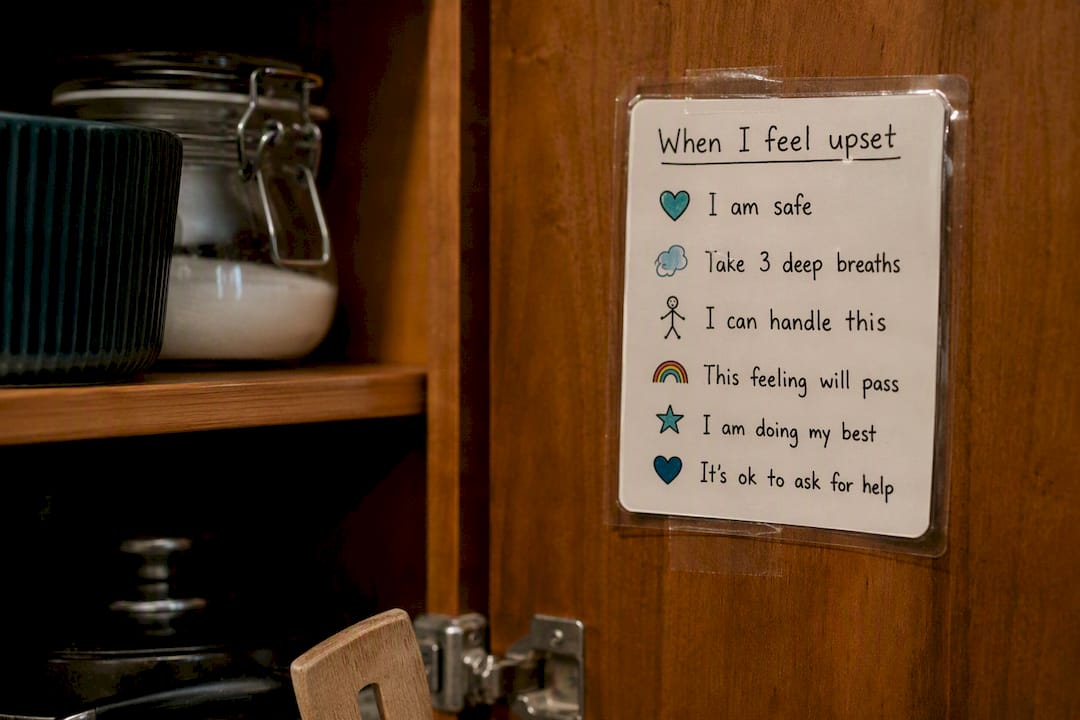
Pro Tip: Keep a single laminated card with your safety rule and your calm-down phrase taped inside a kitchen cabinet. When you’re mid-crisis, you won’t remember your plan. You’ll remember where the card is.
Signs, Patterns, and Red Flags: Normal Teen Anger vs. a Concerning Pattern
Every teenager slams a door at some point. The question that actually matters is whether anger is an occasional storm or the daily weather.
Typical adolescent irritability tends to be tied to specific frustrations, blows over within an hour or two, and doesn’t spill into every setting your teen occupies. Concerning patterns look different: they’re frequent, they don’t resolve, and they follow your teen from home to school to friendships.
Watch for these red flags:
- Outbursts happening frequently multiple times per week for weeks at a stretch
- An irritable or angry mood that’s present most of the day, nearly every day
- Aggression directed at people, pets, or property, not just yelling
- Any mention of self-harm, or signs of substance use accompanying the anger
- Trouble functioning at school, with friends, or at home because of the anger, not just at one of those
Doctors use frequency and duration thresholds like these to distinguish typical teen moodiness from disruptive mood dysregulation disorder (DMDD), which involves severe outbursts averaging three or more times per week alongside a persistently irritable mood lasting 12 months or longer, across more than one setting.
By the numbers: DMDD requires outbursts occurring frequently each week for a prolonged period, with impairment showing up in multiple environments (home, school, with peers), according to NIMH.
Start a simple log now: date and time, what triggered it, how long it lasted, what happened, and how it ended. You’ll want this if you end up in a clinician’s office.
Why Do Teens Get Angry? Causes and the Neurobiology Behind Outbursts
Part of this is ordinary brain construction. The prefrontal cortex, the part responsible for impulse control and weighing consequences, isn’t finished developing until the mid-twenties. Meanwhile, the reward and threat systems are running hot. That mismatch is why a minor frustration can trigger a reaction that looks wildly out of proportion to the actual problem.

Research on irritability in youth backs this up at the neural level. A translational review in the American Journal of Psychiatry links chronic irritability to disrupted reward and threat processing in the prefrontal cortex, striatum, and amygdala. The result is a lower tolerance for frustration and a tendency to read neutral situations as threatening.
Several conditions commonly present as anger rather than sadness or worry:
- ADHD — impulsivity and low frustration tolerance often surface as blow-ups, not just distractibility
- Anxiety — a teen who feels constantly on edge may express that as irritability rather than visible fear
- Depression — irritable mood is a recognized depression symptom in teens, distinct from adult presentations
- Trauma and chronic stress — a nervous system on high alert misreads ordinary friction as danger
- Sleep deprivation — even one or two lost hours a night measurably shortens fuse length
- Substance use — can both cause and mask irritability, complicating the picture
Irritability in youth often reflects abnormal reward and threat processing rather than a character flaw or a discipline failure. Framing it as a brain-based regulation issue, not defiance, changes how caregivers respond and how much progress is possible.
The cause matters because it points to the treatment. A teen whose anger stems from untreated ADHD needs a different plan than one whose outbursts trace back to trauma or chronic sleep loss.
Evidence-Based Treatments and What Parents Can Do at Home
Cognitive behavioral therapy (CBT) remains the frontline psychosocial approach for irritability and anger regulation in teens. It targets frustration tolerance and teaches concrete skills: recognizing early warning signs, pausing before reacting, and replacing an explosive response with a planned one. Newer approaches that gradually expose teens to frustrating situations show early promise, but the same American Journal of Psychiatry review notes this work is still emerging, so CBT-based skill building remains the more established starting point.
Parent training is just as important as anything the teen learns individually; understanding practical tactics for balancing firm safety limits with validation of feelings can be crucial, as explained in autism aggression explained. The NHS guidance on teen aggression and arguments points to consistent, predictable caregiver responses as one of the strongest levers available. That means:
- Responding the same way every time a boundary gets tested, not varying your reaction based on your own mood
- Anticipating known triggers (transitions, homework, screen time cutoffs) and planning around them in advance
- Rewarding small wins in regulation, not just punishing failures
- Holding boundaries without escalating your own voice or posture
School matters too. A behavioral plan, a 504 accommodation, or an IEP can address triggers that are specific to the classroom, like transitions or sensory overload. A short email to your teen’s counselor describing what you’re seeing at home often opens that door.
Medication comes up in some cases, usually for a diagnosed comorbid condition like ADHD or depression rather than as a standalone anger treatment. Clinicians typically position it as an adjunct to therapy, not a replacement for it.
Pro Tip: Bring your event log to the first school meeting. Teachers and counselors respond faster to specific patterns (“outbursts spike Tuesday and Thursday after gym”) than to a general “he’s been angry lately.”
For families managing anger alongside a formal ADHD diagnosis, strategies for managing ADHD at home can help connect the dots between impulsivity and outburst frequency.
Daily Habits That Lower the Odds of an Outburst
Regulation is a skill, and skills improve with repetition, not lectures. The goal over weeks and months is catching the buildup before it becomes an explosion.
- Teach your teen to notice their own warning signs. A clenched jaw, a racing heart, tight fists, heat in the face. Once a teen recognizes these micro-cues, a pre-agreed signal, like a hand gesture meaning “I need to step out,” gives them an exit before things boil over.
- Set up a reset zone. A corner with a beanbag, headphones, or a stress ball, and a five-to-ten-minute routine for using it. The point isn’t punishment. It’s a designated place to downshift.
- Protect the basics. A consistent sleep schedule, regular physical activity, decent nutrition, and a cutoff on screens before bed do more for mood stability than most people expect.
- Practice the skill when things are calm. Short role-plays (“what could you do instead next time you feel that heat rising?”) and specific praise for small wins build the habit outside of crisis moments, when the brain can actually absorb it.
Coaching resources for parents of angry teens consistently point to early cue recognition, paired with a short, rehearsed coping step, as one of the more effective ways to head off a full outburst before it starts, according to ReachOut Parents.
When to Seek Professional Help for Teen Anger Outbursts
Some situations need immediate attention. Call emergency services or a crisis line if your teen has access to a weapon, expresses intent to hurt themselves or others, or shows a pattern of injuries from fights or self-harm.
Outside of an emergency, book a routine evaluation if you’re seeing:
- Impairment that shows up across multiple settings, not just at home
- Persistent irritability most days, for months, rather than occasional flare-ups
- School suspension, exclusion, or repeated disciplinary action tied to anger
- Ongoing family conflict that isn’t improving despite consistent efforts at home
A clinician evaluating severe irritability will typically ask about frequency and duration, look for comorbid symptoms like anxiety or attention problems, and may use standardized rating scales. Youth who meet strict criteria for conditions like DMDD are relatively uncommon, but the ones who do tend to be significantly impaired and usually need a multi-pronged treatment plan that includes therapy and coordination with the school.
Walk in prepared. A two-week event log (date, trigger, duration, behavior, outcome), any school notes, a list of prior treatments, and a brief family mental health history speed up the assessment considerably.
Where Nutrition and Brain Health Support Fit Into the Picture
Anger regulation is a whole-body issue, not just a behavioral one. Brain chemistry, sleep, and nutrition all influence how quickly a teen’s system escalates and how fast it recovers. Snapbrainformula’s educational work focuses on that connection: how neurotransmitter balance and everyday nutrition intersect with mood, focus, and emotional regulation.
- Evidence-informed nutritional support can be one piece of a broader plan alongside therapy and consistent routines, not a replacement for either.
- Always run any supplement past your teen’s clinician first, especially if they’re already on medication.
- Think of nutrition as scaffolding for the skills your teen is learning in therapy, not a standalone fix.
A Note From Ellory
Progress here rarely looks dramatic. It’s a slightly shorter outburst, a faster recovery, a teen who catches themselves once out of ten times. Keep your log, use the resources here, and ask for help before you’re exhausted. Small wins count.
— Ellory
A Complementary Option Worth Knowing About
Therapy, parent training, and school support remain the backbone of managing frequent teen anger outbursts, and nothing replaces that foundation. What Snapbrainformula offers is a way to support the brain chemistry underneath the behavior while that work happens, through nutritional supplements formulated for mood, focus, and emotional balance in teens.

The educational content on supplements for anger walks through how nutrient support may complement, not replace, the therapy and routines outlined above. If your teen is already working with a clinician, bring this option into that conversation before adding anything new. Visit the Snapbrainformula landing page to see the full product lineup and decide whether it fits into your teen’s current plan.
Sources
- Helping your child with anger issues - NHS
- Disruptive mood dysregulation disorder – NIMH
- Irritability in youths: a translational model — American Journal of Psychiatry
- Severe irritability in children and adolescents: a new understanding — PMC
Recommended
- Overcoming Common Parenting Challenges with Emotional Growth Tips – SNAP Brain Health Supplements
- The Ultimate Checklist for Identifying Oppositional Defiance in Teens – SNAP Brain Health Supplements
- Supplements For Anger – SNAP Brain Health Supplements
- 10 Essential Tips for Parents Coping with Oppositional Behavior – SNAP Brain Health Supplements
