
ADHD in women often looks nothing like the stereotype of a fidgety boy who can’t sit still. It shows up as chronic daydreaming, an inbox that never gets answered, and a quiet exhaustion from holding it all together. Because the presentation skews inattentive and gets masked so effectively, many women are diagnosed in their 30s or 40s, if at all. The fix starts with getting evaluated by a clinician who actually understands female ADHD, then building a multimodal plan that accounts for hormonal shifts rather than ignoring them.
TL;DR:
- Women with ADHD often exhibit inattentive symptoms like chronic daydreaming, disorganization, and internal restlessness that are easily masked and diagnosed late.
- Standard screening tools and criteria, based mainly on hyperactive boys, miss many women’s internalized and subtle ADHD signs, leading to delayed diagnoses.
- Hormonal fluctuations during puberty, premenstrual phase, pregnancy, and menopause can worsen ADHD symptoms, requiring cycle-aware assessment and treatment adjustments.
- Untreated ADHD in women commonly leads to higher rates of anxiety, depression, and functional issues across work, relationships, and finances over time.
- A comprehensive diagnosis involves detailed history, specific symptom examples, clinician experience with female ADHD, and awareness of hormonal patterns for personalized care.
Table of Contents
- What ADHD Symptoms in Women Actually Look Like
- Why ADHD in Women Gets Missed or Diagnosed Late
- The Hidden Costs: Comorbidities and Consequences
- How Hormones Reshape ADHD Symptoms Across a Woman’s Life
- Dopamine and Serotonin: What They Actually Do (and Don’t)
- Getting Diagnosed: What the Assessment Process Involves
- Treatment Options for Women With ADHD
- Daily Strategies That Support Focus Without Medication
- How to Prepare for an ADHD Evaluation
- A Note From Ellory: Why Late Diagnosis Isn’t Your Fault
- BrainSteady: Nutritional Support for Everyday Focus and Balance
- Sources
- FAQ
What ADHD Symptoms in Women Actually Look Like
Picture a woman who has never been late to a meeting in her life, but who spends every Sunday night rebuilding her calendar from scratch because her brain refuses to hold onto a plan. That is closer to the real texture of ADHD symptoms in women than the classic image of a kid climbing the furniture.
The inattentive presentation dominates. This means frequent daydreaming during conversations, losing the thread halfway through a meeting, missing details on forms or bills, and a pattern of chronic lateness that has nothing to do with laziness and everything to do with a distorted sense of how long tasks take. Many women describe feeling like they are listening to two conversations at once: the one happening in the room and the one happening in their head.
Masking complicates the picture further. Girls and women learn early, often unconsciously, to cover for their symptoms because inattention and disorganization get punished more harshly in females than in males. That masking pattern shows up as perfectionism, over-preparing, and a practiced calm that hides real internal chaos. A woman might rewrite an email five times to sound put together, or memorize a script for small talk because winging it feels too risky.
Emotional symptoms round out the profile. Rejection sensitivity is common: an offhand comment from a coworker can trigger hours of rumination. Mood swings that look like irritability or anxiety often trace back to unmedicated or undertreated ADHD rather than a primary mood disorder. Many women also describe an internal restlessness, a mental engine that never fully idles, even when their body looks perfectly still.
These patterns play out across every part of life:
- At work: brilliant ideas in meetings, but follow-through on paperwork and deadlines lags, creating a reputation gap between potential and output.
- At home: piles of “almost done” projects, a junk drawer that has become a junk room, and a running mental tally of things forgotten.
- In relationships: partners misread forgetfulness as not caring, when it is closer to a bandwidth problem than a priorities problem.
- In friendships: canceled plans and unanswered texts pile up guilt, even when the friendship itself is genuinely valued.
None of this means a woman is failing. It means her brain is managing attention differently, and the coping strategies she built to survive undiagnosed childhood ADHD are now running on fumes.
Why ADHD in Women Gets Missed or Diagnosed Late
The gap between symptom onset and diagnosis in females is not an accident of biology. It is largely a byproduct of how ADHD was studied, described, and screened for decades.
- Research and diagnostic criteria were built on hyperactive boys. Early ADHD studies overwhelmingly recruited boys with visible hyperactivity, so the diagnostic criteria and popular understanding of the condition reflect that presentation far more than the quieter, inattentive pattern common in girls.
- Clinicians still expect the loud version. A systematic review of adult women with ADHD found many are diagnosed later than men and carry higher rates of impairment by the time they get answers, partly because clinicians are trained to look for disruption rather than daydreaming.
- Standard rating scales miss female-typical symptoms. Many screening tools weight physical hyperactivity and outward disruptiveness heavily, while giving less room to internal restlessness, chronic overwhelm, and emotional dysregulation.
- Masking actively defeats screening. A woman who has spent 20 years compensating can walk into a 15-minute appointment and present as composed, articulate, and fine. The mask that helped her survive childhood becomes the very thing that convinces a clinician nothing is wrong.
- Comorbid anxiety and depression get treated as the whole story. When a woman arrives already anxious or depressed, that becomes the working diagnosis, and the ADHD underneath goes unexamined for years.
Certain history items are red flags worth naming directly during an appointment: a childhood report card that repeatedly said “not living up to potential,” a lifelong pattern of losing items or missing deadlines despite genuine effort, a family history of ADHD, and a sense of relief rather than offense when ADHD is first suggested. Women often describe that relief as the moment things finally made sense.
The Hidden Costs: Comorbidities and Consequences
Untreated ADHD in women rarely stays contained to one area of life. It tends to spread into mental health, physical health, and financial stability, often in ways that get treated as separate problems rather than downstream effects of the same root cause.
The comorbidity numbers are striking. The same systematic review of adult women with ADHD documents notably higher rates of anxiety and depression compared with men, and clinicians increasingly recognize disordered eating patterns and substance use as common companions to the underlying attention and impulse-control struggles.
The functional consequences compound over years, not weeks:
- Occupational impact: job changes driven by burnout rather than ambition, missed promotions despite strong skills, and a pattern of thriving in the first six months of a role before organizational demands overwhelm coping systems.
- Relationship strain: partners and family members interpreting forgetfulness or lateness as a lack of care, when it reflects an executive function gap rather than a values gap.
- Financial consequences: late fees, impulsive purchases during stressful periods, and difficulty maintaining budgets despite genuinely wanting financial stability.
- Diagnostic masking: anxiety or depression treatment that partially helps but never fully resolves the fatigue, disorganization, and focus struggles, because the ADHD underneath was never addressed.
This is why a comprehensive evaluation matters more than a quick anxiety screening. Treating the visible comorbidity while missing the ADHD underneath tends to produce partial results. Readers navigating both ADHD and anxiety may find it useful to look at how the two conditions frequently overlap and reinforce each other.
How Hormones Reshape ADHD Symptoms Across a Woman’s Life
Hormones do not just affect mood and fertility. Estrogen and progesterone interact directly with the dopamine systems that regulate attention, motivation, and executive function, which is why so many women notice their ADHD symptoms are not static. They rise and fall with hormonal tides in a way that stimulant medication alone does not always account for.
An integrative review of ADHD across the female lifespan documents consistent patterns of symptom worsening tied to hormonal transitions, from puberty through menopause, and calls for individualized assessment rather than a one-size-fits-all treatment timeline. The Eunethydis Special Interest Group on Female ADHD points specifically to estrogen and dopamine interactions as a key mechanism behind these shifts.
A few patterns show up again and again in clinical observation and self-report data:
- Puberty: symptoms often intensify or become more visible as hormonal changes and rising academic demands collide.
- Premenstrual phase: many women report a sharp, temporary worsening of focus, irritability, and impulsivity in the days before their period, sometimes described as “ADHD on top of ADHD.”
- Pregnancy and postpartum: symptom severity varies widely and unpredictably, complicated further by sleep loss and medication decisions during pregnancy and breastfeeding.
- Perimenopause and menopause: declining estrogen is linked to symptom exacerbation in many women, sometimes severe enough to prompt a first-ever ADHD diagnosis in a woman’s late 40s or 50s.
The clinical implication is practical: track your symptoms against your cycle or life stage rather than assuming a flat, unchanging baseline. A simple symptom diary that notes focus, mood, and impulsivity alongside cycle phase gives you and your clinician real data instead of a vague sense that “some months are worse.” Some clinicians will adjust medication timing around predictable hormonal windows, though the evidence here remains limited, based more on small studies and clinical judgment than large randomized trials.
Pro Tip: Keep a two-line daily note, one for your main ADHD symptoms and one for your cycle day or life stage. After three months, patterns that felt random usually become obvious, and that pattern is exactly what a knowledgeable clinician needs to fine-tune your care.
Dopamine and Serotonin: What They Actually Do (and Don’t)
Dopamine is not simply the “reward chemical,” and serotonin is not simply the “happiness chemical.” That shorthand, repeated everywhere online, badly oversimplifies two systems that work together constantly and rarely act alone.
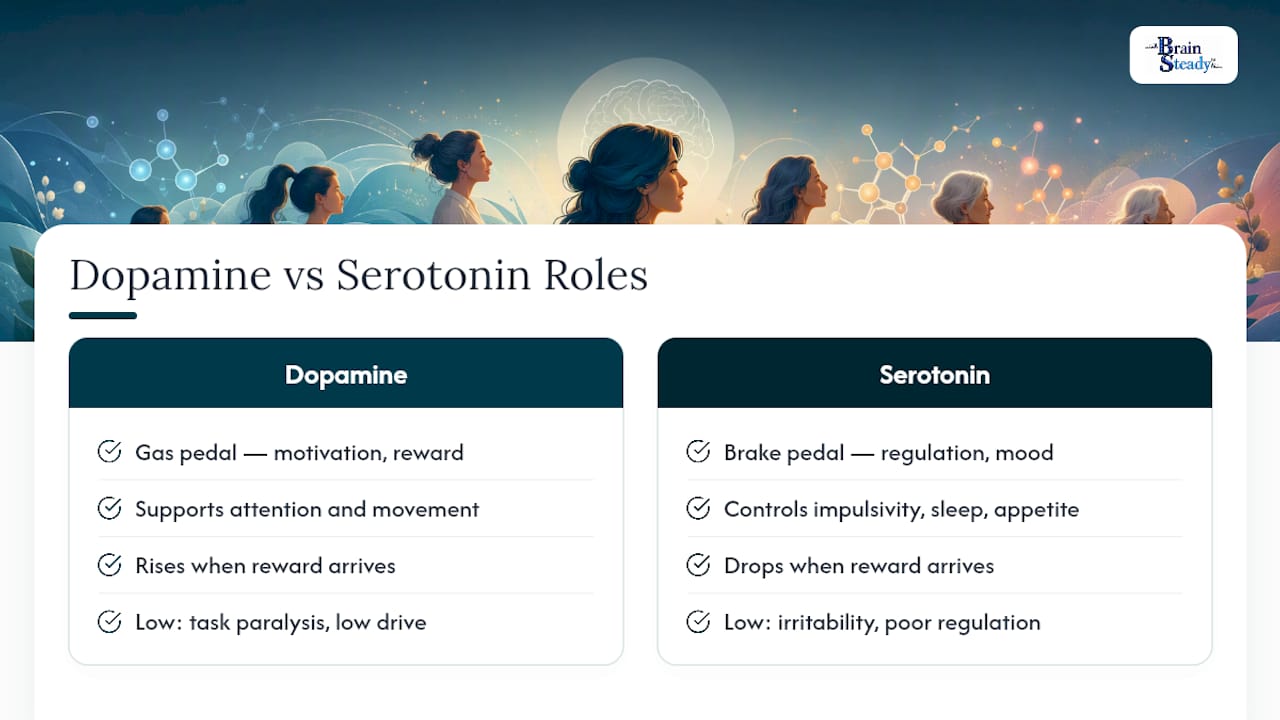
Think of dopamine and serotonin as a gas pedal and a brake pedal working the same car. Dopamine drives motivation, reward learning, sustained attention, and even movement. It is the reason starting a task feels either effortless or nearly impossible depending on how your brain has calibrated its reward signal that day. Serotonin, meanwhile, moderates impulsivity, mood stability, sleep quality, appetite, and digestion. It is less about pure happiness and more about keeping the whole system regulated instead of swinging wildly between extremes.
Research on their interaction backs up the gas-and-brake framing directly.
Dopamine and serotonin work in opposition during learning: dopamine rises when a reward arrives, while serotonin drops at the same moment, and the brain needs both signals together to learn efficiently from experience.
That comes from neuroscience research at Stanford’s Wu Tsai Neurosciences Institute, which recorded these opposing signals directly in reward-related brain circuits. Neither chemical tells the whole story on its own. A brain flooded with dopamine but low on serotonin regulation can look impulsive and reward-driven. A brain with plenty of serotonin but sluggish dopamine signaling can look flat, unmotivated, and stuck before a task even starts, which is exactly the daily experience many women with ADHD describe as “task paralysis.”
Everyday life makes the interplay obvious. Struggling to start a report at your desk despite caring about the outcome reflects a dopamine and motivation problem, not laziness. Snapping at a partner after a short night of sleep reflects serotonin’s role in emotional regulation running on empty. Neither system operates in isolation, and neither is something you can simply will your way past.
Supportive daily habits, consistent sleep, regular movement, real daylight exposure, and steady meals, are widely recommended as complementary strategies for general brain and mood regulation. These habits support how your brain systems function day to day. They are not a substitute for evaluation or treatment, and no habit claims to permanently raise or “fix” neurotransmitter levels on its own.
Getting Diagnosed: What the Assessment Process Involves
If several of the patterns described above feel familiar, the next step is a structured evaluation, not months of self-diagnosing through online quizzes.
- Start with a validated screener. The Adult ADHD Self-Report Scale (ASRS) is a common first-line tool that flags whether a fuller evaluation is warranted, though it was not designed with female-typical presentations as its primary focus.
- Expect a structured diagnostic interview. Tools like the DIVA-5 walk a clinician through childhood and adult symptoms across multiple life domains, which matters enormously for women whose childhood symptoms were masked or misread as anxiety.
- Bring your history, not just your memory. Old report cards, performance reviews, and even a parent’s or sibling’s recollection of your childhood behavior carry real diagnostic weight, since ADHD symptoms have to be traceable back before age 12 under current criteria.
- Choose the right clinician. Psychiatrists, psychologists, and some specialized nurse practitioners can diagnose ADHD, but not every general practitioner has training in female-specific presentations. Ask directly whether the clinician has experience diagnosing women, particularly those with a primarily inattentive or masked presentation.
- Prepare a symptom timeline before your appointment. Write out specific examples: the report you rewrote five times, the meeting you zoned out of, the bill you forgot despite three reminders. Concrete stories carry more diagnostic weight than a general sense that “I struggle with focus.”
Pro Tip: Bring three specific, dated examples of how symptoms affected work, relationships, and daily tasks in the past month. Vague statements like “I’m disorganized” get far less traction with a clinician than “I missed a client deadline on March 3rd because I forgot to check my calendar for two days.”
What happens after diagnosis varies, but a typical next step involves a conversation about treatment options, a discussion of any comorbid anxiety or depression that needs its own attention, and often a referral to a therapist or coach who specializes in adult ADHD. Some clinicians will also ask about your menstrual cycle or menopausal status at this stage, recognizing that hormonal phase can shape both symptoms and treatment timing.
Treatment Options for Women With ADHD
Effective ADHD treatment for women rarely comes from a single intervention. The strongest outcomes tend to come from combining medical, psychological, and practical supports rather than leaning on medication alone.
Stimulant medications (like methylphenidate and amphetamine-based formulations) and non-stimulant options remain the most researched pharmacological tools for ADHD. That said, female-specific randomized controlled trial data remains limited, especially around how hormonal phases might affect dosing or timing. This is not a reason to avoid medication. It is a reason to work closely with a clinician who monitors your specific response over time rather than following a generic protocol. No dosing decision should be made without direct clinical guidance.
Psychosocial support fills the gaps medication alone cannot close:
- Cognitive behavioral therapy (CBT) adapted for ADHD helps address the anxiety, negative self-talk, and avoidance patterns that build up after years of masking.
- ADHD coaching focuses on building systems for time management, task initiation, and follow-through, skills that talk therapy alone does not always address.
- Skills-based interventions target specific executive function weak points, like planning, prioritizing, or emotional regulation, rather than treating ADHD as a single monolithic problem.
- Family and partner education helps the people closest to you understand that forgetfulness and lateness are symptoms, not character flaws, which tends to reduce relationship friction significantly.
Workplace and school accommodations round out a solid plan. Practical examples include flexible deadlines, written follow-ups after verbal instructions, noise-reducing workspace adjustments, and extended time on exams or certification tests. None of these require dramatic disclosure; a brief conversation with HR or a school’s accessibility office is often enough to set them in motion.
The emotional dysregulation that often accompanies ADHD deserves its own attention within any treatment plan, since mood swings and rejection sensitivity rarely resolve through medication alone. Integrated care, where your prescriber, therapist, and any coaching support actually communicate or at least stay aware of each other’s input, tends to outperform fragmented care where each provider treats one slice of the picture in isolation. Clinicians increasingly recommend this multimodal combination specifically because stimulant treatment alone often leaves functional gaps in daily organization and emotional regulation.
Daily Strategies That Support Focus Without Medication
Medication and therapy address the clinical side of ADHD. Daily structure addresses the part that plays out in your kitchen, your calendar, and your inbox every single day.
Executive function support does not require expensive tools. A visible timer for task transitions, a single running checklist instead of five scattered sticky notes, and phone reminders set the night before all reduce the mental load of remembering to remember. Digital apps built for ADHD task management can help, though the specific tool matters less than actually using it consistently.
Physical routines matter just as much as organizational ones:
- Sleep hygiene: a consistent wake time, even on weekends, tends to stabilize attention and mood more reliably than an extra hour of sleep on an inconsistent schedule.
- Regular movement: even a 20-minute walk shifts restlessness and improves focus for the following hour or two for many people.
- Daylight exposure: morning light exposure helps regulate the sleep-wake cycle that ADHD brains often struggle with naturally.
- Balanced meals: skipping meals or relying on caffeine alone tends to worsen irritability and focus crashes later in the day.
Start with one change, not five. Layering an entire new routine overnight tends to collapse within a week; adding a single habit, like a consistent wake time, and holding it for two weeks before adding the next one, sticks far better. For readers managing broader executive function challenges, a coach or skills group becomes worth considering once self-directed strategies plateau, particularly if disorganization is affecting work performance or relationships.
Pro Tip: Pick the one habit that would make the biggest difference if it stuck for a month, not the one that sounds most impressive. Consistency with one small change outperforms an ambitious plan you abandon by Thursday.
How to Prepare for an ADHD Evaluation
Walking into an evaluation prepared saves time and produces a more accurate picture of your symptoms.
Before your appointment, gather report cards or old performance reviews, write down three to five specific recent examples of symptoms affecting your life, and note any family history of ADHD. Ask your clinician directly about their experience diagnosing women, and ask what happens if anxiety or depression also gets identified during the process.
Seek urgent help if ADHD-related overwhelm ever escalates into thoughts of self-harm or an inability to function safely day to day; that calls for immediate professional support, not a routine appointment. For general information and community connection, organizations like CHADD offer education and support networks specifically addressing ADHD across the lifespan, including female-specific resources.
- Bring symptom examples, not just feelings.
- Ask about the clinician’s experience with female ADHD presentations.
- Note any hormonal patterns you’ve noticed alongside symptoms.
- Know that urgent distress warrants immediate care, not a wait-list appointment.
A Note From Ellory: Why Late Diagnosis Isn’t Your Fault
If you spent decades wondering why everyone else seemed to manage life without the constant internal scramble, you were not imagining it. The systems built to identify ADHD simply were not built with you in mind, and masking, however exhausting, kept you functioning in a world that rarely made room for a different kind of brain.
That gap between struggle and diagnosis is exactly why Snapbrainformula exists: to translate real neuroscience into information families and adults can actually use, without the jargon or the guesswork.
— Ellory
BrainSteady: Nutritional Support for Everyday Focus and Balance
BrainSteady offers nutritional support options designed not as stimulants or medications, and not as substitutes for the diagnosis and treatment plan described above. Think of it as one supportive layer alongside sleep, movement, and clinical care, not a replacement for any of them.

These formulas are designed for everyday use across ages, with ingredients intended to support mood, focus, and emotional balance rather than to treat a diagnosed condition. If you are pregnant, breastfeeding, or currently taking ADHD medication, talk with your clinician before adding any supplement, since interactions and individual needs vary.
For readers who want a flexible option, the BrainSteady Liquid Formula offers an alternative to capsules for those who prefer a liquid delivery, while the SNAP BrainSteady Capsules suit a simple daily-routine format. Browse either product page to see current ingredients, pricing, and usage guidance before deciding what fits your household.
Sources
- Miss. Diagnosis: A Systematic Review of ADHD in Adult Women
- Dopamine and serotonin work in opposition to shape learning | Wu Tsai Neurosciences Institute
- Integrative literature review – the impact of ADHD across women’s lifespan | BMC Women’s Health
FAQ
What Are the Signs of ADHD in Women?
The most common signs include chronic daydreaming, difficulty following conversations, disorganization despite genuine effort, emotional sensitivity to perceived rejection, and an internal restlessness that rarely shows up as visible hyperactivity. Many women also describe a lifelong pattern of feeling like they are working harder than everyone else just to keep up.
What Does High Masking ADHD Look Like in Women?
High masking looks like perfectionism, over-preparing for simple tasks, and a calm, composed exterior that hides significant internal effort and exhaustion. This pattern is well documented in research on ADHD across women’s lifespans and often delays diagnosis for years because the woman appears to be coping just fine.
What Are the Symptoms of Undiagnosed ADHD in Women?
Undiagnosed ADHD in women often shows up as chronic overwhelm, anxiety or low mood that never fully resolves with standard treatment, difficulty maintaining routines, and a nagging sense of underachieving relative to real ability. A systematic review of adult women with ADHD links this pattern to higher rates of comorbid anxiety and depression when the underlying ADHD goes unaddressed.
How Can Women Manage ADHD Without Medication?
Non-medication strategies include consistent sleep schedules, regular movement, morning daylight exposure, structured routines with visible timers or checklists, and ADHD coaching for building sustainable systems. These approaches work best as complements to clinical care rather than replacements for it, and a nutritional support like Snapbrainformula’s BrainSteady line can serve as one additional layer within that broader routine.
Is BrainSteady a Treatment for ADHD?
No. SNAP BrainSteady™ Capsules and BrainSteady™ Liquid Formula are nutritional brain support products, not medications or treatments for ADHD. Current pricing and ingredient details are available on the BrainSteady product pages, and anyone taking ADHD medication or who is pregnant should discuss supplement use with a clinician first.
